Chicago restaurant workers brace for July minimum wage increase
Chicago’s minimum wage rose to $17.05, but tipped crews still have to watch paycodes, tip-credit notices and whether managers shave hours to absorb the cost.
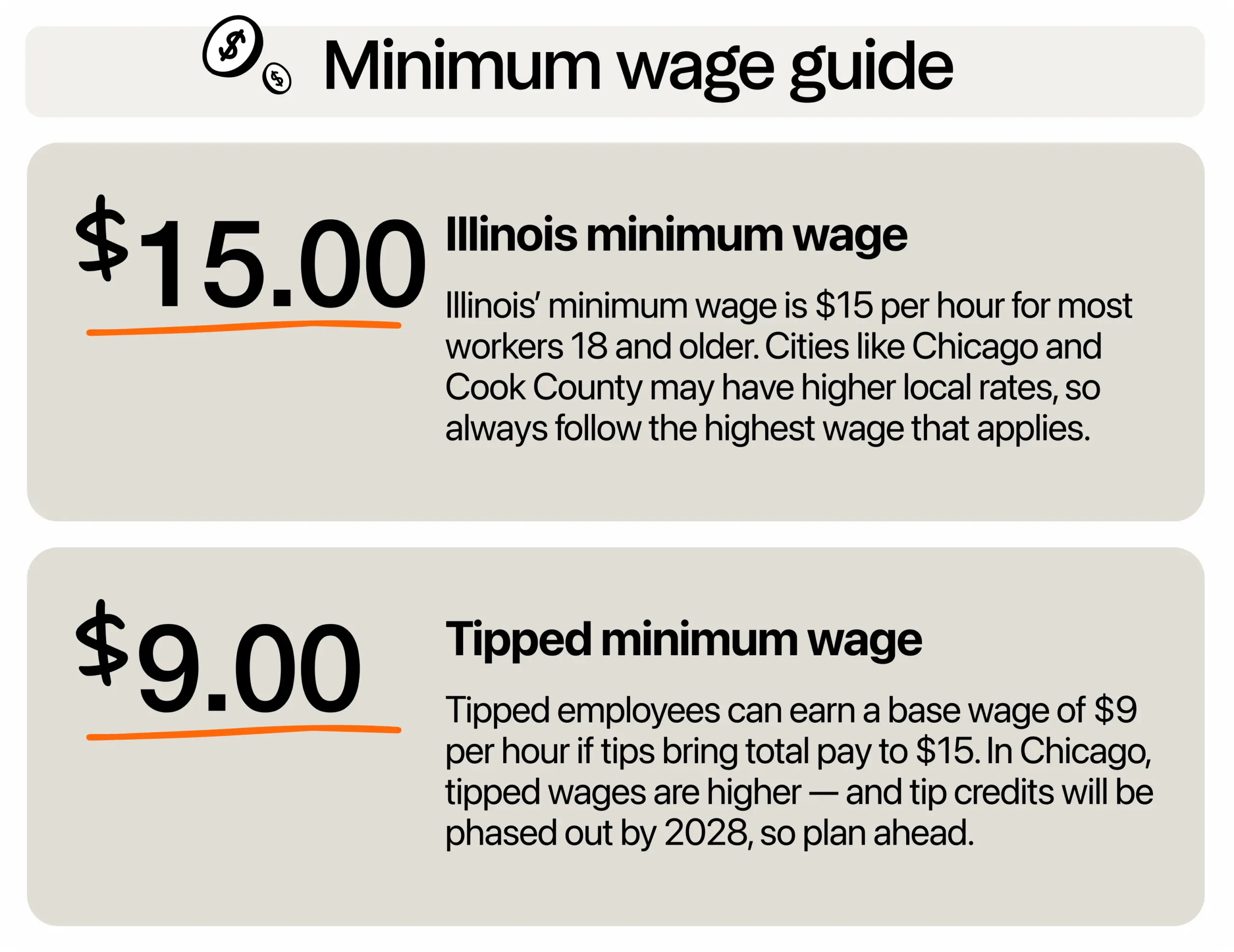
Chicago’s minimum wage rose from $16.60 to $17.05 an hour on July 1. The tipped minimum wage credit stayed at 24% for covered employers, and Cook County had its own July 1 increase to fold into payroll. For restaurant workers, that can mean a slightly bigger check, but also a fresh round of schedule changes, role reshuffling, and compliance mistakes if management misses a step.
What changed on July 1
Chicago’s minimum wage increases every July 1 under the city ordinance, so the date is not a surprise to operators that keep a real calendar. Restaurants still have to treat that date like a hard operational deadline, because Chicago and Cook County were both updating wage rules at the same time in 2026. For every server, bartender, and other tipped worker whose paycheck depends on whether the job is being coded correctly, that 24% credit still matters.
The broader backdrop is bigger than Chicago. The federal minimum wage remains $7.25 an hour and has not changed since 2009, which is why local wage laws drive most real pay movement in restaurant work. A 2026 tally by Yannet Lathrop at the National Employment Law Project counted 68 cities, counties, and states raising minimum wages on January 1, with 26 more later in the year, and more than 20 states had increases scheduled in 2026.
How the new floor shows up in your paycheck
For a non-tipped worker on the city minimum, the increase is a 45-cent raise per hour. That sounds small until you run the math: a 40-hour week means about $18 more before taxes, and a 20-hour week means about $9 more. For hosts, dishwashers, prep cooks, and line cooks paid at the floor, that extra money lands automatically only if payroll was updated correctly for the first full pay period after the increase.

For tipped workers, the paycheck question is different. Chicago kept the tipped minimum wage credit at 24% for covered employers, so servers and bartenders need to check the pay stub category, not just the hourly headline. If your restaurant uses tip pools, the important question is who is included, whether the pool is limited to eligible staff, and whether the employer is still treating training shifts, side work, and non-tipped tasks under the right rules.
Tipped minimum wage rules vary by jurisdiction, and that matters in a region like Chicago where the city and county can operate on different schedules. A chain with one store in the city and another in suburban Cook County cannot safely assume one payroll setting works everywhere.
Where the pressure usually lands on the floor
When labor gets more expensive, managers rarely absorb the cost silently. The usual response is to cut hours, tighten prep times, or reduce the number of stations staffed during slow periods. In a full-service dining room, that can show up as fewer host shifts, less support during opening and closing, or more side work pushed onto servers and bartenders. In a slower week, the same wage increase that raises one pay rate can also make a split shift or a shorter lunch section more likely.
Cross-training often expands when wage floors go up. A counter-service or fast-casual restaurant may ask one worker to handle register, drinks, and expo instead of staffing each station separately. A bar-forward spot may try to keep bartenders flexible enough to cover barback tasks or floor service, while a neighborhood restaurant may spread prep and setup across fewer people. That can build skills, but it can also create role creep, especially when managers blur the line between tipped and non-tipped work without adjusting the pay rules.
Why payroll, notices, and training matter now
Chicago’s 2026 update came alongside other labor-standard changes, which is a reminder that the wage number is only one part of compliance. Dana Holle and Kathryn O'Connor treated the July 1 changes as an all-systems update: payroll configuration, posting, tip-credit notices, and manager training all had to match the new rates. If those pieces are not updated, Chicago employers can face retroactive back-wage liability, which is why the first bad paycheck can become more than a clerical error.
That is especially true in chain restaurants and franchises, where one missed setting can affect dozens of employees at once. A corporate payroll system has to know which locations are in Chicago, which are in Cook County, which employees are tipped, and which shifts include non-tipped work. If managers are still using old tip-credit notices or old schedules, workers can end up doing the same job under a different legal label.
What to check on your next schedule or pay stub
- Your base hourly rate, and whether it changed on the first pay period after July 1.
- Whether the restaurant still classifies your shift as tipped work under the city’s 24% credit rule.
- Whether tip pooling changed, especially if hosts, support staff, barbacks, or food runners were added or removed.
- Whether overtime is being calculated off the new base rate, not the old one.
- Whether training, cleaning, opening, and closing time are being paid under the right code.
- Whether your hours or station assignments were cut back to offset the wage increase.
Cook County workers can file complaints through the Commission on Human Rights if the new rate never shows up or if the payroll math is off. Keep your own time records, because when wages change on paper but not on the schedule, the gap is usually easiest to prove with clock-ins, tip records, and the posted notices.
This article was produced by Prism’s automated news system from verified source data, official records, and press releases, then run through automated quality and moderation checks before publishing. The system is built and supervised by the people who set the standards it runs under. Read our full AI policy.
Did this article answer your question?