Department of Labor guide explains FMLA rights for restaurant workers
FMLA can protect a restaurant worker’s job and health coverage, but only if coverage, hours and paperwork line up.
A dishwasher recovering from surgery, a server dealing with childbirth, or a line cook caring for a parent can run into the same restaurant reality: the schedule does not stop just because life does. The U.S. Department of Labor’s employee guide is built for that clash, laying out when the Family and Medical Leave Act can protect a job, how leave is requested, and what should happen when a worker comes back.
What FMLA does for restaurant workers
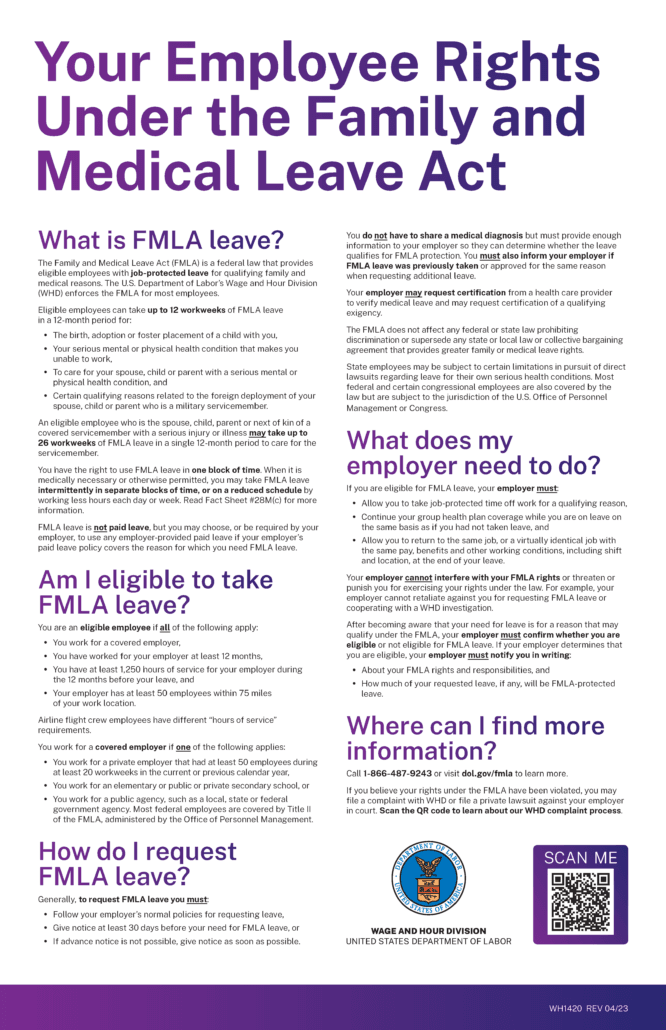
FMLA gives eligible employees up to 12 workweeks of unpaid, job-protected leave per year. It also requires group health benefits to be maintained during that leave under the same terms and conditions as if the worker had never stepped away. For restaurant employees who depend on a rotating schedule, that protection matters because the law is meant to interrupt the common fear that time off means losing shifts, losing a post, or being quietly replaced.
The leave can be used for qualifying family and medical reasons, including childbirth and bonding, a serious health condition, or caring for a spouse, child or parent. The law does not pay wages, but it can protect the worker’s job and keep health coverage in place when the employee meets the requirements.
Who is covered and who is eligible
Coverage starts with the employer. A covered employer generally includes companies with 50 or more employees, and the count includes employees within 75 miles of the worker’s worksite. The 75-mile distance is measured by surface miles along the shortest route over public streets, roads, highways and waterways.
Eligibility depends on several concrete thresholds. A worker generally must have been employed for at least 12 months and must have worked at least 1,250 hours during the 12 months immediately before the leave begins. A worksite can be a single location or a group of contiguous locations, and separate facilities close to each other may be treated as a single site of employment. That matters in restaurant groups where kitchens, dining rooms, catering operations or sister locations can blur into one operational footprint.
The Department of Labor’s employee guide breaks these questions into three flow charts that help workers sort out coverage, eligibility and the leave process. For restaurant workers, those charts are useful because they turn a vague workplace problem into a checklist: is the employer covered, do the hours add up, and does the worksite meet the 50-employee standard within 75 miles?

How to ask for leave without getting lost in the schedule
One of the biggest friction points in restaurants is notice. Workers often need to know whether text, email or an in-person conversation is enough, especially when a shift is about to start and the kitchen is already short-handed. The Department of Labor guide maps out the leave process so employees can understand how to request leave and what the medical certification process looks like.
The safest approach is to ask for help early and keep the request documented. Workers should save texts, emails, doctor paperwork and any responses from management, because the leave process is only as strong as the record behind it. If a manager informally discourages time off by saying the restaurant is too busy or hinting that the worker will lose a spot on the schedule, that does not erase the law’s protections when FMLA applies.
Medical certification is another flash point. In restaurant work, managers sometimes want to control every absence through the schedule, but FMLA gives employers and workers a formal process for confirming that a leave request qualifies. The guide’s flow charts are designed to show when certification may be part of the process and how it fits into the leave request.
Intermittent leave is built for real life
Restaurant schedules are often rigid, but medical needs are not. The Wage and Hour Division says FMLA leave can be taken intermittently when medically necessary, which is especially important for workers who need time off in smaller blocks rather than one long absence. That can mean a few hours for treatment, periodic appointments, or repeated absences tied to the same condition.
Intermittent leave can be the difference between staying employed and being pushed out of a shift-based job. In a restaurant, where staffing shortages already create stress and burnout, the ability to take leave in chunks can matter just as much as a full absence. The law also allows FMLA leave to run at the same time as employer-provided paid leave if the employer allows it, so workers should check whether paid time off can be used alongside the federal leave.
What happens when you come back
FMLA is supposed to bring a worker back to the same job or a virtually identical one. That reinstatement rule is one of the law’s most important protections for restaurant employees, because it is designed to stop retaliation by another name, such as stripping away a section, changing the shift pattern, or moving someone into a clearly worse role.
The Department of Labor says employees returning from leave must be restored to the same or virtually identical position. For restaurant workers, that means the return should not come with a pay cut, a demotion in duties, or a job that is materially different from the one they left. If a manager tries to treat leave like a reason to sideline someone, the law points in the other direction.
What employers must post and where to go if the law is ignored
Covered employers are required to post an FMLA notice in conspicuous places where employees and applicants can see it. That posting rule matters in restaurants where staff may work different shifts and rarely sit in an office. The notice is supposed to make the law visible on the premises, not hidden in a handbook nobody has time to read.
If a leave request is denied, delayed or discouraged, the Department of Labor directs workers to the Wage and Hour Division to file a complaint. For restaurant employees who feel pressure to choose between their health and their paycheck, that complaint process is part of the protection the law promises. In an industry built on urgency, FMLA is one of the few rules that says a qualifying worker does not have to disappear from the schedule to protect a family or medical need.
This article was produced by Prism’s automated news system from verified source data, official records, and press releases, then run through automated quality and moderation checks before publishing. The system is built and supervised by the people who set the standards it runs under. Read our full AI policy.
Did this article answer your question?