DOL reminds restaurants of wage rules, overtime and recordkeeping
Restaurant payroll mistakes usually start with basics: tip credit math, overtime after 40 hours, teen scheduling and weak records can all trigger back wages.
In April 2026, the Department of Labor recovered $95,095 in back wages for 33 cooks at three IHOP franchise locations in North Carolina and South Carolina after finding straight-time pay instead of time-and-one-half for hours over 40 in a workweek. The same restaurant mistakes keep showing up when a prep cook arrives early, a server clocks out but keeps rolling silverware, or a bartender does more side work than the schedule was built to cover.
The FLSA still sets the floor
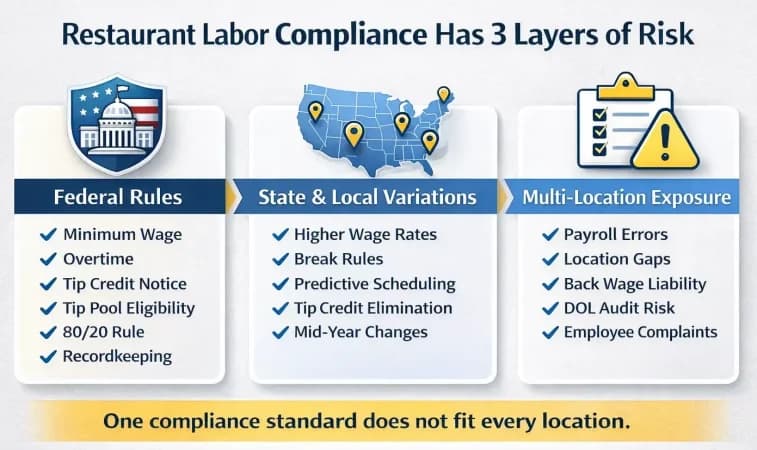
The Fair Labor Standards Act has applied to covered workers since 1938, and its basic rules still control the most expensive payroll disputes in restaurants. The federal minimum wage is $7.25 an hour, tied to the rate effective July 24, 2009, and it requires overtime pay at one and one-half times the regular rate after 40 hours in a workweek. The law does not require overtime just because a shift falls on a weekend or holiday; what matters is whether the worker crosses the 40-hour line.
The part operators often miss is how broadly “hours worked” is read. If a worker is required to be on the employer’s premises, on duty, or at a prescribed workplace, those hours generally count. In restaurant life, that covers a lot of the hidden time around service, including opening setup, closing cleanup, side work, and the extra minutes staff spend waiting for a manager to finish the night.
Tip credit rules are still where restaurants get burned
Tipped pay is one of the most common compliance traps because the arithmetic changes depending on whether the employer is using the tip credit. Under federal rules, an employer that claims the credit must make sure the worker receives enough tips plus direct cash wages in the workweek to equal at least the minimum wage and overtime required under the FLSA. The current federal tipped cash wage under the tip credit is $2.13 an hour, but that number only works if the rest of the wage math also holds.
The cleanest checkpoint for managers is simple: if the tip credit is being used, do the weekly totals actually bring the employee up to the legal floor? If not, the employer has to make up the difference. If the employer does not claim the tip credit, the worker must get at least the full minimum wage in direct cash wages, which is a very different pay model for the front of house.
The department’s 2021 final rule sharpened another issue restaurant crews know well: not all “tipped” time is treated the same. The rule says an employer may take a tip credit only for hours spent doing tip-producing work or tasks that directly support tip-producing work. The proposal that led to that rule stated that directly supporting work that goes past 20 percent of the workweek or lasts more than 30 continuous minutes is no longer part of the tipped occupation.
Overtime problems usually start with ordinary shifts
Restaurants do not usually get into trouble because of one giant payroll error. They get into trouble because of a stack of ordinary ones. A server stays late to close, a line cook is asked to come in early, a bartender spends too much of the shift on prep instead of guest-facing work, and a manager edits time cards to “smooth out” the schedule.

Many restaurant workers are covered by the FLSA minimum wage and overtime rules, and employers also have to follow stronger state laws when they exist. That matters in mixed-role kitchens and dining rooms where tipped and non-tipped work get blended throughout the day. If a house is running on split shifts, rushed turnarounds, and constant schedule changes, the safest move is to treat every minute worked as payroll-relevant until it is clearly accounted for.
Recent enforcement shows what the department is looking for. In December 2022, it recovered $28,162 for 36 employees at Mi Carreta Restaurant & Bakery Inc. in St. Petersburg, Florida, after investigating overtime violations and misclassification as independent contractors. And in March 2022, a federal court ordered three restaurants and their owner to pay $1.45 million in back wages and liquidated damages after repeated minimum wage, overtime, and recordkeeping violations.
Teen work adds another layer of risk
Restaurant hiring often depends on teenagers, especially for summer rushes and after-school shifts, but youth employment rules still apply. The federal child labor provisions cover restaurants and quick-service establishments that employ workers under 18. It also says 16- and 17-year-olds can work any hours and many jobs, except those declared hazardous by the Secretary of Labor.
That is where managers need to check both the federal rule and the state rule. State child labor laws may be more restrictive than federal law, and if they are less restrictive, the federal rule applies. For operators, that means the safe assumption is not that a teen can do any task simply because the schedule is short or the restaurant is short-staffed. Hazardous work remains off-limits, and state restrictions can be tighter than the federal baseline.
Records decide whether a payroll dispute stays a complaint or becomes a case
When wage claims land, the records usually matter more than the argument. Employers need to keep total overtime earnings for the workweek, all additions to or deductions from wages, total wages paid each pay period, and the date of payment and pay period covered. In a restaurant, that documentation is the difference between being able to show the hours worked and trying to reconstruct a week from memory, handwritten notes, and a manager’s best guess.
- Match clock-ins against opening, closing, prep, and side-work assignments.
- Review tipped employees’ non-tipped tasks to make sure the tip credit still fits the work performed.
- Confirm overtime is paid at one and one-half times the regular rate after 40 hours.
- Check that 16- and 17-year-olds are not scheduled into hazardous duties and that state limits are also being followed.
- Keep payroll records complete enough to show overtime earnings, deductions, total wages, and pay dates.
A practical weekly check can keep the worst problems from snowballing:
This article was produced by Prism’s automated news system from verified source data, official records, and press releases, then run through automated quality and moderation checks before publishing. The system is built and supervised by the people who set the standards it runs under. Read our full AI policy.
Know something we missed? Have a correction or additional information?
Submit a Tip