DOL toolkit helps restaurants navigate wage, overtime and labor rules
Restaurant payroll mistakes can get expensive fast. The DOL toolkit gives managers a plain-English way to avoid overtime, tip, youth-work, and recordkeeping violations.
Missed overtime, bad tip handling, off-the-clock side work, or a teenager put on equipment they should never touch are the payroll mistakes that get restaurants into trouble week after week. The Department of Labor’s Restaurant Employment Toolkit is built to stop those errors before they turn into back wages, damages, or an investigation.
What the toolkit is really for
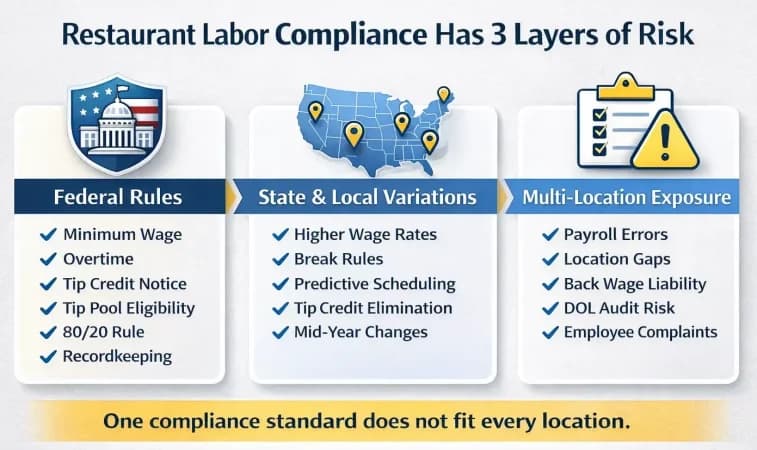
The restaurant toolkit is aimed squarely at the problems that hit dining rooms, bars, and kitchens again and again. It covers minimum wage, overtime, child labor, recordkeeping, deductions, retaliation, and the fact that state law can add more protections on top of federal law.
Restaurant compliance is not only for large chains. Under the Fair Labor Standards Act, restaurants and fast-food businesses with annual gross sales from one or more establishments totaling at least $500,000 are covered. Even smaller businesses can still have individually covered workers if those employees handle goods moving in interstate commerce, such as processing credit-card transactions.
The wage and overtime mistakes that cost the most
The biggest dollar problems in restaurants usually start with hours. If a server, cook, bartender, or dishwasher crosses 40 hours in a workweek, overtime rules matter whether the schedule was short-handed, the line got slammed, or someone stayed late to finish cleanup. The federal minimum wage under the FLSA is $7.25 per hour, effective July 24, 2009, and that floor is only part of the picture when overtime, tips, and deductions come into play.
The department’s enforcement history shows how fast these cases add up. In April 2026, a McMinnville, Oregon, restaurant was found to have misclassified 19 workers as exempt, failed to pay the required overtime premium, and used tips to supplement base wages. The department recovered $200,000 in back wages in that case. In June 2026, four Washington restaurants agreed to pay $750,000 in back wages and damages to 42 workers after minimum-wage and overtime violations were found. A 2023 case involving an East Coast restaurant chain recovered $11.4 million for more than 1,000 employees.
Tips, retaliation, and what workers can safely raise
Restaurants run on tipping culture, but tips are not a floating pool of management money to patch holes in payroll. The McMinnville case shows why tip handling is part of wage-and-hour enforcement, not a separate issue. If tips are used to supplement base wages in a way the law does not allow, the result can be back wages and damages, not just an internal correction.
Retaliation is prohibited under the FLSA. A worker who complains about short hours, questions a tip pool, or cooperates in an investigation is protected from retaliation. A manager who treats that complaint as insubordination is creating another legal problem on top of the first one.
Youth labor rules are not a side issue
A lot of restaurant compliance breakdowns start with good intentions and bad assumptions about what minors can do. Restaurant child labor rules cover hazards and restrictions involving balers, compactors, meat slicers, bakery machines, forklifts, and the hours minors are allowed to work.
Managers need to know which tasks are off limits, which hours are too late or too long, and not let a rush override the rules. A teen who is fine on the host stand may not be permitted to clean certain equipment or work the same closing schedule as an adult line cook.
Use the tools before the mistake becomes a case
It points employers to the Payroll Audit Independent Determination program, or PAID, which can help resolve potential minimum wage and overtime violations under the FLSA and certain potential FMLA violations. That gives a manager who discovers a past payroll problem a path other than waiting for a complaint or an investigation.
The toolkit also points employers to a free Timesheet App. For a restaurant manager, the first line of defense is still basic: accurate clocks, careful review of breaks and shift changes, and records that match the schedule, the tip report, and the paycheck.
A shift supervisor checklist that actually helps
Before and after each shift, the people running the floor should be checking the same few things every time:
- Make sure every hour worked is recorded, including prep, cleanup, and any time spent waiting after close.
- Watch overtime closely once a worker approaches 40 hours in the workweek.
- Keep tip handling consistent with the law and the house policy, and do not use tips to cover base wages.
- Check that deductions are lawful before they hit a paycheck.
- Keep minors away from restricted equipment like balers, compactors, meat slicers, bakery machines, and forklifts.
- Confirm that younger workers are not being scheduled outside the hour limits that apply to them.
- Save clean records of clock-ins, schedules, tip distributions, and pay changes.
- If a mistake is found, flag it immediately and consider whether PAID can help resolve it.
This article was produced by Prism’s automated news system from verified source data, official records, and press releases, then run through automated quality and moderation checks before publishing. The system is built and supervised by the people who set the standards it runs under. Read our full AI policy.
Did this article answer your question?