EEOC says pregnant restaurant workers can request job accommodations
Pregnant servers, cooks and hosts can ask for schedule changes, lifting limits and other help under the PWFA, and pumping rights now carry federal force too.
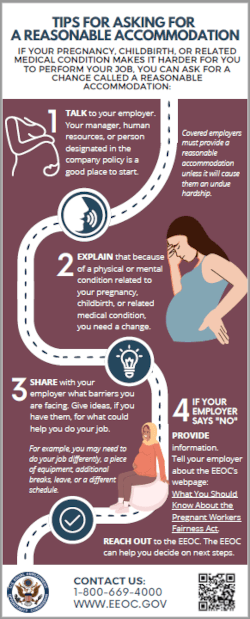
Pregnant restaurant workers do not have to choose between keeping up with the line and asking for basic help. Under the Pregnant Workers Fairness Act, covered employers must provide reasonable accommodations for known pregnancy-related limitations unless the request would create an undue hardship, a rule that matters in kitchens and dining rooms where standing, lifting, rushing and repeated motion can quickly become harder.
The law is aimed at accommodation, not leave. In restaurant terms, that can mean a shorter section for a server, help with heavy stock, a stool for a host stand, a break from nonstop closing tasks, or a change in side work when a pregnant worker’s doctor says certain movements are off limits. The EEOC says the PWFA took effect on June 27, 2023, and its final rule was issued on April 15, 2024, then took effect on June 18, 2024. The law generally covers employers with 15 or more employees.
That federal floor extends beyond pregnancy itself. The EEOC also says employees and applicants who need to pump breast milk have rights under the Fair Labor Standards Act and the PWFA. Under the FLSA, nursing employees are entitled to reasonable break time and a private space to pump for up to one year after the child’s birth. The Labor Department says that space must be functional, shielded from view, free from intrusion, available as needed and not a bathroom.
For restaurant managers, that can be the difference between a workable shift and a needless violation. Small break rooms and packed prep schedules do not erase the obligation. The Labor Department’s restaurant-specific guidance says employers cannot require nursing employees to make up pump-break time to meet productivity measures, a point that lands squarely in an industry built on ticket times, section coverage and labor targets.

The enforcement risk is real. The EEOC has brought pregnancy-discrimination actions involving restaurants, including a Louisiana case that resolved for $30,000 and a Wichita steakhouse case that resolved for $55,000. Those settlements show that pregnancy-related problems are not just HR complaints, but potential legal exposure when managers refuse reasonable changes or treat pregnancy as a staffing inconvenience.
The National Restaurant Association says the industry is the nation’s second-largest private-sector employer, which helps explain why these rules matter far beyond a single dining room. In a business already strained by turnover, burnout and constant understaffing, the practical test is simple: when a pregnant cook, server or bartender asks for help, the law requires a real conversation and a real accommodation, not a shrug.
This article was produced by Prism’s automated news system from verified source data, official records, and press releases, then run through automated quality and moderation checks before publishing. The system is built and supervised by the people who set the standards it runs under. Read our full AI policy.
Did this article answer your question?