Houston Restaurant Steps Up to Feed TSA Workers During Government Shutdown
Benchawan Painter stayed up through the night prepping Thai food for unpaid TSA workers. Her Houston restaurant, Street to Kitchen, committed to 3,000 free meals.
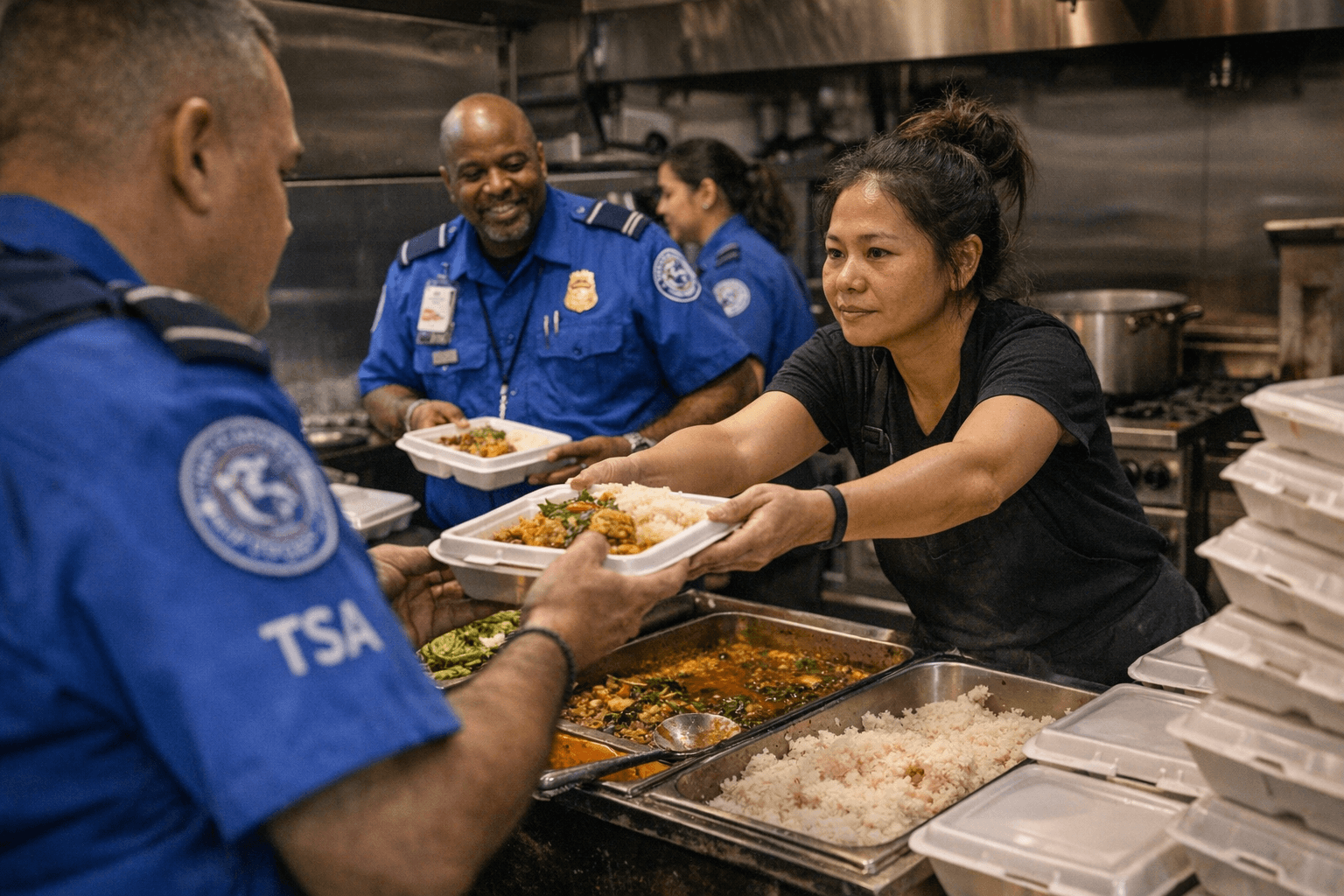
While security lines at George Bush Intercontinental Airport stretched past four hours, Benchawan Painter was in her East End kitchen well past midnight, prepping hundreds of Thai dishes for the people holding those checkpoints together.
Painter, chef and co-owner of Street to Kitchen, and her husband Graham hadn't been summoned by an airport authority or handed a subsidy check. They called World Central Kitchen, the José Andrés-led nonprofit that mobilizes restaurant networks during humanitarian crises, and said they were in. By Saturday, March 14, Street to Kitchen was delivering 400 free lunches a day across George Bush Intercontinental and William P. Hobby airports, at its own food cost, on donated labor.
The partial government shutdown had left roughly 61,000 TSA employees across the country working without pay. Houston felt it harder than most. At Bush Intercontinental, where 37 checkpoint lanes normally run, only between a third and half were operating. The city's sickout rate hit nearly 40 percent. For TSA agent Njukua Njuka, the calculus was grinding. "You have to decide: what am I going to pay? What am I going to do? Do I keep showing up?" he said. When a Street to Kitchen meal arrived at his checkpoint, his reaction was unguarded: "It's a little unreal. I'm not getting paid, and they're really still doing this."
The Painters made clear this was not a one-day gesture. Graham Painter estimated the restaurant would deliver roughly 3,000 meals total before the shutdown resolved. "Our goal is to keep doing it 'till the government both stops the shutdown and these guys can get some pay," he said, "because even if they vote to stop the shutdown, they're not going to immediately get compensated."
The operation required real-time recalibration. As more agents chose to stay home rather than report unpaid, daily counts dropped from 400 over the first weekend to 375, then to 325 by the following week. That flexibility mattered. A fixed commitment the kitchen could not adjust would have punished staff who were already stretched. "She's staying up all night on many of these nights to prep and get these meals ready," Graham said of Benchawan.
That is the part the goodwill coverage tends to gloss over. Community feeding operations at this scale, without a financial backstop, fall hardest on kitchen workers. The World Central Kitchen partnership provided what a single independent restaurant cannot: donation infrastructure, coordination across 18 partner restaurants, and a network that had already delivered more than 8,000 meals to TSA workers nationally by late March. During the previous year's government shutdown, which ran longer, WCK served over 110,000 meals to federal workers. The model Street to Kitchen adopted, a willing local restaurant paired with a nimble nonprofit partner and a daily count calibrated to actual demand, is what kept the effort from becoming an unfunded mandate on its own cooks.
Benchawan put the mission plainly. "Sometimes, on a bad day or a tough day, when you have a good meal, it gives you a little smile," she said. "That's my happiness, to see people happy."
Three weeks in, the kitchen was still running.
Know something we missed? Have a correction or additional information?
Submit a Tip

