Labor Department restores pre-2024 overtime rules for restaurant managers
Restaurant payrolls just snapped back to the old overtime line. Shift managers and assistant managers near the $684 weekly salary mark are back in the exemption fight.
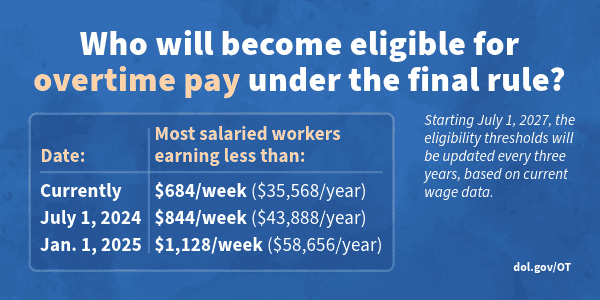
Restaurant payrolls just got a reset with immediate consequences for labor costs, scheduling and wage-and-hour risk. On May 14, the U.S. Department of Labor issued a technical amendment that restored the pre-2024 overtime exemption framework under the Fair Labor Standards Act for executive, administrative and professional employees.
For restaurants, the biggest impact falls on shift managers, assistant managers, catering leads and other salaried supervisors who often split their time between office work and the floor. Under the restored framework, some of those employees may again be treated as overtime-exempt if they meet the duties test and the salary requirements, including the $684 weekly salary level and the $107,432 annual compensation threshold for highly compensated employees.
That matters because the restored rule changes who can be scheduled like salaried management and who cannot. Chains that had been bracing for a broader overtime bill under the 2024 rule now have a clearer path to keep certain managers exempt, but only if their pay and job duties actually fit the federal tests. Restaurants that put a salaried assistant manager on the line during rushes, or lean on a catering lead to fill in service gaps, still face exposure if the person’s actual work does not match the exemption on paper.
The department said it removed the regulatory language from the 2024 rule that had been vacated by a federal court and republished the operative 2019 regulations. That puts the industry back under the earlier standard rather than the short-lived 2024 approach, which had threatened to pull more salaried supervisors into overtime coverage.
The practical message for operators is blunt: revisit classifications now. Restaurant groups should check whether salaried managers really clear the $684-a-week threshold, whether highly compensated employees reach $107,432 a year, and whether day-to-day duties still support an exemption. Where managers spend too much time on prep, coverage, cashiering or other nonexempt work, the risk of back pay claims, payroll corrections and litigation remains high.
For workers, the change can cut both ways. Some salaried managers may stay out of the overtime pool, while others who fall short of the federal tests may have stronger claims that they should be paid for extra hours. In a business already squeezed by staffing shortages, burnout and high turnover, the restored pre-2024 framework gives restaurant operators breathing room, but it also leaves chains with a familiar compliance problem: the title on the schedule does not control the law.
This article was produced by Prism’s automated news system from verified source data, official records, and press releases, then run through automated quality and moderation checks before publishing. The system is built and supervised by the people who set the standards it runs under. Read our full AI policy.
Did this article answer your question?