Restaurant workforce trends call for flexible schedules, training and advancement
A workforce built around students, parents and early-career workers forces restaurants to treat scheduling and training as core operations, not side issues.
Flexible schedules are a business requirement, not a perk
One in four restaurant workers is enrolled in school, and more than 6 in 10 have never been married. That mix helps explain why the restaurant floor runs on calendars as much as it runs on tickets, prep lists and the dinner rush. The National Restaurant Association says the industry supports 15.7 million jobs, or 10% of the U.S. workforce, and that scale comes with a workforce that is younger and more diverse than the broader labor market.
For managers, that means a standard nine-to-five mindset is usually the fastest path to turnover. Class schedules, transit times, childcare pickup, a second job and shifting family obligations all collide with the service day. A good schedule in restaurants is not just a staffing tool; it is the operating system that decides whether a server can keep a section, whether a line cook can stay through close and whether a host can come back next week.
The National Restaurant Association’s March 2026 data brief makes the point even sharper by breaking the 15.7 million jobs into 12.5 million at eating and drinking places and about 3.2 million foodservice jobs in other sectors such as healthcare, accommodations, education, food-and-beverage stores, and arts, entertainment and recreation. That spread shows how deeply restaurant work is woven into the broader economy, and why flexible staffing systems matter far beyond the dining room.
The industry is large because it is a launchpad
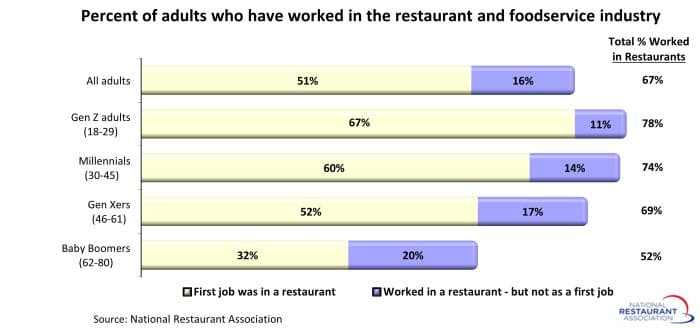
Restaurants are often the first structured workplace for students and young adults, which gives the sector a special role in shaping work habits. A well-run dining room can teach punctuality, food safety, conflict management, guest service and the pace of coordinated teamwork long before a worker ever becomes a lead, supervisor or general manager. That is why training quality matters so much: the habits set on a first job often become the habits that stick.
The industry’s growth outlook reinforces that role. The association projected in 2024 that restaurant and foodservice employment would rise by 200,000 jobs that year, reach 15.7 million by the end of 2024, and climb to 16.9 million by 2032, with average annual growth of about 150,000 jobs. In plain terms, restaurants are not just replacing turnover. They are still adding people, which means they need systems that can absorb new hires without lowering standards.
The National Restaurant Association Educational Foundation has built workforce and career tools around that reality, aiming to help people begin or advance careers in the industry. That reflects an important truth on the ground: restaurant jobs are not only entry-level slots to fill. They are often the first rung on a career ladder, and when the ladder is visible, workers are more likely to stay long enough to climb it.
Training has to match a mixed, mobile workforce
Restaurant teams are not a monolith. The National Restaurant Association says restaurants employ more minority and female managers than any other sector in the economy, and 41% of restaurant firms are owned by minorities. Those numbers tell operators something practical, not just demographic: the industry already draws leadership from a wide range of backgrounds, so onboarding, mentorship and promotion systems need to work for people who arrive with different life experiences and expectations.
That diversity makes a one-size-fits-all training packet a weak bet. A student working lunch shifts, a parent covering school pickup, a new immigrant learning both the language of the menu and the language of the floor, and an ambitious prep cook trying to become a sous chef will all need different support. The best operators build training that is clear enough for a first-day hire and deep enough for someone already thinking about management.
- pairing written standards with live shadow shifts
- repeating the same core procedures at different moments in the first month
- giving each role a visible path from entry point to lead, trainer or manager
- making sure tip-pool rules, side-work expectations and closing duties are explained the same way every time
In practice, that means:
When training is inconsistent, restaurants pay for it in mistakes, friction and avoidable quits. When it is clear, workers learn faster and managers spend less time putting out fires.
Pay and advancement decide whether workers stay
The wage picture explains why advancement matters so much. The U.S. Bureau of Labor Statistics says food and beverage serving and related workers had a median hourly wage of $14.92 in May 2024. The same occupation group is projected to grow 5% from 2024 to 2034, with about 1,159,600 openings per year on average. That is a large and persistent hiring need, but it also underscores how tight the economics are for hourly staff.
The numbers are different across jobs inside the same industry. The National Restaurant Association says waitstaff at full-service restaurants earn a median of $27.00 an hour, with a lower quartile of $19.00 and an upper quartile of $41.50. That gap captures the uneven reality of restaurant pay, especially in a tipping culture where earnings can swing with section quality, shift timing, house traffic and tip-pool design. It also explains why some workers chase tipped roles while others look for steadier hourly work or management tracks.
Black Box Intelligence added another layer to that picture in October 2024, reporting that restaurants paying top-tier salaries for general managers saw 6% lower turnover than lower-paying counterparts. The takeaway is blunt: retention is not driven by slogans. It is driven by whether the people running the shift, the line and the building can see a financial future in the job.
What stronger restaurant operations look like
Restaurants that hold onto workers tend to do the same things well. They do not treat scheduling, training and advancement as separate HR tasks. They connect them.
- publish schedules far enough ahead for school, childcare and second-job planning
- offer shift swaps that do not punish workers for having a life outside the restaurant
- cross-train staff so callouts do not collapse service
- map promotion paths from host, server, prep or line roles into lead and manager roles
- train managers to coach, not just correct
The strongest operators usually:
That approach matters because restaurant work is still expanding, still young and still central to the labor market. The BLS divides the sector into full-service restaurants, limited-service eating places, special food services and drinking places, but the management challenge is similar across all four: build a workplace flexible enough for the people who make service possible, then show them a future worth staying for.
The restaurants that get this right are not just filling shifts. They are turning a high-turnover business into a real career pipeline, one schedule, one training session and one promotion at a time.
This article was produced by Prism’s automated news system from verified source data, official records, and press releases, then run through automated quality and moderation checks before publishing. The system is built and supervised by the people who set the standards it runs under. Read our full AI policy.
Did this article answer your question?