Restaurants must become employers workers choose, not settle for
Restaurants are losing the old hiring assumptions. The operators that win will make schedules, pay, and management good enough for workers to stay.
The hiring problem is now an operating problem
Restaurants can no longer assume that posting a shift will fill it. Panelists at the National Restaurant Association Show said the industry has not seen a workforce pinch this severe among younger workers since the 1970s, and the pressure is coming from a mix of forces: the rise of the gig economy, population declines, and immigration policy that has made hiring harder.

That is why the old playbook is breaking down. Workers are comparing options, judging whether the strain on their bodies and mental health is worth the paycheck, and deciding faster than ever whether a restaurant deserves their time. In practical terms, that means labor is no longer a back-office issue. It is showing up in service speed, line stability, callouts, and whether a restaurant can keep enough people on the floor to survive a rush.
The workforce is younger, smaller, and more selective
Restaurants have always depended on young workers, but the labor pool has tightened around them. The National Restaurant Association says restaurant and foodservice workers are three times more likely than the total U.S. workforce to be under age 25. Its demographic brief says 40% of restaurant and foodservice employees are under 25, and 60% are under 35.
The broader youth labor market helps explain why the pressure feels different now. In July 2025, the U.S. Bureau of Labor Statistics said 25% of employed 16- to 24-year-olds, or 5.4 million workers, were in leisure and hospitality, the largest share of any industry. The restaurant industry was also projected to add 490,000 summer jobs in 2025, a sign that younger workers were returning in numbers not seen in years, but not nearly enough to make hiring easy again.
For operators, that means the competition is not just with the restaurant across the street. It is with delivery apps, gig work, retail, warehouse jobs, and any job that looks more predictable or less punishing. If a restaurant cannot explain why the job is worth the stress, workers move on.
What workers are really grading you on
The most important shift in restaurant labor is not just about base pay. It is about whether the workplace feels organized, fair, and survivable. A crew will notice quickly if scheduling is chaotic, training is weak, communication is inconsistent, or managers only show up to correct mistakes instead of solving problems.
That is especially true in restaurants, where tipping culture, tip pooling, minimum wage rules, and pay differences between front and back of house all affect whether a shift feels fair. When workers do not understand how their earnings are built, or when compensation changes with no explanation, trust breaks down fast. Pay transparency matters here because a server, bartender, line cook, host, and dishwasher all experience the job differently, but they all notice when the math does not add up.
The same is true of workload design. Workers are not just deciding whether the pay is acceptable; they are deciding whether the physical load, the mental strain, and the pace are manageable. If a restaurant expects people to cover too many stations, absorb too many absences, and still deliver polished service, burnout becomes part of the labor model. That is how turnover becomes a business cost, not a personal issue.
Retention now depends on the job, not the slogan
Restaurant Business reported in March 2025 that recruitment and retention had returned to pre-Covid rates, but labor costs were still more than 30% higher than before the pandemic. That mismatch is the central problem for operators: hiring has improved, but keeping people is still expensive, and replacement labor is not cheap enough to make churn painless.
That is why some employers are trying to compete with more than cash. Operators have added healthcare, tuition reimbursement, 401(k) plans, mental health support, Spotify subscriptions, and financial literacy benefits to attract and keep staff. Those additions matter because they signal something workers can feel immediately: this place understands that employment is more than a shift assignment.
But benefits alone will not fix a bad floor. If the manager behavior is erratic, if the schedule changes constantly, if advancement is unclear, or if the pace makes a 10-hour shift feel like a survival test, workers will still leave. The restaurants that become employers people choose are the ones that treat stability as a system, not a perk.
The business case is getting harder to ignore
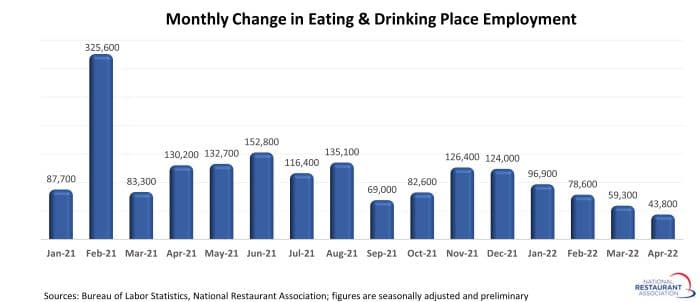
The demand side of the industry is still there. The National Restaurant Association’s 2026 outlook said 61% of adults consider dining out essential to their lifestyles, which means restaurants are still part of daily life for millions of people. At the same time, fullservice restaurant employment in March 2026 was still 193,000 jobs, or 3.4%, below pre-pandemic levels, even after the sector added 97,000 jobs between March 2025 and March 2026.
That gap matters because it shows how slowly the labor market has normalized. Restaurants may be busier, and guest demand may be strong, but staffing has not fully caught up. The result is a familiar pattern for workers: fewer hands on the clock, more pressure per person, and a higher chance that one missing shift turns into a bad service night for everyone.
The operators who understand this will stop asking why people will not take the job and start asking why they should stay. Predictable scheduling, honest pay practices, real advancement paths, competent managers, and workload that human beings can sustain are no longer soft perks. They are the difference between a restaurant that keeps a crew and one that keeps replacing it.
This article was produced by Prism’s automated news system from verified source data, official records, and press releases, then run through automated quality and moderation checks before publishing. The system is built and supervised by the people who set the standards it runs under. Read our full AI policy.
Did this article answer your question?