Starbucks reshapes licensed stores around travel, healthcare and campus growth
Starbucks is pushing licensed stores into travel, healthcare and campus growth while telling customers they should not see a difference. For workers, that promise can mean brand pressure inside very different staffing and ownership models.
Starbucks wants one brand feel, even when the store model changes
From the customer side, Starbucks says there should be no separate class of licensed café. Whether the store sits in an airport, hospital, hotel, grocery store, or university, the company wants the same Starbucks experience to come through at the counter, on the app, and in the cup. That promise matters on the floor because it puts a single brand expectation on stores that are often run under very different ownership and staffing arrangements.

For baristas, shift supervisors, and store managers, the tension is familiar: the logo looks the same, but the operating reality can be completely different. Starbucks says licensed locations are run by licensee partners who know how their venues move, and that distinction shapes everything from product mix to equipment to service flow. The company is still asking workers in those stores to deliver a familiar customer experience, even when the store is built around a hotel lobby, a clinic, a campus building, or a terminal with constant turnover.
The licensed business is being reorganized around the customer environment
Starbucks says it has moved its U.S. licensed coffeehouse business over the past year from a primarily regional model to a segment-focused one. Instead of treating licensed stores as a single bucket, the company is organizing them around the setting they serve, with travel, healthcare, and campus growth at the center of the plan. That shift is meant to let Starbucks support licensees differently depending on whether they serve patients, students, commuters, or travelers.
The company is also “rightsizing” product and equipment and adding sourcing flexibility so licensees can operate efficiently without sacrificing the Starbucks look and feel. In practical terms, that means the company is trying to simplify what gets stocked, what equipment gets used, and how much each site needs to carry while preserving the same customer promise. For workers, it signals that some licensed stores may become more streamlined, more specialized, and more dependent on the pace of the host venue than a standard café.
Airports are the stress test
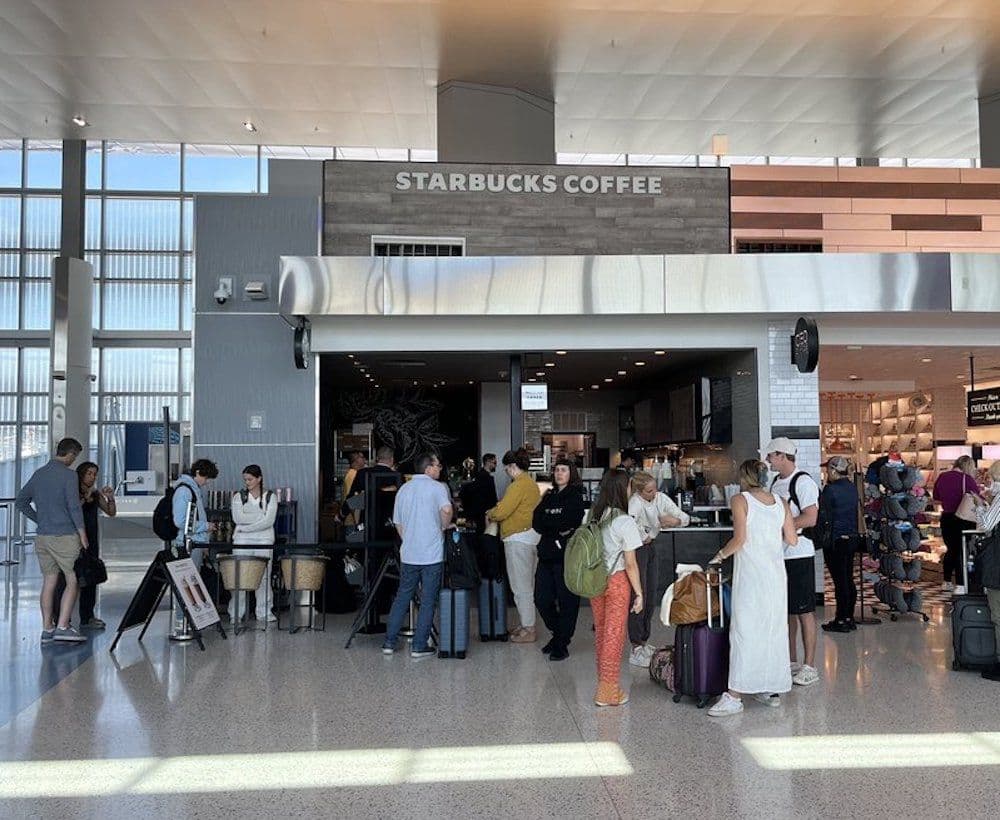
If there is one place that shows how hard this promise can be, it is the airport. Starbucks sees airports as a key test case for order-ahead, digital ordering, and counter service, all of which are supposed to feel unmistakably Starbucks even when the venue is chaotic and the line never really stops. Trade reporting in March said Starbucks was trying to get rid of long lines at airport shops, and separate reporting said the company was testing kiosks and scheduled app orders in airports and other high-volume locations.
That matters to frontline workers because airports compress every challenge at once: bursts of traffic, tight labor windows, and customers who expect speed. A barista may have limited control over the physical setup or the number of people walking through the door, but customers still judge the store on the same Starbucks standard. The result is pressure to move faster and smoother in places where the venue itself, not just the team, drives the pace.
What workers can control, and what they cannot
The cleanest way to understand the difference between company-operated and licensed stores is to ask who controls the basics. In a company-operated café, Starbucks controls the operating model directly. In a licensed store, the venue owner or operator is responsible for the space, and Starbucks is trying to support that operator without turning the experience into something visibly different.
That leaves frontline workers in a harder position than many customers realize. Baristas and supervisors can control drink quality, register flow, customer tone, and how well they move a line. They cannot control the host site’s traffic patterns, the building’s layout, or the staffing choices of a licensee partner. Starbucks’s promise that customers should not see the difference can therefore create a real workplace standard: deliver the brand without always having the same tools, space, or staffing model as a company-run café.
For workers in the Starbucks Workers United organizing wave, that gap between brand promise and store reality is not abstract. It sits at the center of labor questions about staffing, consistency, and who really sets the pace in each store. When the company says it wants seamless service, workers hear the operational burden that comes with it.
Licensed stores still matter because the channel is huge
This is not a side business. Starbucks reported 40,990 total stores in fiscal 2025, including 21,514 company-operated stores and 19,476 licensed locations. That works out to about 53% company-operated and 47% licensed, which shows how central the licensed channel remains to the company’s footprint. Starbucks has also said licensed stores generally carry a lower gross margin but a higher operating margin than company-operated stores, and licensed-store revenue accounted for 12% of total net revenues in fiscal 2024.
That financial structure explains why the company keeps leaning on licensed growth. Licensed stores let Starbucks expand in places where it does not run every shift itself, but they still extend the brand into high-traffic settings where customers expect the same menu, speed, and familiarity. For workers, the channel’s size means the licensed store experience is not a small exception. It is part of how Starbucks grows, and part of how it manages labor, service, and cost at scale.
The licensed strategy sits inside a larger turnaround
Starbucks’s push on licensed stores is happening alongside a broader turnaround under Brian Niccol. At its January 29, 2026 Investor Day, the company said it was making progress on its Back to Starbucks transformation and said it wants to be the world’s leading customer service company. Mike Grams has framed the effort as improving the full café ecosystem, including mobile, drive-thru, and delivery, while Brady Brewer has said Starbucks wants to accelerate growth through licensed partnerships with local operators.
The company has also kept an eye on growth outside the U.S. Starbucks has said it can grow China to 20,000 locations, which reinforces how important partner-led and licensed expansion remains to its long-term strategy. At the same time, Starbucks said in September 2025 that it was restructuring and closing underperforming locations as part of a broader turnaround, a reminder that not every store format is getting the same patience.
For workers, the message is clear: Starbucks is still building around licensed growth, but it is doing so in a way that asks frontline teams to deliver one brand standard across very different operating worlds. The pressure point is not the logo. It is the work required to make every location feel like the same store when the reality behind the counter is anything but.
This article was produced by Prism’s automated news system from verified source data, official records, and press releases, then run through automated quality and moderation checks before publishing. The system is built and supervised by the people who set the standards it runs under. Read our full AI policy.
Did this article answer your question?