760 NYC Taco Bell and Dunkin Workers Win $1.8 Million Settlement
Salz Management LLC must pay $1.5M to 760+ workers at 24 NYC Taco Bell and Dunkin' locations after DCWP found clopening, scheduling notice, and open-shift violations.
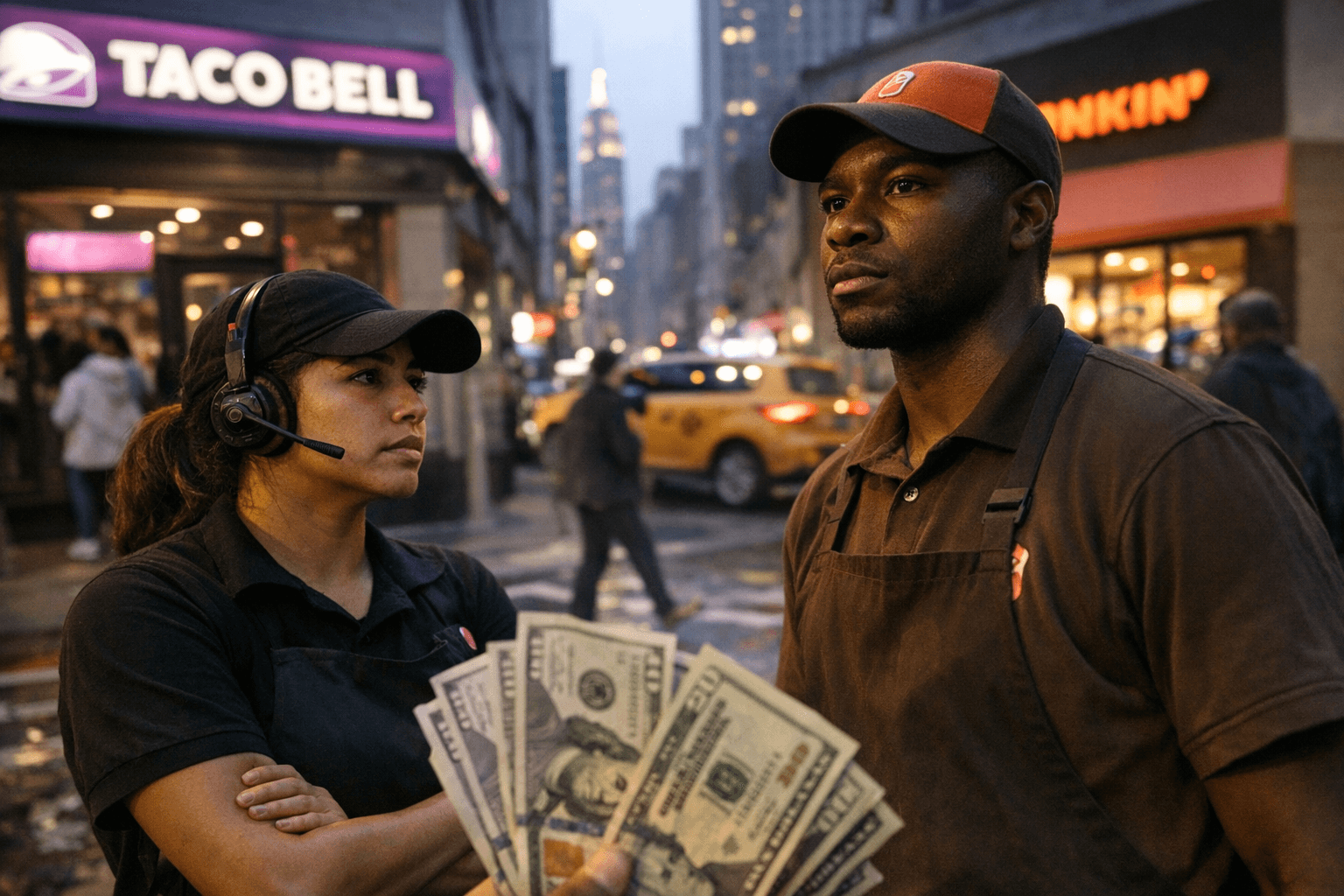
The New York City Department of Consumer and Worker Protection secured a $1.5 million settlement from Salz Management LLC, a franchise operator running 24 Taco Bell and Dunkin' locations across Manhattan and Queens, after investigators documented systematic violations of the city's Fair Workweek Law. More than 760 workers will receive restitution, and the city imposed an additional $155,000 in civil penalties. A separate settlement with fashion retailer Theory LLC pushed the combined enforcement round to more than $1.8 million for over 830 workers.
DCWP Commissioner Sam Levine and Mayor Zohran Mamdani announced the settlement in a YouTube Live broadcast from City Hall, where both officials ate Crunchwrap Supremes, Mexican pizza, Dunkin' Munchkins, and Baja Blasts while detailing the case against Salz Management. Mamdani framed the enforcement action in direct terms: "Today's settlements are about more than financial compensation for working New Yorkers. At their core, these actions are about restoring dignity on the job." Levine disclosed that some individual workers covered by the settlement will receive more than $10,000 each.
Investigators found that Salz Management violated the rights of workers across all 24 locations by failing to provide schedules 14 days in advance and failing to obtain consent for schedule changes. The company also frequently failed to offer open shifts to existing employees before hiring new workers, and did not pay the required premiums for clopening shifts. A clopening occurs when a worker closes a location and must return to open it within fewer than 11 hours. Under the law, scheduling those back-to-back shifts requires written employee consent and a $100 premium payment per occurrence. "The workers didn't have predictable schedules," Levine said, adding that employers wanting to change fast-food workers' schedules must give them 14 days' notice.
Workers covered by the settlement do not need to file a complaint to receive payment. Checks and direct deposits for Salz Management employees are scheduled to begin in August 2026. Workers who believe their rights were violated at other locations can file a complaint at nyc.gov/workers or by calling 311.
The Salz case is a detailed record of exactly which scheduling behaviors trigger enforcement and what the financial exposure looks like at scale. At $1.5 million across 760-plus workers, the average restitution obligation runs to roughly $2,000 per employee before penalties, but Levine's disclosure that individual payouts can exceed $10,000 signals that concentrated, repeated violations against specific workers carry heavier costs. The $155,000 in civil penalties adds further to the operator's liability; none of it is absorbed by Yum! Brands or the Dunkin' parent company. Under the franchise model, every dollar of restitution, penalty, and administrative cost from a DCWP investigation lands on the local operator's balance sheet.
The compliance obligations the law imposes are specific and documentable, which means both violations and a defense against them live in the records a manager keeps. Under NYC's Fair Workweek Law, fast-food employers must post schedules 14 days before the first shift they cover, and must pay premiums for schedule changes or clopening shifts. Changes to posted schedules trigger a premium between $10 and $75, depending on how close to the shift the change is made. Clopening shifts require written employee consent and a $100 premium each time, unless the worker requests the arrangement in writing. Open shifts must be offered to existing qualified employees before any new hire fills the position, and documentation of that offer and its outcome is a record DCWP will look for during an investigation. Maintaining timestamped schedule postings, signed consent forms, and a clear log of open-shift offers and premium payments is the operational infrastructure that separates a dismissed complaint from a settlement.
Since Mayor Mamdani took office at the beginning of the year, the DCWP has secured more than $8.5 million in restitution for New York City workers, including $5 million for more than 49,000 wrongfully-deactivated delivery workers and $500,000 for late payments to freelancers. The same announcement also included an enforcement petition against QSR Management LLC, a Staten Island-based Dunkin' franchisee, seeking monetary relief for approximately 1,000 workers and civil penalties that have not yet been determined. The petition was filed at the Office of Administrative Trials and Hearings. Multi-location franchise operators now face the realistic prospect that scheduling practices across an entire portfolio, not just one store, will be examined at once. Levine's message to the industry was unambiguous: "If DCWP sees you break the law, we will not hesitate to bring you to court. Compliance is not optional.
This article was produced by Prism’s automated news system from verified source data, official records, and press releases, then run through automated quality and moderation checks before publishing. The system is built and supervised by the people who set the standards it runs under. Read our full AI policy.
Did this article answer your question?