CIW Mobilizes with Hunger Strike at Taco Bell Headquarters Starting Feb. 24
The Coalition of Immokalee Workers began a hunger strike and solidarity actions at Taco Bell headquarters in Irvine on Feb. 24, 2026, joined by student, faith-based and labor allies.
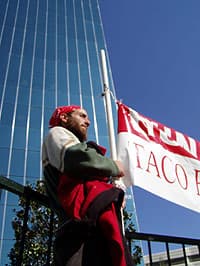
The Coalition of Immokalee Workers has begun a hunger strike at Taco Bell headquarters in Irvine, California, with solidarity actions staged by student, faith-based and labor allies beginning Feb. 24, 2026. Organizers describe the mobilization as part of a renewed high-profile campaign targeting Taco Bell and its parent company Yum! Brands.
The CIW is a membership-led farmworker rights organization based in Immokalee, Florida, that built its tactics through marches, strikes and campus organizing since the mid-1990s. Founding member Lucas Benitez helped lead early direct actions, and members including Francisca Cortez and Romero Ramirez have told reporters about field conditions that drove the group to sustained pressure on buyers.
The CIW’s strategy has long relied on campus pressure and broad coalitions. Tracie McMillan recounts that students took the Taco Bell campaign to more than 300 college campuses and 50 high schools and that University of Florida students helped target a popular on-campus Taco Bell franchise. At one earlier picket a manager told protesting youths, "You eat here every day," and a student replied, "Not anymore!" The movement also used signature and postcard campaigns: by Christmas 2002 more than 2,000 campaign cards had been signed, and 842 campers at Justice and Peace camps mailed postcards to Taco Bell; one card addressed to CEO Emil Brolick said, "Our poverty is the basis of your company’s wealth, and we are saying 'Enough is enough'!"
CIW’s most visible corporate victory came in 2005, when Taco Bell announced an agreement with the CIW to address wages and working conditions in Florida’s tomato fields. In a March 8, 2005 statement CIW and Taco Bell announced that "Taco Bell announced today that it will fund a penny per pound 'pass-through' with its suppliers of Florida tomatoes, and will undertake joint efforts with the CIW on several fronts to improve working conditions in Florida’s tomato fields. For its part, the CIW has agreed to end its three-year boycott of Taco Bell, saying that the agreement 'sets a new standard of social responsibility for the fast-food industry.'"

That penny-per-pound model spread: Tracie McMillan reports Taco Bell and Yum! Brands agreed to the extra penny in 2005, McDonald’s followed in 2007, and Burger King, Subway and Whole Foods Market adopted similar measures in 2008, with growers reported to have signed on by 2010. McMillan also notes the CIW argument that "If corporate buyers agreed to pay that tiny premium, and the premium went toward wages, workers would, in effect, receive a nearly 80 percent raise."
Field conditions that drove the CIW’s campaigns remain central to the group’s messaging. Socialist Worker recorded members saying that foremen have inflicted violence on pickers, with one account noting, "One worker once came to us, and he was bloody from a beating he received," and describing chronic problems such as inadequate water in the fields. The CIW continues to use popular education and seasonal outreach - flyers, drawings, videos and visits to labor camps - to rebuild leadership each season.
The strike comes with corporate-scale context: Taco Bell purchased roughly 10 million pounds of Florida tomatoes in 2004, a share the Oakland Institute says was less than one percent of Florida production, while Taco Bell serves more than 35 million consumers each week in over 6,500 U.S. restaurants. The Feb. 24 hunger strike will put renewed public pressure on Taco Bell and Yum! Brands to address whether agreements struck in 2005 and later commitments translate into enforceable protections for tomato pickers today.
This article was produced by Prism’s automated news system from verified source data, official records, and press releases, then run through automated quality and moderation checks before publishing. The system is built and supervised by the people who set the standards it runs under. Read our full AI policy.
Did this article answer your question?