EPI Urges California Fast Food Council to Index $20 Wage to Inflation
The Economic Policy Institute says California's $20 fast-food wage has lost 4.2% of its real value since April 2024 — and the council meant to fix that has no chair.
The Economic Policy Institute published a policy brief urging California's Fast Food Council to make inflation indexing its top priority in 2026, arguing that nearly two years of rising prices have steadily eroded what the $20-per-hour fast-food wage is actually worth to workers who earn it.
Inflation since April 2024 means the real minimum wage paid to California's fast-food workers has been steadily cut since then. From April 2024 to January 2026, as measured by the consumer price index for all urban wage earners, that cut amounts to 4.2%. For a crew member at Taco Bell or any other large chain covered under AB 1228, that is roughly 80 cents an hour in lost purchasing power without a single dollar being taken from their paycheck.
The California Fast Food Council, composed of worker, industry, and government representatives, instituted the $20 minimum wage for workers at large chain fast-food restaurants in 2024. The Council is also empowered to protect that wage standard from inflation by raising it by the annualized increase in the consumer price index or 3.5%, whichever is lower. It has not yet used that authority.
The Council was preparing to discuss a wage adjustment in June 2025 when the chair resigned. It is expected to take up the issue when the governor names a new chair, which has yet to happen. Given that almost two years have passed since the initial setting of the $20 wage standard, the EPI argues the Council should prioritize this cost-of-living adjustment in 2026 to prevent rising prices from erasing the gains made by fast-food workers.
The backdrop to that argument is a contested record on what the $20 floor has actually done to menu prices and employment. Governor Newsom signed AB 1228 into law on September 28, 2023, raising the hourly minimum wage for certain fast-food workers to $20 effective April 1, 2024. Almost immediately, operators began adjusting prices ahead of that date, and the data fight over how much prices actually rose has never fully resolved.
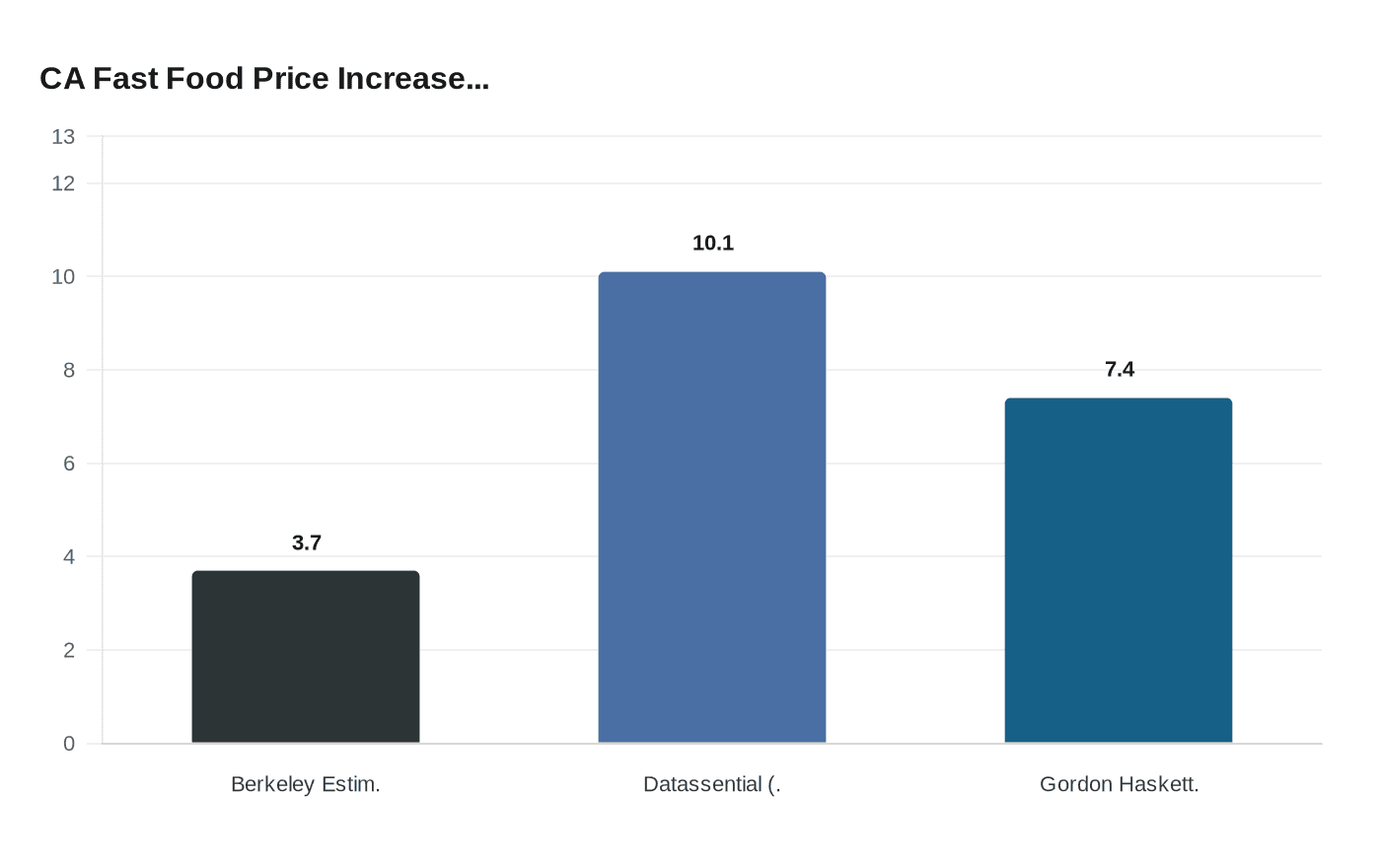
Critics of a Berkeley research team's price analysis point to competing measures that paint a sharply different picture. According to the Employment Policies Institute, the Berkeley report relied on third-party UberEats data to measure the entire fast-food industry, a methodology critics describe as a "poor metric for analyzing actual price changes" that caused the report to characterize price increases as falsely modest. The Berkeley team estimated price hikes of 3.7%, a figure that drew immediate pushback from multiple industry analysts.
Datassential, tracking limited-service restaurant prices from September 2023 through April 2024, found that California led the nation in menu price inflation at 10.1% during that window — more than double the rate seen at California's full-service restaurants over the same period. Gordon Haskett Research Advisors, whose findings were reported in Barron's, found that core menu item prices at certain chains had already more than doubled Berkeley's 3.7% estimate when looking at the two months immediately before the April 1, 2024 wage increases took effect.
On the employment side, the picture drew similar dispute. Seasonally adjusted Bureau of Labor Statistics data showed employment in the fast-food industry was down by over 4,400 jobs since January, when businesses began announcing layoffs. A National Bureau of Economic Research working paper by economists from UC San Diego and Texas A&M estimated the losses were far deeper. That study estimated California had lost nearly 18,000 fast-food jobs since the law went into effect in September 2023.
One impediment to an inflation adjustment is opposition from fast-food restaurant operators, who argue that raising workers' pay to $20 damaged their businesses. A supermajority of operators surveyed said further staffing and pricing adjustments may still be required in the year ahead. An Employment Policies Institute survey of California fast-food restaurant operators found 89% said the law has made them less likely to expand in California, and a majority, 59%, said they are more likely to expand in other states.
Without effective and automatic indexation, higher wage standards can be eroded almost entirely over time. Today's debate over the cost-of-living adjustment to the California Fast Food Council's minimum wage often frames such adjustments as imposing new burdens on low-wage employers. EPI's brief makes the case that the framing obscures the real dynamic: a $20 wage that buys less every month is not the same $20 wage workers won in 2024.
This article was produced by Prism’s automated news system from verified source data, official records, and press releases, then run through automated quality and moderation checks before publishing. The system is built and supervised by the people who set the standards it runs under. Read our full AI policy.
Did this article answer your question?