Federal Labor Law Sets Minimum Wage, Overtime Rules for Taco Bell Workers
The Dept. of Labor's wage law for fast food has six failure points that regularly trigger back-wage claims, starting before any crew member clocks in.
The U.S. Department of Labor's Wage and Hour Division has drawn a clear federal baseline for every Taco Bell on the map: pay workers at least $7.25 an hour, pay time-and-a-half when they cross 40 hours in a workweek, and track every minute worked. What that looks like in practice, shift by shift, is where compliance breaks down, and the DOL's Fact Sheet #2 on restaurants and fast-food establishments spells out exactly how.
The FLSA covers any restaurant with annual gross sales above the statutory threshold, which captures virtually every Taco Bell location, corporate or franchise. Non-exempt employees, meaning most crew members and shift leads, are entitled to federal minimum wage and overtime regardless of how a local franchise structures its pay periods or scheduling software. State and municipal rules layer on top of those federal minimums, and where they are higher, state law governs. California's sector-specific minimum wage and New York City's Fair Workweek ordinance both clear the federal floor; no employer, anywhere, may fall below the federal minimums.
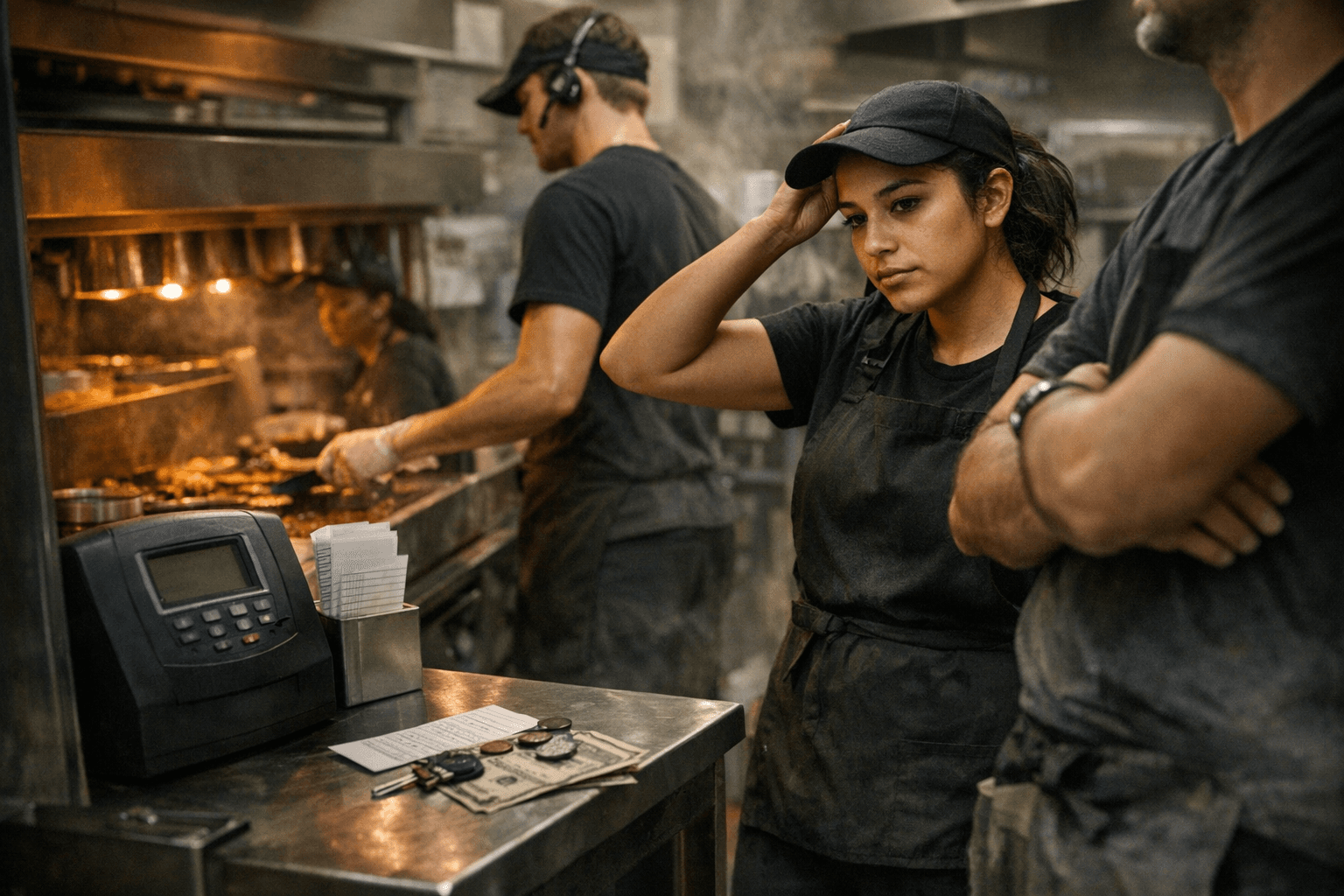
The most common place that foundation cracks is off-the-clock work, and it tends to happen in two predictable spots. The first is pre-shift prep: a crew member who arrives early to stock the line, restock sauces, or count the drawer is working the moment that prep begins, whether or not the timekeeping system has been touched. The second is closing overage. When a closing shift runs 20 minutes past the scheduled end time because the fryers need a second scrub, those 20 minutes are compensable. The DOL is explicit that all hours actually worked must be paid, and a manager who tells a closer to finish up after clocking out has created a wage claim, not a labor-cost savings.
Overtime calculation is the next pressure point, and it carries a specific trap for workers who pick up shifts across more than one Taco Bell under the same employer. Hours worked at two locations owned by the same franchisee in a single workweek must be combined when determining whether the 40-hour threshold has been crossed. A crew member who works 25 hours at one store and 20 at another has worked 45 hours for overtime purposes, and the employer owes five hours at 1.5 times the regular rate. Treating each location as a separate workweek is one of the violations the DOL flags most frequently in multi-unit restaurant enforcement.
Tip credit rules surface less often at QSR counters, where tipping is not standard, but they apply at any Taco Bell unit that employs delivery drivers or operates in a market where tips are in play. Under the FLSA, an employer may pay a tipped employee as little as $2.13 an hour in direct wages and claim a tip credit of up to $5.12 against the $7.25 federal minimum, but only if tips actually bridge that gap every workweek. When they don't, the employer must make up the difference. Any tip pool that draws in non-tipped workers invalidates the credit entirely, and that exposure runs backward to the start of the invalid arrangement.
Minors bring a separate set of hour restrictions that are easy to violate during busy stretches. Fourteen- and fifteen-year-olds may not work more than three hours on a school day or more than eight hours on a non-school day, and they may not work past 7 p.m. during the school year. Sixteen- and seventeen-year-olds face no FLSA hour caps but remain barred from operating certain equipment the DOL classifies as hazardous. A closing manager who keeps a 15-year-old past 7 p.m. on a Tuesday to cover a no-call faces a child labor violation on top of any overtime issue.
Deductions are another live wire. An employer cannot deduct the cost of a uniform, a required food-safety certification, or a register shortage from a paycheck if doing so drops a worker's effective hourly rate below $7.25. Some franchise operators trip over this when they auto-deduct for a missing shirt or a drawer that comes up short at end of shift.
Underlying all of it is recordkeeping. Inadequate timekeeping is the trigger that most often opens a full wage-and-hour investigation, because poor records make it impossible to disprove a worker's account of hours actually worked. Employers who cannot produce accurate clock-in and clock-out data, including compensable training time and any required pre-shift duties, bear the evidentiary burden when a claim is filed. Back wages can reach two years under the FLSA, or three years if the violation is found to be willful. Across a crew of 20 workers, the math turns costly fast.
The 15-minute audit a store manager can run before any pay period closes: pull the prior week's timecards and flag any shift that shows a punch-out falling before the scheduled end time on a night with a known late close. Verify that any employee who worked at more than one company location had hours combined before overtime was calculated. Confirm that every minor's schedule complied with their age-based limits for that day type. Check that no paycheck deduction pushed a worker's effective rate below $7.25. Review whether any tip arrangement in use is properly documented and valid. Each check takes roughly two to three minutes; the full pass takes less than a quarter-hour. Catching a discrepancy before payroll issues is substantially less expensive than resolving it after the DOL Wage and Hour Division receives a complaint, which it accepts online and by phone without requiring a worker to have retained an attorney.
Crew members who believe something is off on their stub should preserve copies of pay statements and shift schedules. Internal resolution is one path; the WHD is another.
This article was produced by Prism’s automated news system from verified source data, official records, and press releases, then run through automated quality and moderation checks before publishing. The system is built and supervised by the people who set the standards it runs under. Read our full AI policy.
Did this article answer your question?