Federal Wage-and-Hour Rules Every Taco Bell Manager Must Follow
A Taco Bell franchisee's $1.5M New York City settlement for scheduling violations is the clearest proof that wage-and-hour exposure in fast food is real, recurring, and preventable.

The $1.5 Million Lesson Already on the Books
A franchisee operating Taco Bell and Dunkin' locations in New York City agreed to pay $1.5 million in restitution to more than 760 workers under a settlement with the Department of Consumer and Worker Protection (DCWP) for violations of the city's Fair Workweek Law. The franchisee, Salz Management LLC, violated the rights of workers across 24 locations in Manhattan and Queens by failing to provide schedules 14 days in advance and failing to obtain consent for schedule changes. The announcement came from NYC Mayor Zohran Mamdani on a YouTube Live stream filmed inside City Hall while he ate a Crunchwrap Supreme, and it came with consequences beyond restitution: Salz Management and a second settling company paid more than $176,000 in civil penalties and costs on top of the worker restitution.
This is the enforcement environment store-level leaders operate in right now. The violations that cost Salz Management over $1.5 million were not exotic fraud. They were documentation gaps that compounded across dozens of locations and hundreds of pay periods. What follows is a scenario-by-scenario prevention map, built from federal law, documented enforcement actions, and the specific behaviors that investigators flag most often in quick-service restaurants.
Scenario 1: Off-the-Clock Work
Time spent on required tasks before or after a scheduled shift, including setting up stations, counting a cash drawer, or attending a mandatory pre-shift meeting, is compensable under the FLSA, and not paying for it is one of the most cited violations in restaurant audits. Sending employees off the clock to wait for business to pick up while they remain on premises is also compensable time under the FLSA. The Department of Labor's Wage and Hour Division (WHD) can recover back wages plus an equal amount in liquidated damages, which effectively doubles the financial exposure for every missed minute.
Quick decision rule: if you assign it, it is paid time. There is no gray area.
Scenario 2: Manager Time Edits Without a Paper Trail
When managers edit employee time records, each edit must be documented with a reason, and undocumented time edits are treated as falsification of records during DOL investigations. A pattern of edits that consistently reduce hours is one of the clearest signals investigators use to identify systemic wage theft. Civil penalties for willful FLSA violations can reach $1,000 per incident, and the willfulness finding is easier to sustain when the audit trail has been erased.
Quick decision rule: log every edit with a written reason, manager signature, and, where operationally possible, employee acknowledgment.
Scenario 3: Overtime and the Misclassification Trap
Overtime violations are a frequent topic of wage-and-hour litigation, and they often generate expensive settlements. A Taco Bell franchisee has faced suit specifically for withholding overtime pay from employees improperly classified as exempt managers, and similar cases have cost competitors dearly. A Panera Bread operator agreed to pay $4.6 million to settle a class action alleging assistant managers were improperly classified as exempt from overtime pay. Under the FLSA, a salaried title alone does not create an exemption; the position must meet both a current salary-level threshold and a duties test requiring that the employee's primary role is genuinely executive, administrative, or professional. Any shift manager whose primary job is making food and supervising a crew is almost certainly non-exempt regardless of how the org chart reads.
Quick decision rule: before classifying any position as exempt, verify both the salary level test and the primary duties test. When in doubt, classify as non-exempt.
Scenario 4: Tip Credit and the 80/20 Rule
Most Taco Bell locations do not operate on a tipped-worker model, but franchisees in states that permit a tip credit need to understand the 80/20 rule precisely. Timekeeping must separately track time spent on tipped duties versus non-tipped duties, because when a tipped employee spends more than 20% of a shift on non-tipped work such as cleaning, stocking, or side work, those hours cannot be paid at the tipped minimum wage. Violations here generate back-wage liability for every tipped employee on every affected shift, and the calculation is retroactive across the entire limitations period.
Quick decision rule: if your location takes a tip credit, build separate tipped and non-tipped time codes into the timekeeping system from the first day.
Scenario 5: Predictive Scheduling Violations
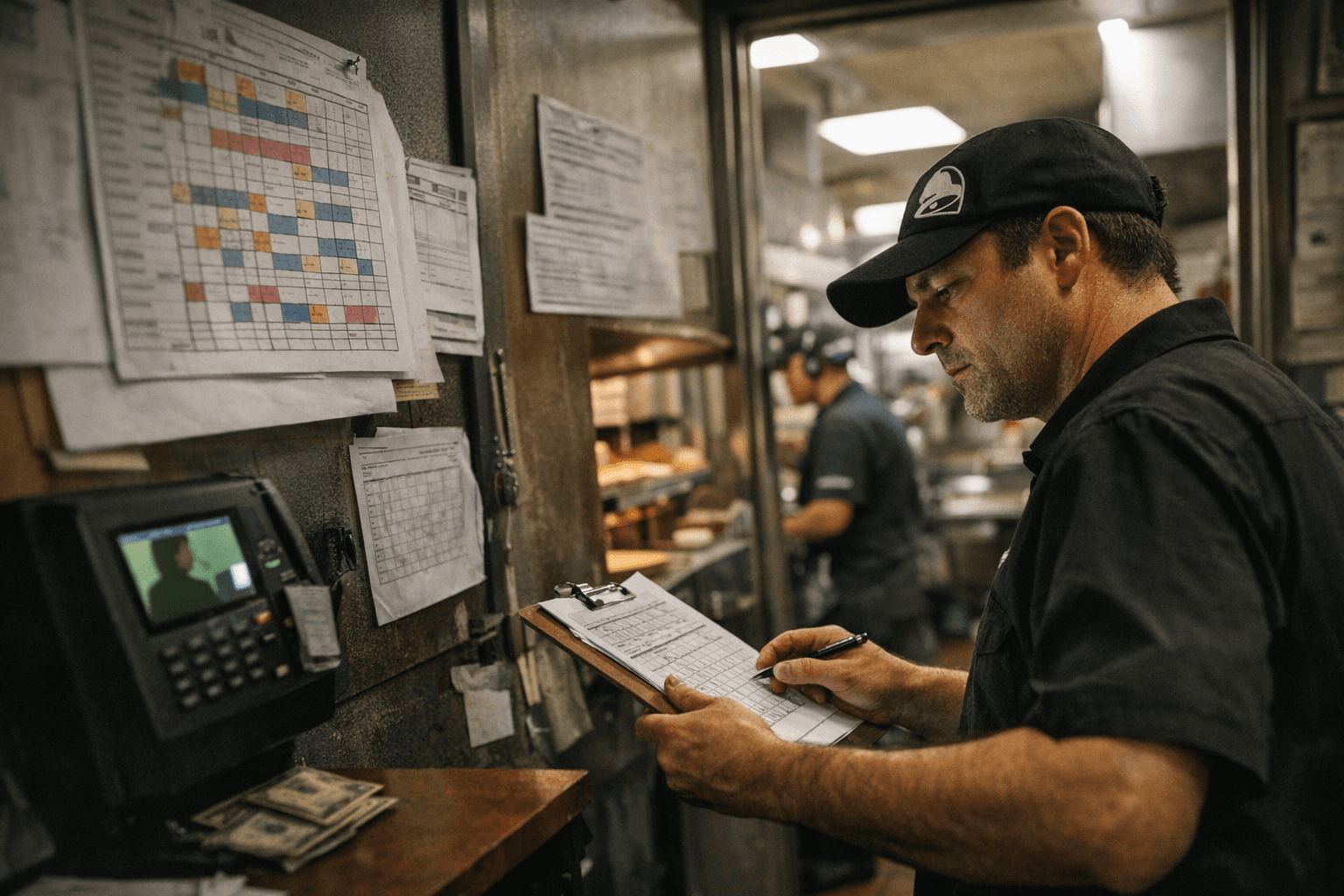
The Salz Management settlement is not an isolated event. It reflects an active and well-funded enforcement posture by city agencies in jurisdictions that have enacted fair-workweek laws. NYC's law requires 14-day advance schedule notice and documented worker consent for any changes. Other cities with active enforcement frameworks include Chicago, Philadelphia, Seattle, and San Francisco, each with their own notice windows and premium-pay requirements for short-notice changes. The Mamdani administration announced settlements totaling more than $1.8 million for more than 830 workers to resolve fair-workweek violations across multiple companies in the same enforcement cycle.
Quick decision rule: publish schedules in the scheduling system at least 14 days in advance wherever required, and document every change request and consent with a timestamp.
Scenario 6: Minor Employees and Child Labor Rules
The DOL recently fined a Minneapolis pizza restaurant for multiple wage-and-hour violations, including failure to pay overtime and improper tip pooling practices. The final penalty in that case included $44,915 in back wages, an equal amount in liquidated damages, and $15,954 in civil money penalties tied specifically to child labor and tip-retention violations. In 2025, cases involving companies such as Chick-fil-A, Mar-Jac Poultry, and McDonald's with child labor violations drove overall penalty figures higher across the restaurant industry. In fast food, where minor workers are common and rush-period pressure runs high, keeping a separate log of every minor employee's weekly scheduled and actual hours is non-negotiable.
Quick decision rule: track minor employees in a dedicated log, review it at the start of every shift, and never permit a minor to work beyond their state or federal permit limits even once.
State and Local Overlays: Where the Federal Floor Falls Short
The FLSA sets a federal minimum wage of $7.25 per hour, but virtually every major Taco Bell market operates under a higher state or local rate. California's AB 1228 created the Fast Food Council, which meets regularly to develop minimum employment standards specific to the fast food industry, including the authority to set future minimum wage increases and rules on working hours and working conditions. The law established a $20-per-hour wage floor for California fast-food workers that applies independently of any general state minimum. The most reliable operational control is to configure payroll systems to pull rate updates automatically through the franchisee HR portal; manual tracking of multi-jurisdictional rate changes is a compliance liability waiting to happen.
Self-Audit Checklist: Run This Every Week
- Are all non-exempt employees clocking in and out for every minute worked, including pre-shift prep and post-shift tasks?
- Is every time-record edit documented with a written reason and manager signature?
- Has someone reviewed the current workweek for any employee approaching 40 hours before approving additional hours?
- Are schedules posted at least 14 days in advance in jurisdictions that require it, and are change consents documented?
- Are all minor employees' hours tracked against their state and federal permit limits?
- Is the current minimum wage rate confirmed for your specific city or county?
- Are tipped and non-tipped duties tracked separately if your location operates under a tip credit?
What to Document: Your Legal Audit Trail
The FLSA requires payroll records showing exact clock-in and clock-out times to be retained for at least three years. Beyond that federal floor, the following records form the defense against a WHD investigation or a class-action complaint: timestamped schedule offers and all changes in the scheduling system; written worker consent for any schedule modification; a separate tip log and tip-credit calculation file for any tipped position; a written justification for every manager time-record edit; and a dated log of every wage complaint received, including informal ones raised verbally on the floor.
When a Complaint Arrives: Six Steps That Control the Outcome
1. Document the complaint in writing immediately and confirm receipt to the employee the same day.
2. Preserve all timecards, schedule logs, tip records, and any related communications before anything is altered.
3. Escalate to franchise HR or payroll right away; most payroll errors are correctable without regulatory involvement if caught early.
4. If a government agency contacts the location, cooperate fully and provide requested records. Non-cooperation is consistently treated as an aggravating factor in penalty decisions across federal and city enforcement actions.
5. Issue any owed pay correction without delay. Every week of delay is an additional week of liability.
6. Communicate the correction to affected employees directly. Transparency at this stage consistently reduces the likelihood of a formal complaint filing.
Where to Get Current Guidance
The DOL Wage and Hour Division publishes restaurant-specific fact sheets and maintains the Workers Owed Wages tool, which allows anyone to check whether their employer owes recovered wages from a prior investigation. State labor departments carry current minimum wage schedules and predictive scheduling rules for their jurisdictions. The Yum! intranet and your franchisee HR portal are the fastest path to rate updates and compliance SOPs tailored to your operating agreement. District HR is the appropriate escalation point before any ad-hoc pay adjustment is made unilaterally at the store level.
The Salz Management settlement covered 760-plus workers across 24 locations for violations that were, at their core, a scheduling documentation failure. The cost of the controls that would have prevented it runs to a few hours of manager training and a scheduling system setting. The cost of skipping them ran to $1.5 million and a press conference held over Crunchwrap Supremes.
This article was produced by Prism’s automated news system from verified source data, official records, and press releases, then run through automated quality and moderation checks before publishing. The system is built and supervised by the people who set the standards it runs under. Read our full AI policy.
Did this article answer your question?