OSHA warns Taco Bell crews face heat, burns, slips, and cuts
Taco Bell shifts can turn dangerous fast, especially around heat, steam, slips, and knives. OSHA and FDA rules point to one clear fix: make the safe move the easy one.
What makes a Taco Bell shift physically harder than it looks
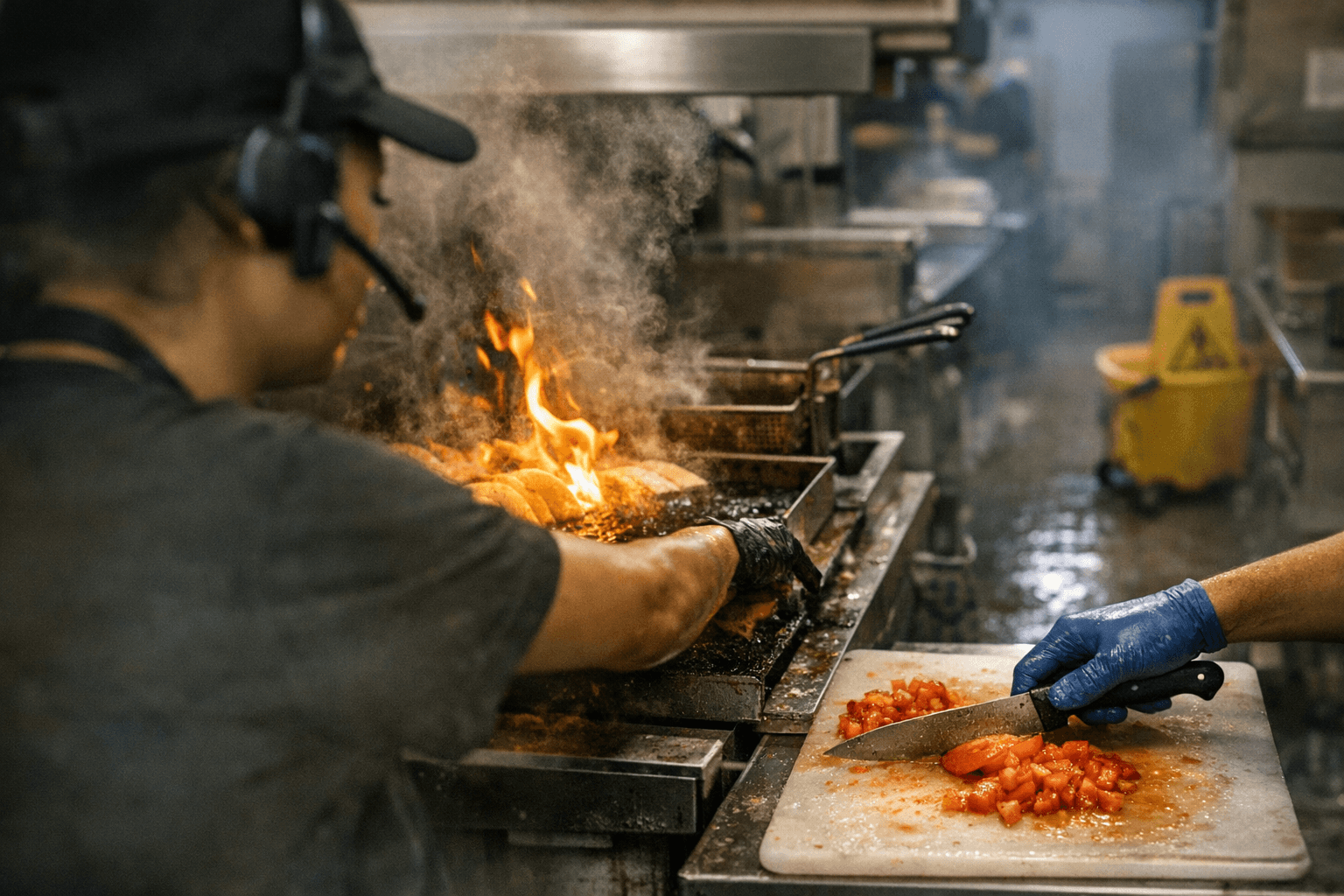
A Taco Bell kitchen can look routine from the dining room, but the work behind the counter is a constant physical sprint. Crew members move between hot surfaces, tight prep lines, wet floors, sharp tools, and crowded stations, often while the clock is pushing every task to happen faster. That is why a safety lapse in a fast-food kitchen is rarely just a small mistake; it can become a burn, a fall, a cut, or a callout that leaves the next shift short-staffed.
The Occupational Safety and Health Administration says millions of U.S. workers are exposed to heat at work, and thousands become sick from occupational heat exposure every year. In food service, that risk is not limited to summer weather. Ovens, fryers, steam, dish areas, and packed prep lines can all raise the strain on a worker who is already moving quickly and standing for long stretches.
Heat is a real shift-level hazard
Heat stress is one of the easiest workplace dangers to underestimate because it builds gradually. OSHA warns that 50% to 70% of outdoor heat fatalities happen in the first few days on the job, before workers have acclimatized. That warning matters in restaurant work because new hires, cross-trained employees, and borrowed shifts often mean people are stepping into a hot environment without enough time to adjust.
A safer Taco Bell shift starts with recognizing when the kitchen feels too hot, not just when someone feels sick. Water breaks, task rotation, and a manager who notices when a worker is slowing down can prevent a bad shift from becoming an incident report. Heat becomes especially dangerous when it combines with rushed movement, because a tired worker is more likely to slip, misjudge a lift, or reach into the wrong spot near hot equipment.
Burns, slips, and cuts are all connected
OSHA’s restaurant safety guidance for young workers identifies burns and scalds, knives and cuts, slips, trips and falls, strains and sprains, and workplace violence as common restaurant hazards. Its kitchen-equipment guidance adds hot surfaces, cuts and lacerations, electrical shocks from frayed cords, and amputations from unguarded equipment. In a Taco Bell setting, those risks can stack up in the same minute: a wet floor near a prep station, a hot pan moved too quickly, or a blade used in a cramped space.
The Centers for Disease Control and Prevention has warned that slips or trips can trigger serious restaurant burns when workers instinctively grab for balance and knock hot liquids onto themselves. That is the kind of injury chain crews should think about before it happens. Dry floors, clear walkways, and a habit of calling out “hot” or “behind” before moving equipment are not just housekeeping details; they are injury prevention tools.
A safer shift also depends on pacing. Rushed prep is when people stop wearing the right gloves, cut corners on knife handling, or carry items one-handed because they want to save time. That may keep the line moving for a few minutes, but it also increases the odds of a burn, strain, or cut that can take someone out for days.
Food safety and worker safety run together
The Food and Drug Administration says the Food Code is its best advice for safe handling of food in retail and food-service settings. The most recent Food Code 2022 version is dated January 18, 2023, and it shapes the standards that restaurants use for storage, sanitation, and temperature control. For Taco Bell crews, that means food safety is not separate from the rhythm of the shift; it is part of how the line stays controlled and predictable.
FDA also says a food thermometer is the only way to ensure the safety of meat, poultry, seafood, and egg products for all cooking methods. That matters in a busy kitchen because guesswork leads to rework, and rework leads to rushed handling. When food is undercooked or held wrong, the shift gets more chaotic, the error rate rises, and the staff ends up doing more corrective work under pressure.
The FDA’s employee health and personal hygiene handbook is designed to help prevent food employees from spreading bacteria and viruses such as Salmonella and norovirus. That is a worker issue as much as a customer issue. Sick crews, poor handwashing discipline, or broken sanitation habits create a more stressful kitchen for everyone because one weak link forces the rest of the team to cover more ground.
What safer Taco Bell operations look like in practice
A safe restaurant is one where people can move quickly without being reckless. In practical terms, that means floors stay dry, walkways stay clear, and hot equipment is communicated clearly before anyone reaches in. It also means managers do not treat asking for help as a delay, because in a fast kitchen, the second a worker hesitates alone is often the second an injury becomes more likely.
- Check floors before carrying hot items across a station.
- Use the right tool for the job instead of improvising with bare hands or a damaged utensil.
- Speak up when a cord is frayed, equipment is unguarded, or a surface is hotter than expected.
- Slow down enough to avoid reflexive grabs, especially when carrying liquids.
- Follow thermometer and hygiene rules even during a rush.
For crew members, the most useful habits are simple:
For managers, the responsibility is bigger than reminding people to “be careful.” The job is to make the safe path the shortest path, with enough staffing, enough training, and enough communication that workers are not forced to choose speed over safety. If the line is too tight, the floor is slick, or the team is understaffed, the risk is not theoretical. It is already in the room.
Why the numbers matter for Taco Bell
The U.S. Bureau of Labor Statistics reported 93,800 nonfatal injuries and illnesses in full-service restaurants in 2019, a reminder that food-service injuries are common enough to show up in national data, not just in isolated store incidents. BLS also reported 2,488,400 total recordable private-industry cases in 2024, including 888,100 cases involving days away from work, with a median of 8 days away from work in 2023-2024. Those numbers show what a single injury can do to staffing: one worker off the schedule can mean a weaker close, a slower open, or more pressure on the rest of the crew.
For a chain like Taco Bell, which sits inside Yum! Brands alongside KFC, Pizza Hut, and The Habit Burger Grill in more than 155 countries and territories, the lesson scales quickly. Safety on one shift is not a small local issue; it is part of how a massive food system keeps running. The kitchens that stay safest are the ones that respect the heat, respect the floor, and respect the pace before someone gets hurt.
This article was produced by Prism’s automated news system from verified source data, official records, and press releases, then run through automated quality and moderation checks before publishing. The system is built and supervised by the people who set the standards it runs under. Read our full AI policy.
Did this article answer your question?