Taco Bell workers may get pregnancy and lactation accommodations under law
Missed breaks and heavy lifting can turn a Taco Bell shift into a health risk. Federal rules can require lighter duty, more breaks, seating, pumping time, and schedule changes.
What the law is trying to fix
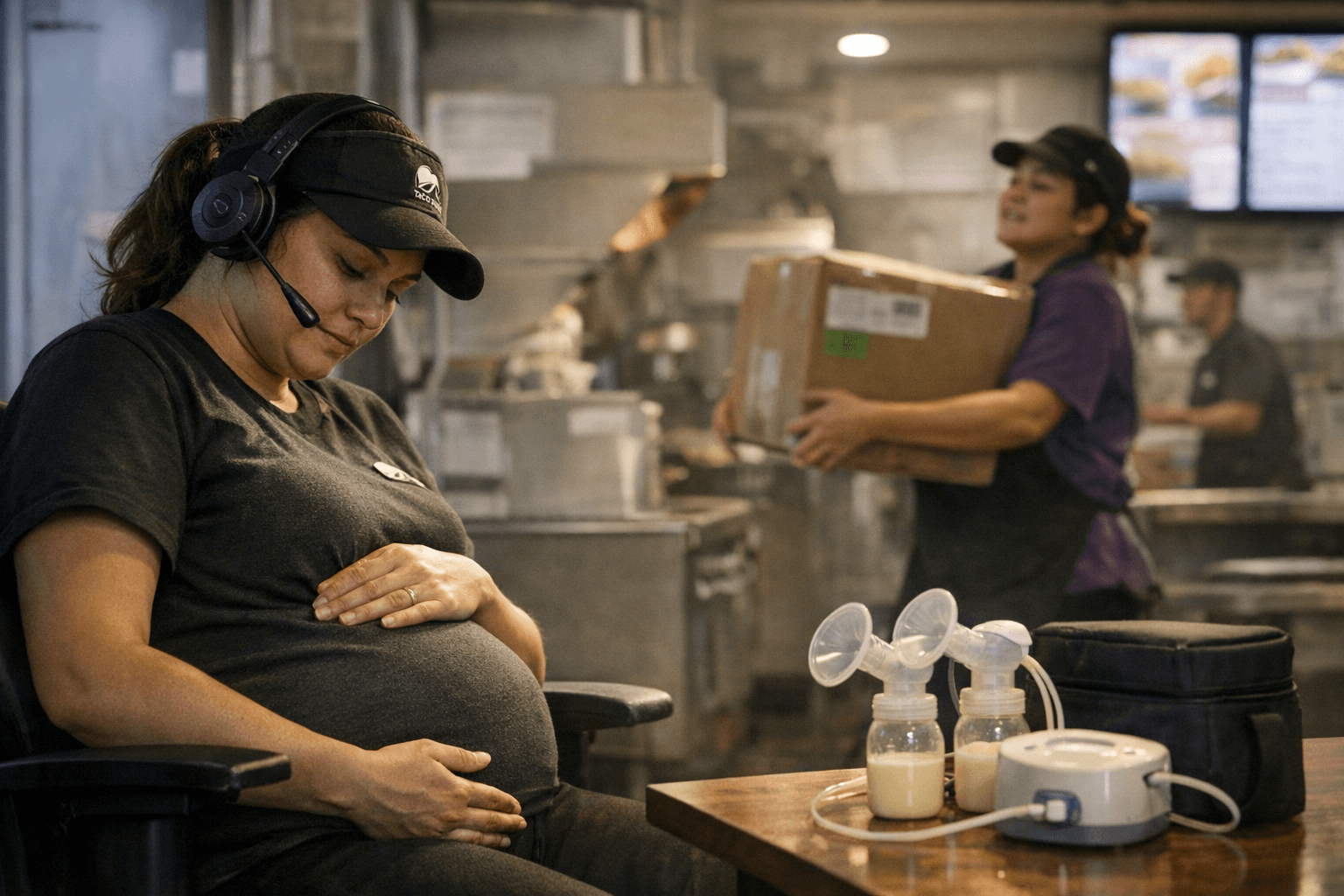
A missed break at Taco Bell can turn into a real safety problem fast: a pregnant crew member stuck hauling stock, a shift lead forced to stand through a long rush, or a new mother trying to pump without any privacy or plan can end up choosing between the job and their health. The EEOC says employers may need to provide reasonable accommodations for pregnancy, childbirth, or related medical conditions, and the point is to keep workers attached to their jobs safely when their bodies or medical needs change.
For Taco Bell workers, that can mean lighter tasks, more frequent breaks, changes to standing or lifting demands, or schedule adjustments when medically appropriate. In a restaurant built around speed, repetition, and constant movement, those changes are not luxuries. They are the difference between staying on the schedule and being pushed out of it during one of the most vulnerable stretches of a worker’s life.
What accommodation can look like on a Taco Bell shift
A Taco Bell store is full of work that can become harder during pregnancy: long periods on the line, running food to the front counter, taking drive-thru orders, restocking cups and ingredients, and handling truck product or heavy bags. A practical accommodation might move a worker away from the most physically demanding stations for part of a shift, reduce repetitive bending or reaching, or keep them off heavy stock runs and other lifting-heavy tasks when that is medically appropriate.
The same logic applies to standing time. If a worker can do the job from a stool at the register or a less crowded station, the law may support that kind of adjustment instead of forcing a pregnant employee to stay on their feet simply because the schedule is tight. More frequent breaks also matter in a place where the rush can swallow an entire shift, because a protected worker should not have to wait until the floor slows down to sit, hydrate, or take care of a medical need.
Schedule changes can be just as important as task changes. For some workers, the problem is not only what they do on the clock, but when they are asked to do it. A later start, an earlier cutoff, or a more predictable set of shifts can make it possible to keep working through pregnancy without turning every day into a fight with nausea, appointments, or fatigue.
Lactation is a shift issue, not a side issue
Lactation needs do not disappear when a worker returns to the store. The research notes are clear that workers may need breaks, privacy, and a predictable plan after giving birth or returning from leave, and the practical point is simple: if a restaurant does not build that into the day, the worker pays for it with stress, missed time, or an impossible choice between pumping and staying on the floor.
At Taco Bell, that means the store should know in advance where the break will happen, who is covering the station, and how the worker will get there without scrambling during a rush. A store that handles this well does more than help one employee. It shows the whole crew that the restaurant can adapt to real life without punishing people for having bodies that need care.
How workers should make the request
The most effective move is usually the simplest one: speak up early, keep the request clear, and document the conversation. A worker does not need to build a legal case on the spot; they need to let the store know what kind of help would make the shift safe and workable, then keep a record of when the request was made and who received it.
1. Say what the issue is in plain language, such as needing more sitting time, less lifting, or a steadier schedule.
2. Ask who at the store or district level handles accommodations so the request does not disappear into the middle of a rush.
3. Save a note, text, email, or calendar entry that shows the request was made and when it was discussed.
That approach matters in fast food because there is not much room for confusion once the lunch rush starts. A clear request gives the store a chance to respond before the worker is already hurt, exhausted, or forced to miss time. It also creates a paper trail if the answer is no, which is often where workplace rights disputes begin.
What managers and shift leads should do
Managers should treat an accommodation request as an operational issue, not a nuisance. The EEOC guidance says the right response is to take the request seriously, involve the appropriate internal contact, and avoid assumptions about what a worker can or cannot do. In a Taco Bell kitchen, that may mean reassigning tasks, building in more breaks, or swapping one station for another instead of demanding that a pregnant worker simply “push through.”
The stakes are not abstract. In a high-turnover business, an experienced crew member is hard to replace, and a well-handled accommodation can keep that person working through a life stage when they might otherwise walk away. The store that handles this well earns trust across the team, because everyone sees that management can make room for real life without losing control of the shift.
That is the practical lesson for Taco Bell, whether the location is corporate-run or franchised: the worker experiences the policy on the floor, in the schedule, and at the prep table. If the store can adjust a station, a break pattern, or a set of tasks to keep one worker safe, it often prevents a bigger problem later, including missed shifts, turnover, and the resentment that builds when people feel the restaurant only values them when they are fully available.
Why this matters beyond one employee
Pregnancy and lactation accommodations sit alongside the broader pay and fairness debates in fast food. Workers are already watching hours, wages, and whether the job is stable enough to count on; when a medical need arrives, a good manager does not turn that into unpaid stress or a reason to lose the schedule. The legal standard is supposed to help workers stay employed safely, and in a Taco Bell setting that can be as simple as changing who lifts, who stands, and who covers the next break.
In practice, the best-run store is the one that makes room for pregnancy and pumping before a problem becomes a resignation. That is what compliance looks like on the next shift: a stool where standing used to be mandatory, a break plan that actually exists, and a manager who understands that keeping a worker safe is part of keeping the restaurant running.
This article was produced by Prism’s automated news system from verified source data, official records, and press releases, then run through automated quality and moderation checks before publishing. The system is built and supervised by the people who set the standards it runs under. Read our full AI policy.
Did this article answer your question?