Taco Bell franchise handbook reveals crew rules and management expectations
K-Mac's Taco Bell handbook shows how crew rules, manager discipline, and franchise systems shape the job far beyond the first shift.
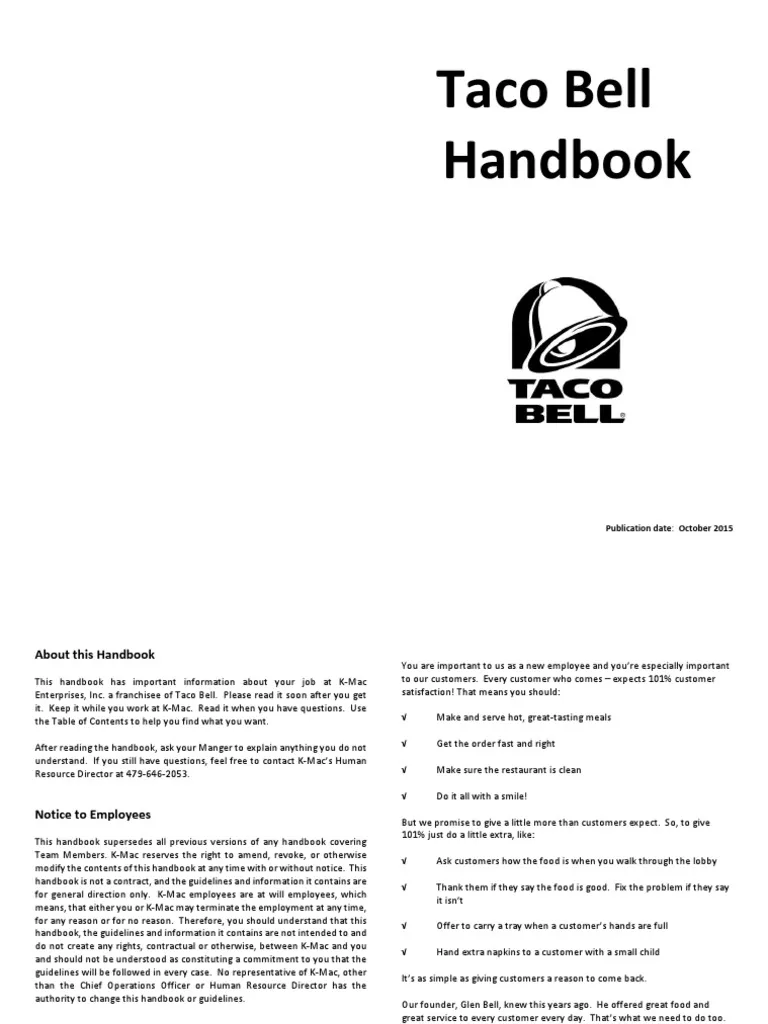
The October 2015 K-Mac Enterprises Taco Bell handbook tells employees to read it soon after receiving it, keep it while they work at K-Mac, and contact the Human Resource Director at 479-646-2053 if a manager cannot answer a question. It is a working map of how a large franchisee expects crew members, shift leads, and restaurant managers to behave, get trained, and stay accountable in a store where the real job is often defined by schedules, documentation, and enforcement.
What the handbook says about the real job
The handbook spells out the pieces of restaurant life that usually get normalized as “just how it works.” Crew members are dealing with attendance rules, conduct standards, uniforms, breaks, and where to take workplace questions. Shift leads are typically the people who have to make those rules stick on a busy shift, and restaurant managers inherit the harder version: documenting problems, keeping standards consistent, and making sure training is actually happening.
Management in a fast-food store is less about abstract leadership than about repeatable control. A shift lead who ignores a uniform rule, a break issue, or a late arrival creates inconsistency fast. A manager who does not document discipline or explain expectations leaves the next supervisor to clean up the mess.
Crew rules are really control rules
The parts of the handbook that feel most routine are often the ones that shape the workday most. Uniforms, breaks, attendance, and conduct standards are not small details in a restaurant with constant turnover and overlapping stations. They define how a crew member gets through the shift, how quickly a supervisor can correct a problem, and whether the store feels predictable or chaotic.
New workers often hear the rules in pieces during their first week, then forget where the official version lives. A handbook gives them a place to check what counts as a real violation, what the standards are for appearance and behavior, and what to do when a manager’s verbal instruction conflicts with what they were told before.
What shift managers and restaurant managers are actually being judged on
For shift managers, the handbook points to a familiar reality in quick-service restaurants: the job is less about personal style than about enforcement. If a worker is late, out of uniform, or unclear on procedure, the shift manager is the first line of correction. If an issue repeats, the restaurant manager is the one expected to document it and keep the operation aligned with company rules.
The handbook is a performance tool, not just a reference sheet. It shows that advancement from crew to shift lead to manager usually comes with more paperwork, more discipline decisions, and more responsibility for training consistency.
K-Mac’s scale explains why the handbook is more than local paperwork
K-Mac Enterprises operates 350+ Taco Bell restaurants across 10 states: Arkansas, Illinois, Indiana, Kansas, Kentucky, Mississippi, Missouri, Oklahoma, Tennessee, and Texas. The company was founded in 1964 by Ken McGruder, and Olympus Partners describes K-Mac as a leading Yum! franchisee. Mubadala Capital called it the second-largest Taco Bell franchisee in the United States. By 2025, K-Mac was the nation’s largest Taco Bell franchisee and planned to invest $350 million through 2029.
When one franchisee controls hundreds of stores, a policy on attendance, discipline, or training can shape the day-to-day experience of thousands of workers across multiple states.
Franchise language matters because ownership is split from the brand
Franchised Taco Bell locations are owned by the franchisee, not the brand itself, and franchisees are independent business owners. That distinction is easy to miss when the store looks and feels like Taco Bell, but it affects where your questions go and who sets your work rules. The brand may define the look and some operational systems, but the franchisee hires, disciplines, schedules, and manages the store.
Workers need to know whether a policy is coming from the franchisee or from a brand-linked tool. K-Mac authorizes MyTacoBell/Learning Zone, GIAM, the Taco Bell Deployment Tool, and HME Cloud for drive-thru timer reports. In practice, that means daily operations are run through a mix of franchise and brand systems, with managers expected to keep the store moving inside those platforms.
The newer handbooks show the rules keep changing
K-Mac later issued handbook versions in April 2021 and November 2022, and both say they supersede previous versions. When the handbook gets updated, the store’s expectations can shift, and the most current version matters when there is a dispute about scheduling, job duties, or discipline.
For workers, that also means old advice from a trainer or shift lead may not be enough. The company can revise expectations, and the written handbook is the place to check what is current. For managers, the updates are a warning sign that stale practices can put the store out of step with official policy.
The fine print tells you how disputes are handled
Other Taco Bell franchise handbooks make the same underlying point even more plainly. An MTB Management handbook page highlights uniforms, work-related injuries, probationary periods, job abandonment, and employees who are 14 or 15 years old. A B & G Food Enterprises handbook includes an at-will employment section and says the handbook is not a contract.
Franchise handbooks are built to manage risk as much as to train workers. They set out the ground rules for injury reporting, probation, youth labor, and whether the company considers the handbook binding.
This article was produced by Prism’s automated news system from verified source data, official records, and press releases, then run through automated quality and moderation checks before publishing. The system is built and supervised by the people who set the standards it runs under. Read our full AI policy.
Did this article answer your question?