Taco Bell hiring FAQ clarifies franchise and corporate job paths
Taco Bell’s hiring FAQ helps applicants avoid the biggest mistake in fast-food job hunting: applying to the wrong employer. It draws a hard line between franchise stores and corporate roles, which can change hiring, benefits, and career paths.
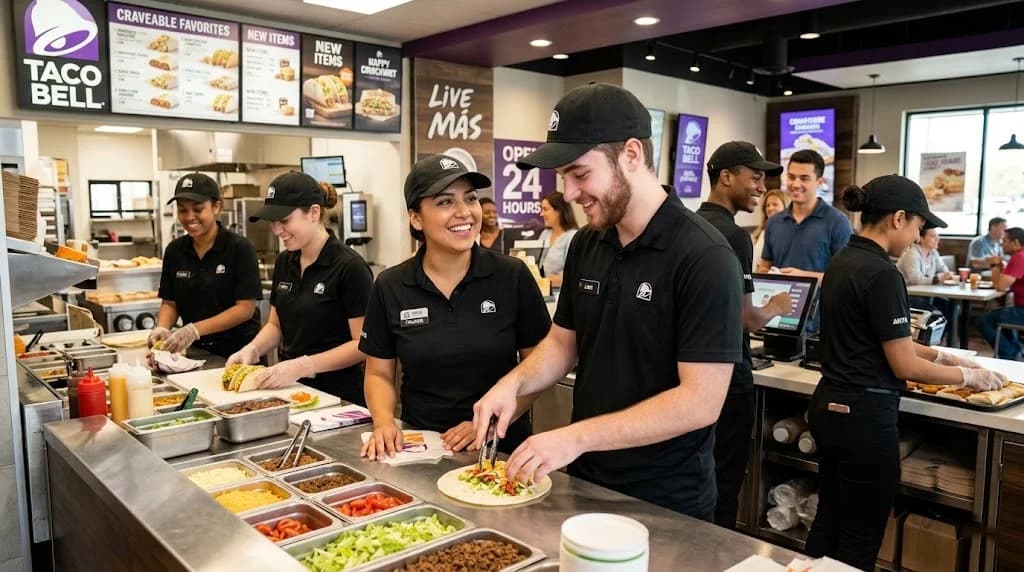
Taco Bell’s local work FAQ tells applicants that franchisees and licensees are independent business owners. A Taco Bell restaurant job, a corporate role, and a franchisee job are not interchangeable, even when the logo on the building looks the same. The hiring FAQ tells applicants exactly where they belong before they apply. For crew members, shift managers, and anyone chasing a first or next step in fast food, that distinction can save time, reduce confusion, and keep an application from landing with the wrong employer.
Start with Taco Bell Careers, not guesswork
The company’s FAQ points people to Taco Bell Careers, where applicants can explore restaurant opportunities at both corporate and franchise locations through the official hiring channels. The site also has a separate HQ Life & Perks section for corporate workers. That structure is a practical filter: it helps applicants decide whether they are looking for a store-floor role, a headquarters job, or something outside the United States.
For workers used to walking into a restaurant and asking for a manager, that online split matters. Taco Bell’s hiring setup signals that the brand wants applicants to start in the right lane instead of treating every open position as the same kind of job. If you want hourly store work, the restaurant path is the one to check first; if you are looking for office work, the corporate hub is where Taco Bell directs you.
Franchise jobs are not the same as Taco Bell Corp. jobs
If you apply for a position with a franchisee or licensee, you are not applying to work at Taco Bell Corp. or any of its affiliates. That is the key legal and operational split inside the brand, and it affects who hires you, who interviews you, and which policies apply after you are hired.
For workers, that difference can show up in the details that matter most day to day. A franchise location may set its own pay structure, training rhythm, and hiring process, even if the menu and uniforms look familiar. That is why the same Taco Bell sign on two different stores can still mean two different employers, two different paychecks, and two different chains of command.
Corporate jobs open a different career lane
Taco Bell’s corporate office FAQ tells applicants to “bring your talents to the corporate side of The Bell.” It then sends applicants to Taco Bell’s corporate online jobs hub. The company sees store work and corporate work as part of one brand ecosystem, but not one job path.
The careers site carves out a separate Corporate Jobs section and a dedicated HQ Life & Perks area. For employees who start in restaurants, that matters because the brand is not only recruiting for shifts on the floor, but also for office-based roles in operations, marketing, HR, and related support work. If you are thinking past part-time hours or looking to move out of the store later, the site is telling you that the move has to happen through a different hiring channel.
Why this reduces wasted applications
A lot of applicants know the brand name on the building, but not whether the store is operated by Taco Bell Corp. or by an independent franchisee. By pushing people to the official careers site and spelling out the franchise split, Taco Bell gives applicants a way to check the right opening before they submit personal information or chase an interview that is not the right fit.
In a high-volume hiring environment, store leaders do not need more confusion in the pipeline, especially when restaurants are trying to fill crew and shift roles quickly. The FAQ creates a cleaner front door for applicants and makes it easier for a candidate to land in the correct hiring process the first time.
The scale behind the hiring system
Taco Bell has more than 9,000 restaurants in 35+ countries and territories, and its 2025 year-end earnings report put total system sales at $18,361,000,000. Yum! Brands, the parent company, works through about 1,500 franchisees operating more than 61,000 restaurants in over 155 countries and territories.
A brand that large has to separate restaurant openings from corporate openings and franchise opportunities from company-owned roles.
What franchise growth looks like on the ground
Flynn Group entered the Taco Bell system in 2013 and now operates more than 280 restaurants in 9 states. That kind of footprint shows how much of the Taco Bell job market can sit outside the direct corporate payroll, even when the brand identity is uniform from store to store.
For workers, that means two people in different Taco Bell restaurants can have very different employment experiences. One may be hired through a corporate channel with access to HQ Life & Perks and office-style internal mobility; another may go through a franchise operator’s own recruiting portal with policies set by an independent owner.
How to use the FAQ before you apply
A few quick checks can keep your application pointed in the right direction:
- Start on Taco Bell Careers and look at the category that matches the job you want.
- Decide whether you want Restaurant Jobs, Corporate Jobs, or International Jobs.
- If the role is at a local restaurant, confirm whether the location is corporate or franchise run.
- If the opening is with a franchisee or licensee, understand that the employer is the independent business owner, not Taco Bell Corp.
- If you are aiming for headquarters work, use the corporate online jobs hub and the HQ Life & Perks section as your guide.
This article was produced by Prism’s automated news system from verified source data, official records, and press releases, then run through automated quality and moderation checks before publishing. The system is built and supervised by the people who set the standards it runs under. Read our full AI policy.
Did this article answer your question?