Taco Bell operators must track local wage changes, not just federal rates
One local wage change can now ripple into schedules, payroll, and wage-claim exposure for Taco Bell operators. ADP’s April 20 wage chart shows why managers need city-by-city compliance, not a federal default.

The new compliance problem at store level
A wage table that looks routine on paper can turn into an immediate operations risk inside a Taco Bell system. When state, city, and tipped-worker rules change on different calendars, the manager building next week’s schedule is also making a legal call about payroll accuracy, labor cost, and back-pay exposure.
That is the real lesson in ADP’s April 20, 2026 minimum wage list. The chart tracks current non-tipped and tipped rates across states, the District of Columbia, territories, and local jurisdictions, and it also shows the next scheduled increase when one has already been enacted. For operators, that makes the chart less like administrative reference material and more like a live planning tool.
Why a single national wage assumption no longer works
The federal minimum wage has sat at $7.25 an hour since 2009, but that number tells Taco Bell managers very little about what they actually owe in a specific restaurant. ADP says employers must use the highest applicable wage when federal, state, and local rates differ. In practice, that means a store a few miles away can face a different legal floor if it sits under a different city rule or a separate local ordinance.
That matters in a franchise-heavy system like Taco Bell’s, where Yum! Brands operates through local franchise operators rather than one universal payroll structure. The brand may be the same, but compliance is often handled by the owner-operator on the ground. If a wage change hits one market and a manager misses it, the result can show up fast in underpayment, payroll corrections, or a wage claim from a crew member who notices the posted rate does not match the legal minimum.
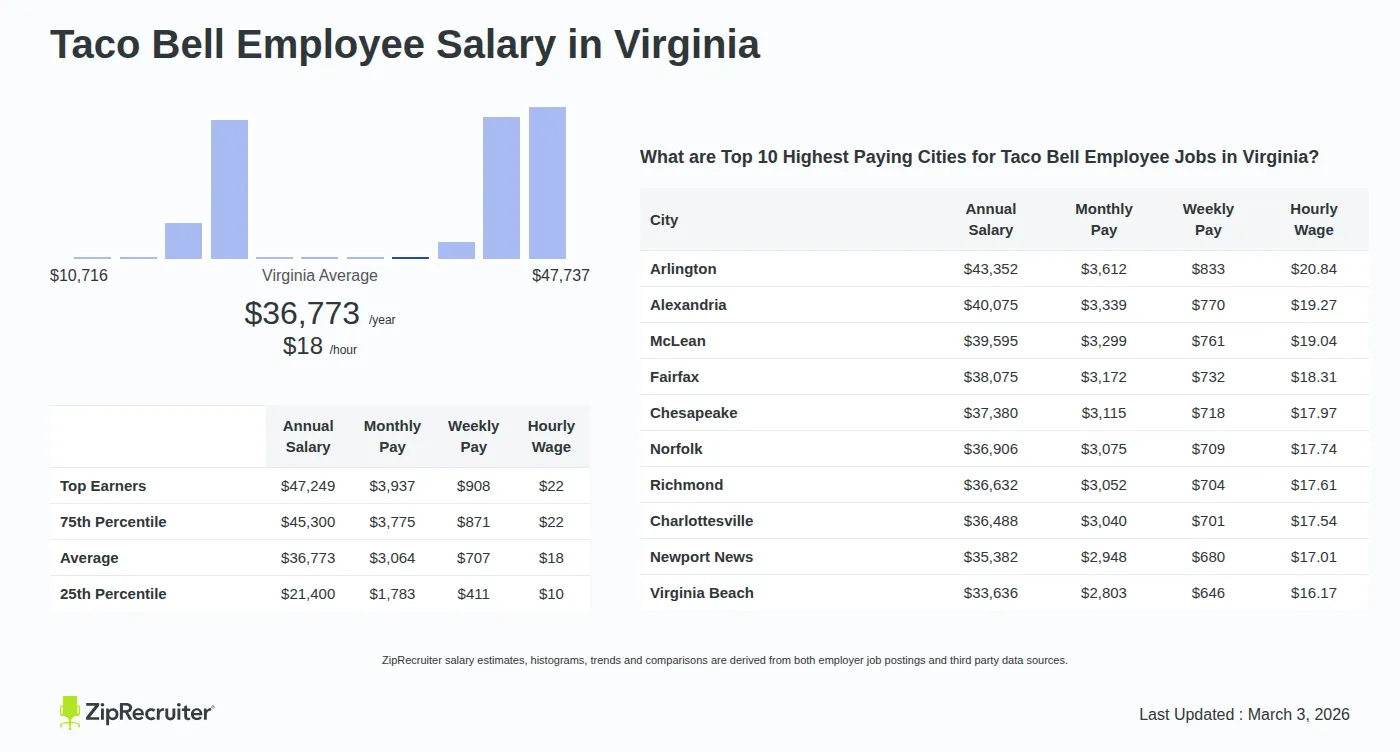
For crew members, the practical value is simple: a current wage table makes it easier to check whether the posted wage is actually legal where they work. For managers, it is a budgeting tool that can help forecast labor cost, compare locations, and update pay before the change lands on a paycheck. In a business with thin margins and high turnover, that kind of monitoring is no longer optional.
California shows how quickly the floor can move
California is the clearest recent example of why these changes cannot be treated as an annual housekeeping task. On April 1, 2024, fast-food workers at covered chains began earning a $20 minimum wage under AB 1228. The state said the average hourly wage for fast-food workers in 2022 had been $16.21 before the new law took effect.
That $20 fast-food floor also sat above California’s statewide minimum wage, which was $16.90 in 2026. So even within one state, quick-service operators had to track more than one number at once: the general state floor, the fast-food-specific floor, and any local wage rule layered on top. California’s Fast Food Council was created under AB 1228 to set future fast-food wage and workplace standards, which is another reminder that the rulebook can keep moving after the initial increase.
The policy debate around California’s law remains split. A Northeastern University analysis reported an average 8% decrease in on-site staffing at California fast-food restaurants after the wage hike. At the same time, a University of California, Berkeley-related analysis has argued the pay increase raised wages with limited downside. A University of California, Santa Cruz summary said the $20 fast-food wage exceeded the statewide minimum and noted that business groups warn such moves can push prices higher and reduce staffing, while labor unions say the higher floor helps workers keep up with cost-of-living pressure.
The labor-cost pressure behind the wage fight
The California example sits inside a larger labor-cost squeeze that restaurant operators already know well. The National Restaurant Association says salaries and wages, including benefits, represented a median 31.7% of sales among limited-service operators in 2024. Among full-service respondents, that figure was 36.5% of sales. The association said labor costs were running well above historical averages and were having a significant impact on profitability.
For Taco Bell managers, that means wage changes are not just a compliance issue, they are a margin issue. A higher local minimum can change how many people you put on the floor for a breakfast rush, whether you cross-train enough crew to cover callouts, and how aggressively you can schedule shifts without overshooting the labor budget. If the wage floor rises in one market but not another, the same staffing model can suddenly become unaffordable in one store and manageable in the next.
That is why operators need to treat wage tracking like any other core operating metric. It affects staffing, overtime risk, menu execution, and the manager’s ability to keep service times on target without drifting into payroll mistakes.
What managers need to watch now
The safest approach is to assume that wage compliance is local first, not national first. A Taco Bell operator covering multiple cities should review the highest applicable rate for each store, confirm whether the employee is tipped or non-tipped, and look for the next scheduled increase rather than waiting for a calendar-year reset. That is especially important in markets where a city ordinance or special industry rule can override a broader state baseline.
In a franchise system, that review has to happen close to the store. Local operators are the ones most likely to absorb the immediate risk if a rate changes and the payroll system does not catch it in time. The consequences are not abstract. Miss one local change and a manager can end up with a payroll correction, a complaint about an inaccurate wage posting, or a claim that the store underpaid a worker for hours already worked.
California’s fast-food rules also show how quickly worker expectations can shift once a higher floor is in place. In mid-2024, the California Fast Food Workers Union asked the Fast Food Council for a $20.70 wage starting in 2025 and a $21.40 wage in 2026. That kind of proposal matters even to operators outside California, because it shows how fast wage benchmarks can climb once a sector-specific board and organized labor start setting the pace.
The bottom line for Taco Bell operations
For Taco Bell, the old habit of checking the federal minimum wage once a year is no longer enough. ADP’s April 20, 2026 chart captures the new reality: wage rules now move across states, cities, and tipped categories on separate timelines, and the highest applicable rate controls what a store must pay.
That makes wage tracking part of competent restaurant operations, not just HR paperwork. The managers who stay ahead of local changes will be better positioned to protect payroll accuracy, control labor costs, and avoid the kind of compliance slip that turns a routine scheduling week into a costly wage dispute.
This article was produced by Prism’s automated news system from verified source data, official records, and press releases, then run through automated quality and moderation checks before publishing. The system is built and supervised by the people who set the standards it runs under. Read our full AI policy.
Did this article answer your question?