Taco Bell pay and benefits vary by role and ownership
The real Taco Bell offer is not the headline wage, but the store's rules on pay, PTO, tuition and ownership, which can change by role and location.
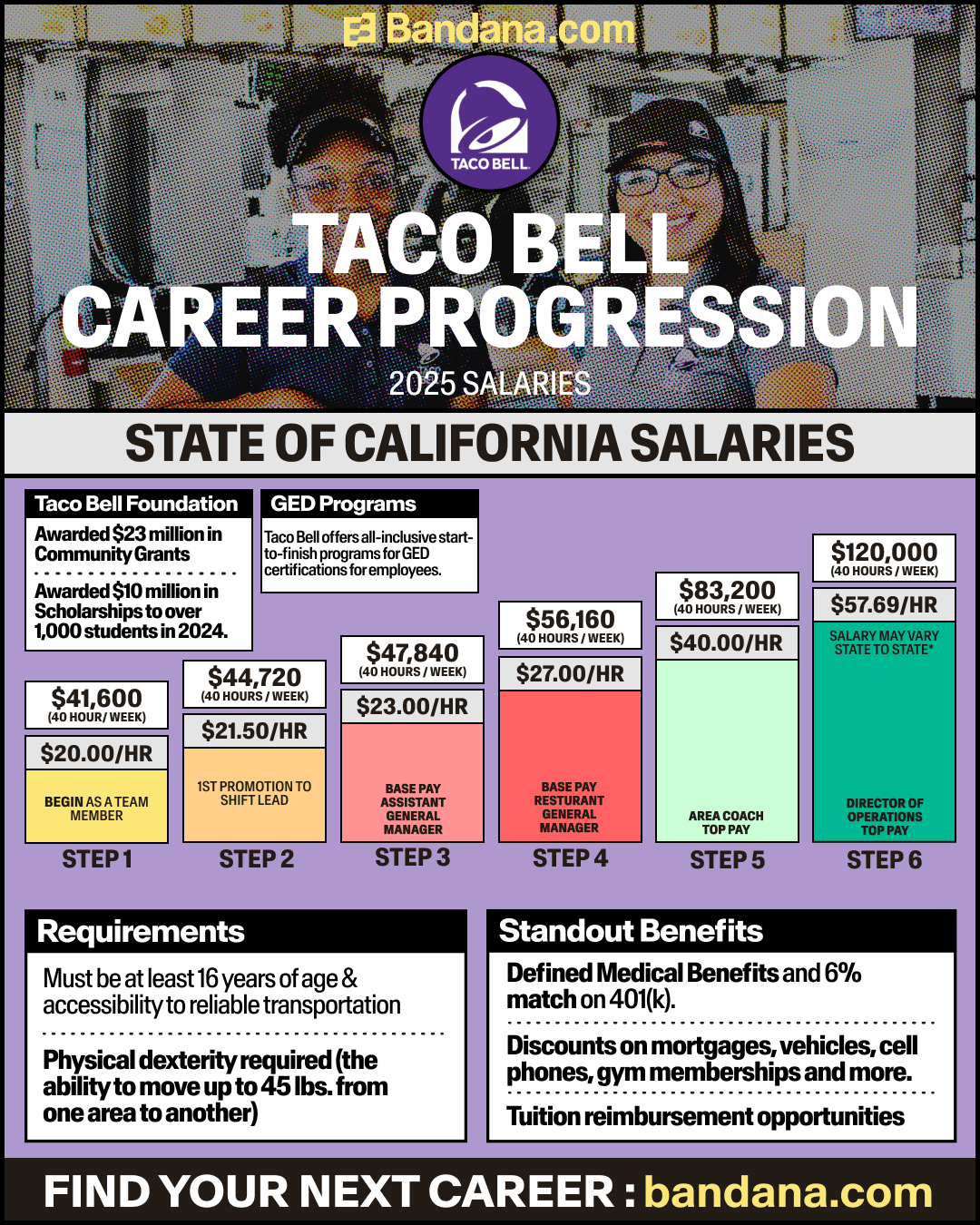
Built In’s Taco Bell compensation page collects the questions candidates usually ask about pay and benefits, but it is not an official Taco Bell policy document and it was not reviewed or approved by Taco Bell. At Taco Bell, the offer on the table can change with the job, the store and the owner. One city can hold a corporate-run restaurant and a franchise-run one, each with its own rules on schedules, time off and advancement.
What the Built In page tells you, and what it does not
Compensation has several layers: base pay, schedules, bonuses or incentives, time off, meal policies, training support and the chance to move into roles with more responsibility. For crew members, shift managers and restaurant managers, those layers often matter more than the starting hourly rate because restaurant jobs can vary by ownership group and market.
That is why the right interview questions go well beyond “What do you pay?” A candidate should ask how raises are handled, whether overnight or late-night shifts pay more, how promotions affect pay, whether leaders can qualify for bonuses and what benefits begin after a certain tenure.
Start with pay, then ask how it changes
A Taco Bell job can look straightforward from the outside, but the pay structure often has more moving parts than a job board summary suggests. Two restaurants with the same brand can still pay and schedule differently if one is corporate-operated and one is franchise-run. That is why a candidate should ask who sets the pay scale, whether raises are tied to performance reviews or tenure, and whether the location uses different rates for different shifts.
A useful interview script is direct and specific:
- What is the starting hourly rate for this role?
- How are raises decided, and how often are they reviewed?
- Is there extra pay for late-night, overnight or weekend shifts?
- Do shift leaders or managers qualify for bonuses?
- What documentation shows how pay changes after promotion?
If the answer is vague, the written offer should do the heavy lifting.
Scheduling and time off can matter as much as hourly pay
Taco Bell’s own help and FAQ language lists flexible schedules, growth opportunities and a supportive team among benefits at a corporate Taco Bell. Those benefits apply to some corporate Taco Bell jobs, not every store, so candidates need to know whether the location is corporate-operated or franchise-run before accepting an offer.
Time off is another area where the details matter. An Indeed FAQ result lists that after a year, Shift Leads earn 2 weeks of paid time off and base-level Food Makers and Order Takers earn 1 week.
Before you say yes, ask:
- When does paid time off start?
- Does PTO accrue by hours worked or by tenure?
- Is there separate sick time, vacation time or holiday pay?
- Are schedules posted a week ahead, or do they change with short notice?
- Does the location offer any schedule flexibility for school, childcare or a second job?
Tuition and advancement are part of the compensation picture
Taco Bell has also used education benefits as part of its retention strategy. In 2019, the Taco Bell Foundation said its fifth annual Live Más Scholarships round would award more than $6 million, bringing the foundation to a total of $17 million in awarded scholarships and moving toward a commitment of $21 million by 2021.
More recently, Taco Bell said education benefits have driven retention, and linked the education program to a 17% drop in turnover in 2025.
Candidates should ask exactly how tuition help works at their location:
- Is there tuition assistance, scholarship access or reimbursement?
- Does the benefit apply to crew members, shift leads and managers, or only certain roles?
- Is there a waiting period before the benefit starts?
- Does the location use the Taco Bell Foundation scholarship route, a corporate education benefit or both?
- What proof of enrollment or grades is required?
If a manager says education support is available, ask for the written policy. The difference between “available” and “accessible” can be several months of waiting, a minimum-hours rule or a role restriction.
Corporate, franchise and location-specific rules are the key dividing line
Taco Bell’s careers site separates restaurant jobs from HQ and corporate jobs, which signals that the experience is not the same across the company. HQ Life & Perks is a corporate-work page, while store crews live under restaurant-level policies that may be set by a franchisee.
Before you accept an offer, verify the location’s ownership and the policy that applies to it. Ask whether you are being hired by Taco Bell corporate or by a franchise operator, and ask which handbook governs pay, PTO, training and benefits. If the recruiter points to a general career page or a broad FAQ, press for the version that matches your specific restaurant.
For healthcare, the same rule applies. Ask what medical, dental and vision options exist, when eligibility begins and whether the plan is different for hourly crew, shift leaders and managers.
This article was produced by Prism’s automated news system from verified source data, official records, and press releases, then run through automated quality and moderation checks before publishing. The system is built and supervised by the people who set the standards it runs under. Read our full AI policy.
Did this article answer your question?