Taco Bell workers face AI tools that act like digital supervisors
Taco Bell’s AI is moving from drive-thru gimmick to shift control, affecting scheduling, coaching, and execution on every rush.
The next supervisor at Taco Bell may not be standing on the line. It may be software that knows the recipes, sees the schedule, tracks inventory, and nudges the team on what to do next.
That is the real shift in the brand’s AI rollout: this is no longer just about a voice ordering screen at the drive-thru. The technology is being built to act more like a digital supervisor, handling routine oversight that used to sit in a manager’s notebook, on a binder page, or in a quick shout across the kitchen. For crew members, that can mean faster answers on builds and procedures. For shift managers, it can mean tighter labor deployment, more real-time monitoring, and fewer moments spent chasing paper systems instead of running the floor.
What a digital supervisor can actually do
The AI tools now reaching Taco Bell are trained to sit on top of the restaurant’s operating system. According to Yum! Brands, Byte by Yum! spans online and mobile ordering, point of sale, kitchen and delivery optimization, menu management, inventory and labor management, and team member tools. That means the software is not just taking orders, it is increasingly shaping the pace of the shift.
In practical terms, a tool like this can answer employee questions, suggest what to do next, and monitor how well the restaurant is executing. It can help flag when labor is out of line with demand, when product counts look off, or when an order build is drifting away from standard. In a Taco Bell restaurant, where speed, consistency, and precise builds matter to guest satisfaction, those reminders can feel a lot like management direction coming from a screen instead of a person.
That is why the job-design question matters. If AI is deciding which task should happen next, the human supervisor’s role changes from constant prompting to judgment, exception handling, and coaching. The people who can interpret the software, correct it when it is wrong, and keep the team moving are the ones most likely to look indispensable.
How Taco Bell got here
The company has been moving toward this model for more than a year. On July 31, 2024, Yum! Brands said Voice AI was already live in more than 100 Taco Bell U.S. drive-thrus across 13 states, with a target of reaching hundreds of stores by the end of 2024. By February 2025, Yum had introduced Byte by Yum!, a broader AI-driven SaaS platform intended for Taco Bell, KFC, Pizza Hut, and Habit Burger & Grill.
That broader platform matters because it shows the company is not treating AI as a one-off experiment. It is building a management layer that can stretch across ordering, staffing, inventory, and team operations. Reporting in March 2025 said Taco Bell was already using AI to schedule labor in 5,000 U.S. restaurants, and Yum said it had invested $1 billion in digital and technology.
For workers, that scale changes the stakes. A tool that helps with one drive-thru lane is one thing. A tool that touches scheduling in 5,000 restaurants is another. It can shape who gets hours, how shifts are built, how fast managers respond to demand, and how quickly new hires learn the rhythm of the store.
What changes on a normal shift
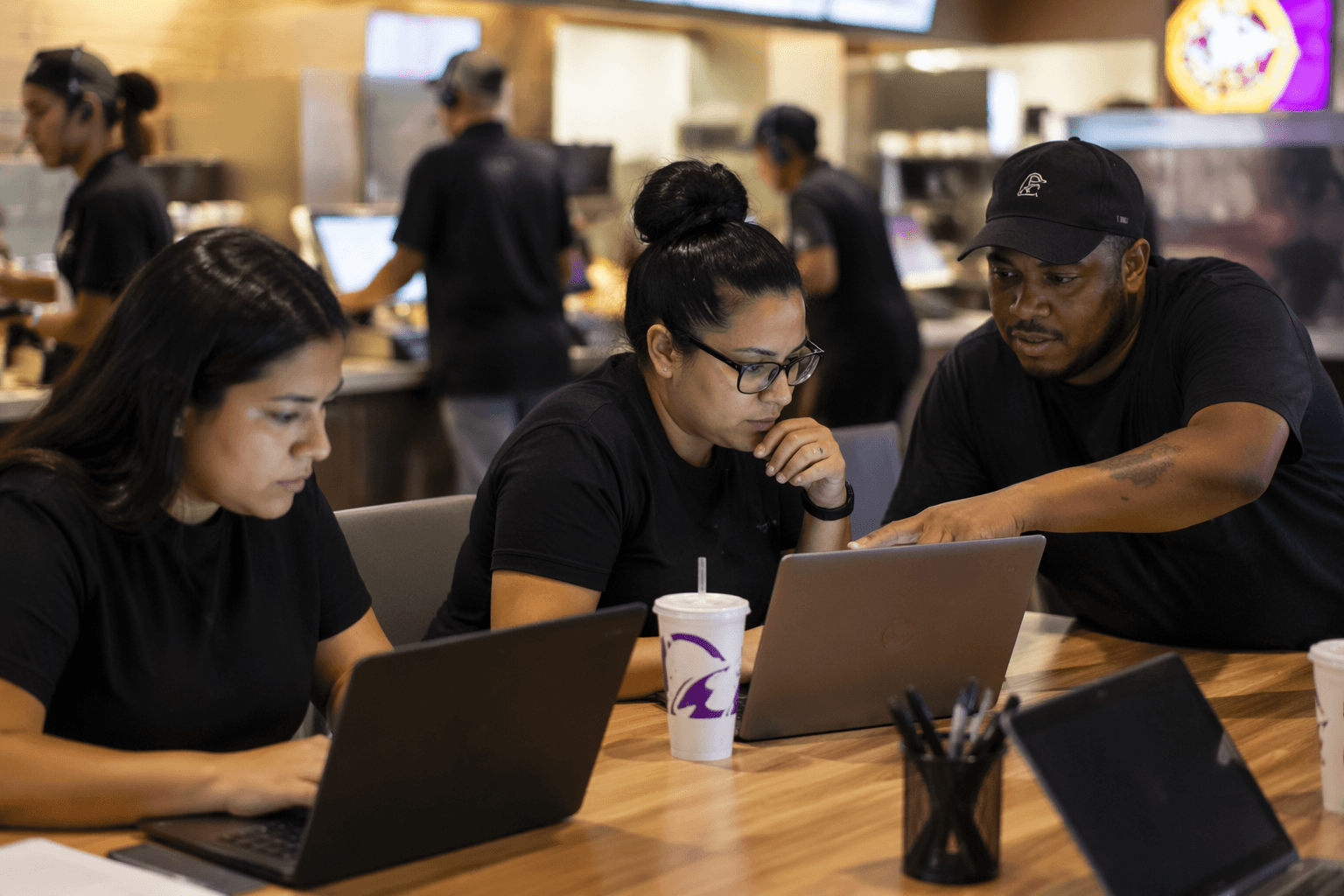
Picture a Friday dinner rush. The line is growing, the drive-thru is backed up, and a crew member is unsure about a build or a modifier. In the old setup, that worker might wait for a shift lead to finish a separate task and then ask for help. In the AI setup Taco Bell is moving toward, the answer may come from the system immediately, with a prompt tied to the recipe, the labor plan, or the current order mix.
That speed can help a store move faster, but it also changes where authority lives. A manager who used to be the main source of direction may now be one layer above the software, validating decisions, correcting mistakes, and handling the exceptions the system cannot solve. If the AI says to cut labor or redistribute the team, the manager still has to decide whether that makes sense in a real restaurant with real people, a short-staffed shift, or a burst of mobile orders.
Taco Bell has said the voice AI rollout was designed to enhance back-of-house operations for team members and improve the order experience for consumers. The company also said the goal was to ease workloads and improve order accuracy. Those are the upside claims that matter to a crew trying to get through a rush without rebuilding the same item twice or fixing the same wrong order again and again.
Why the backlash matters to workers
The rollout has not been clean. Public reporting has documented customer complaints and trolling around the AI drive-thru, including widely reported cases of the system mishearing or mishandling orders. That backlash helps explain why operators are now emphasizing human oversight alongside automation.
For restaurant workers, the lesson is straightforward: AI only helps if the guardrails are clear. If the system suggests the wrong labor move, misreads an order, or pushes a task at the wrong moment, the human manager still has to catch it. The more the company leans on software to guide the shift, the more important it becomes for workers to know when to trust the tool and when to override it.
That is also where training becomes more valuable. Workers who understand how the system works, what data it uses, and what it is not allowed to decide will be better prepared than workers who treat it like a black box. In a restaurant built around speed and consistency, the strongest employees may be the ones who can use AI without letting it run the floor.
Which human skills become more promotable
When routine oversight shifts to software, the human skills that stand out are the ones AI cannot easily replace. At Taco Bell, that means:
- Coaching a new hire through a messy rush without freezing the line.
- Solving a guest issue when the order looks correct in the system but wrong in the bag.
- Adjusting labor in real time when the store gets slammed unexpectedly.
- Spotting when a machine-generated prompt does not fit the actual room.
- Keeping morale steady when the shift is moving too fast for anyone to slow down.
Those are the skills that move a worker from following prompts to leading people. That matters at a brand where Taco Bell said its company-owned portfolio had 250,000-plus U.S. team members in 2025, team-member retention improved year over year by 17%, and general managers on average spend 10 years with the brand. A long-tenured management culture gives AI a very specific test: the software has to fit into a system already built on operational discipline, not replace the judgment that has kept those managers in place.
The bigger workplace change
The biggest change is not that Taco Bell is using more technology. It is that AI is becoming part of the operating model itself. Scheduling, inventory, menu management, drive-thru support, and team-member tools are all starting to sit inside the same digital framework.
For workers, that means the job is changing in two directions at once. Routine oversight is becoming more automated, while the value of human judgment is rising. The people who can run a shift, read the room, and turn a software prompt into a better restaurant will be the ones who move up fastest as Taco Bell’s digital supervisor becomes part of daily life.
This article was produced by Prism’s automated news system from verified source data, official records, and press releases, then run through automated quality and moderation checks before publishing. The system is built and supervised by the people who set the standards it runs under. Read our full AI policy.
Did this article answer your question?