Taco Bell's $1 Mexican Pizza App Drop Tests Crew Surge Readiness
Taco Bell's $1 Mexican Pizza app drop on March 31 hit 30,000 redemptions in a 5 p.m. surge window, exposing the prep gaps that separate a smooth drop from a service breakdown.

The failure cascade on a capped app drop like Taco Bell's March 31 Mexican Pizza promotion doesn't start at the grill. It starts in the parking lot, when a guest whose phone loaded the offer three seconds too late walks up to the counter expecting crew to honor a deal that no longer exists.
The mechanics were tight by design. Taco Bell opened the $1 Mexican Pizza to the first 30,000 Rewards members nationwide who claimed the offer in the mobile app, one redemption per user, at exactly 5 p.m. ET on March 31. Winners had to redeem through the app at their selected location the same day. The Taco Bell Brief, the brand's Substack newsletter, and deal-tracking outlets including DealSeek had flagged the promotion days in advance, ensuring that demand was aggregated and primed well before the Tuesday afternoon window opened. That advance signal is a double-edged condition for restaurant operations: it maximizes digital engagement and concentrates guest arrivals into the narrowest possible window.
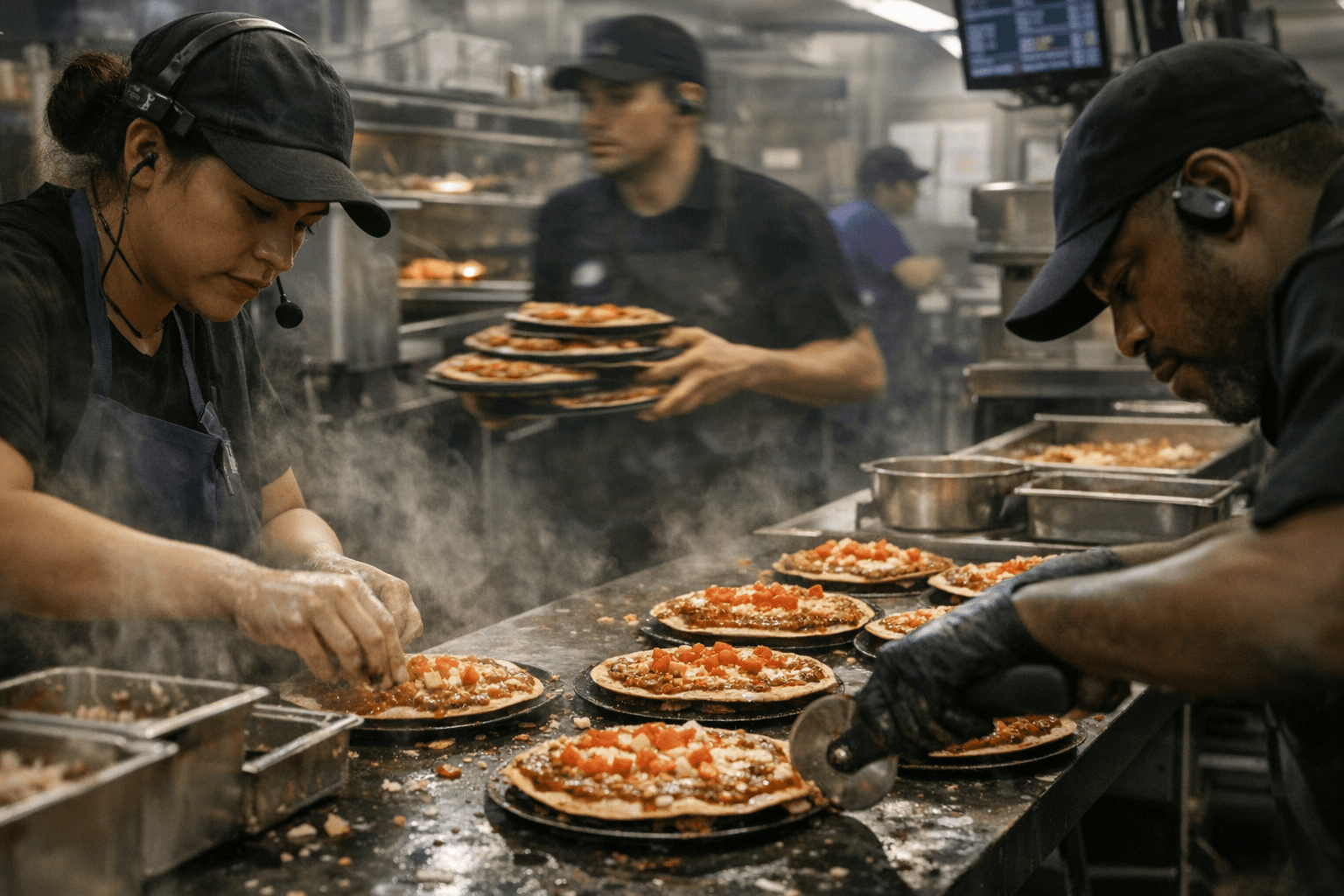
For crew working the 4-to-close shift, the exposure was predictable and specific. The 5 p.m. ET release aligned with the tail end of the late-afternoon lull and the lead edge of the dinner build, a transition window when full staffing isn't always guaranteed. The first 10 to 20 minutes of a 30,000-unit systemwide drop can generate simultaneous order volume that strains grill throughput, expo pacing, and drive-thru timing at once. The Mexican Pizza, a double-tortilla build with refried beans, seasoned beef or chicken, cheese, sauce, and a baked finish, is a revived fan-favorite that most teams know. But familiarity with a product and speed at volume under a spike are not the same skill.
Three operational risks compounded in that window. Line congestion at the 5 p.m. drop created conditions for wrong or late orders, which at $1 require a pre-authorized, fast comp policy to resolve without clogging the expo window. Guests who arrived after 30,000 redemptions had cleared the system faced an in-app dead end, a scenario that escalates quickly if crew aren't briefed on exactly what to say and aren't empowered to de-escalate without gifting a full-price item. And because the $1 price depends entirely on controlled food cost, any drift in portion standards during a high-pace surge, loose sauce portioning, non-standard scoops, extra tortillas, directly erodes the unit economics the promotion was built on.
Break coverage was the fourth variable. A surge window pinned to a single clock hour makes split-break scheduling around the 5 p.m. release non-negotiable. A station running short at assemble or expo during a 20-minute order spike is the difference between a smooth drop and a complaint spike.
The operational playbook for an event with this structure starts the day before. Confirm par levels on tortillas, seasoned beef, refried beans, and Mexican Pizza packaging. Run a two-minute build refresher with closing and opening crew. Assign stations on paper, not at the start of the rush. Day-of, mise-en-place should be completed before 4:45 p.m.: pre-portioned meat, sauce ready, tortillas warming, and packaging staged at assemble. Positioning a crew member or shift lead near the expo window specifically during the first 30 minutes to handle wrong, missing, or duplicate orders keeps line throughput intact without pulling an assembler off the station.
Tuesday Drop promotions have run weekly since the program launched, cycling through items like the $1 Chalupa Supreme and $1 Chicken Quesadilla before landing on the Mexican Pizza. Each one is a predictable surge event. The 30,000-unit ceiling is also the ceiling on exposure: once it clears, the sprint is over. The question is only how cleanly the team ran it.
This article was produced by Prism’s automated news system from verified source data, official records, and press releases, then run through automated quality and moderation checks before publishing. The system is built and supervised by the people who set the standards it runs under. Read our full AI policy.
Did this article answer your question?