Taco Bell’s scale shows a global career path beyond restaurant shifts
Taco Bell’s size creates real rungs from crew to shift lead, corporate, and international roles, but the path still runs through store-level control and franchise ownership.
Yum! Brands said Taco Bell posted 5% same-store sales growth in the fourth quarter of 2024. The chain calls itself the largest Mexican-inspired concept in the world, with more than 9,000 restaurants in more than 35 countries and territories and $18,361,000,000 in total system sales.
The ladder starts in the restaurant
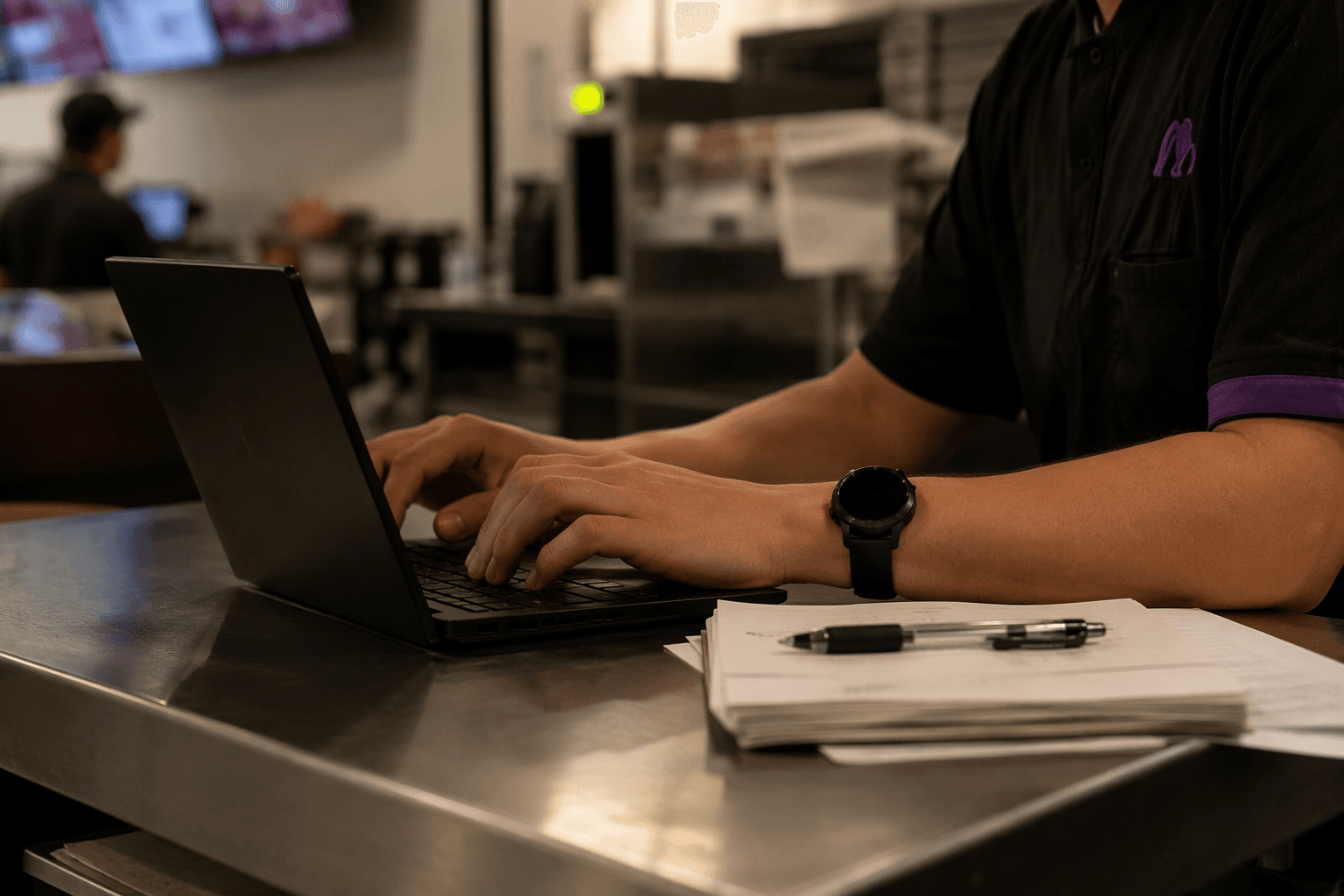
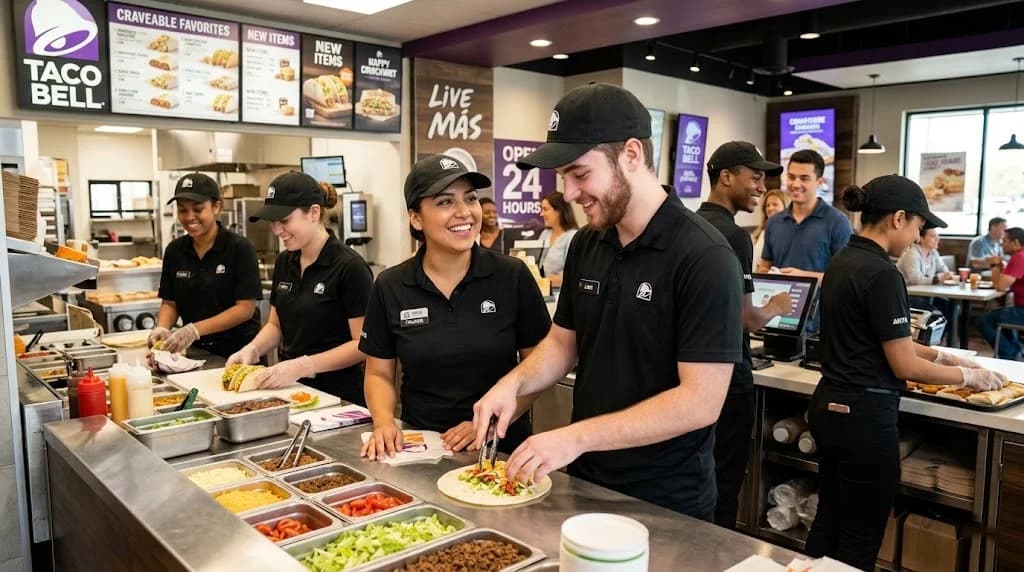
The company’s careers site splits openings into Restaurant Jobs, Restaurant Life & Perks, Corporate Jobs, HQ Life & Perks, and International Jobs. Taco Bell treats them as distinct job families rather than a single entry-level track. A Taco Bell store is built around repeatable training, standardized procedures, and layers of supervision that can move someone from crew work into a shift lead role and then into store management.
Current postings show that the shift lead rung is not abstract. Taco Bell is advertising Shift Lead and Shift Leader jobs in the Bronx, New York; Mexico, Missouri; New London, Connecticut; Los Angeles, California; Baltimore, Maryland; Cincinnati, Ohio; Saint Louis, Missouri; Dallas, Texas; Covington, Louisiana; Longmont, Colorado; and Southfield, Michigan.
Franchise ownership shapes who controls the next step
The bigger corporate picture explains why the ladder looks the way it does. Yum! Brands’ 2024 annual report calls it the world’s largest restaurant company, with approximately 1,500 franchisees operating more than 61,000 restaurants in over 155 countries and territories. That means a Taco Bell worker is often dealing with a franchisee’s local decisions on staffing, schedules, and promotions, even when the brand itself is part of a global machine.
A restaurant job can lead to more responsibility inside a store, but a move into corporate, headquarters, or international work usually requires a different application path and a different skill set. Taco Bell’s separate career sections make that divide plain: restaurant work is not the same as HQ work, and a store manager runs a location while a corporate employee shapes systems across many stores.
Geography is a real career asset, not just a logo on the wall
Taco Bell’s 2025 business strategy, R.I.N.G. The Bell, short for Relentlessly Innovative Next-Generation Growth, said it planned to grow its international footprint from about 1,150 locations to more than 3,000 outside the United States by 2030, enter nine new countries including France, Greece, and South Africa, and build toward more than 10,000 restaurants in the U.S. and 3,000 internationally. A chain that is adding markets needs people who can open stores, train new teams, and run multi-unit operations.
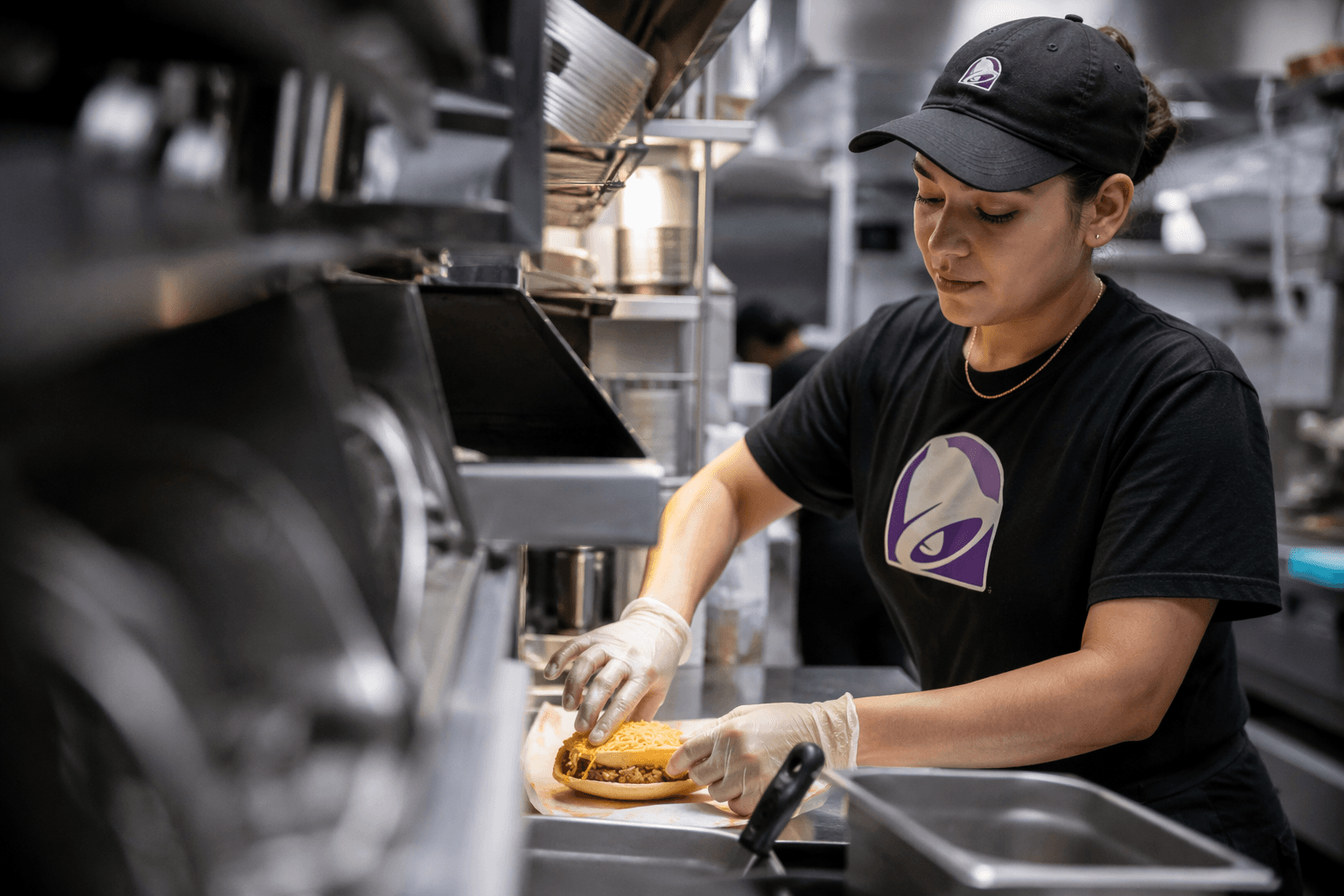
For managers, that kind of expansion creates the most concrete mobility outside a single restaurant. A good shift lead can become a store leader, and a store leader can become someone who trains others, opens new locations, or manages multiple units if the network keeps expanding in the places Taco Bell is targeting.
Sales growth helps, but it does not automatically create advancement
The brand’s recent sales results are strong enough to support more openings, but they do not solve the promotion problem by themselves. Later in 2025, Taco Bell’s U.S. and international same-store sales both rose 4% for the quarter. Those are healthy numbers for a chain that runs on high-volume service, but they are still top-line measures, not promises of new titles for every crew member.
More than 61,000 restaurants across Yum! Brands’ system and more than 9,000 Taco Bell locations give the brand depth, but advancement still depends on store openings, turnover, local franchise decisions, and whether a worker is ready to move into the next level of responsibility. Bottlenecks can still show up in pay, hours, and manager openings inside a given market.
The scholarship program is support, not the main ladder
Taco Bell Foundation’s Live Más Scholarship program shows another way the company tries to shape mobility. The foundation announced up to $10 million in scholarships in 2023, then a record $14 million in 2024, and later $14.5 million for the class of 2026. For workers looking at school or credentials, that can help with the cost of moving toward management or a different career track.
A scholarship can help pay for classes, yet the main workplace ladder still runs through the restaurant: crew to shift lead, shift lead to manager, manager to district or field work, and from there potentially into corporate or international roles.
This article was produced by Prism’s automated news system from verified source data, official records, and press releases, then run through automated quality and moderation checks before publishing. The system is built and supervised by the people who set the standards it runs under. Read our full AI policy.
Did this article answer your question?