AI reshapes Target stores, changing roles, formats and shopping decisions
Target’s next store shift is less about robots than speed: AI will push faster lookups, smarter fulfillment and tighter guest service while raising expectations on the floor.
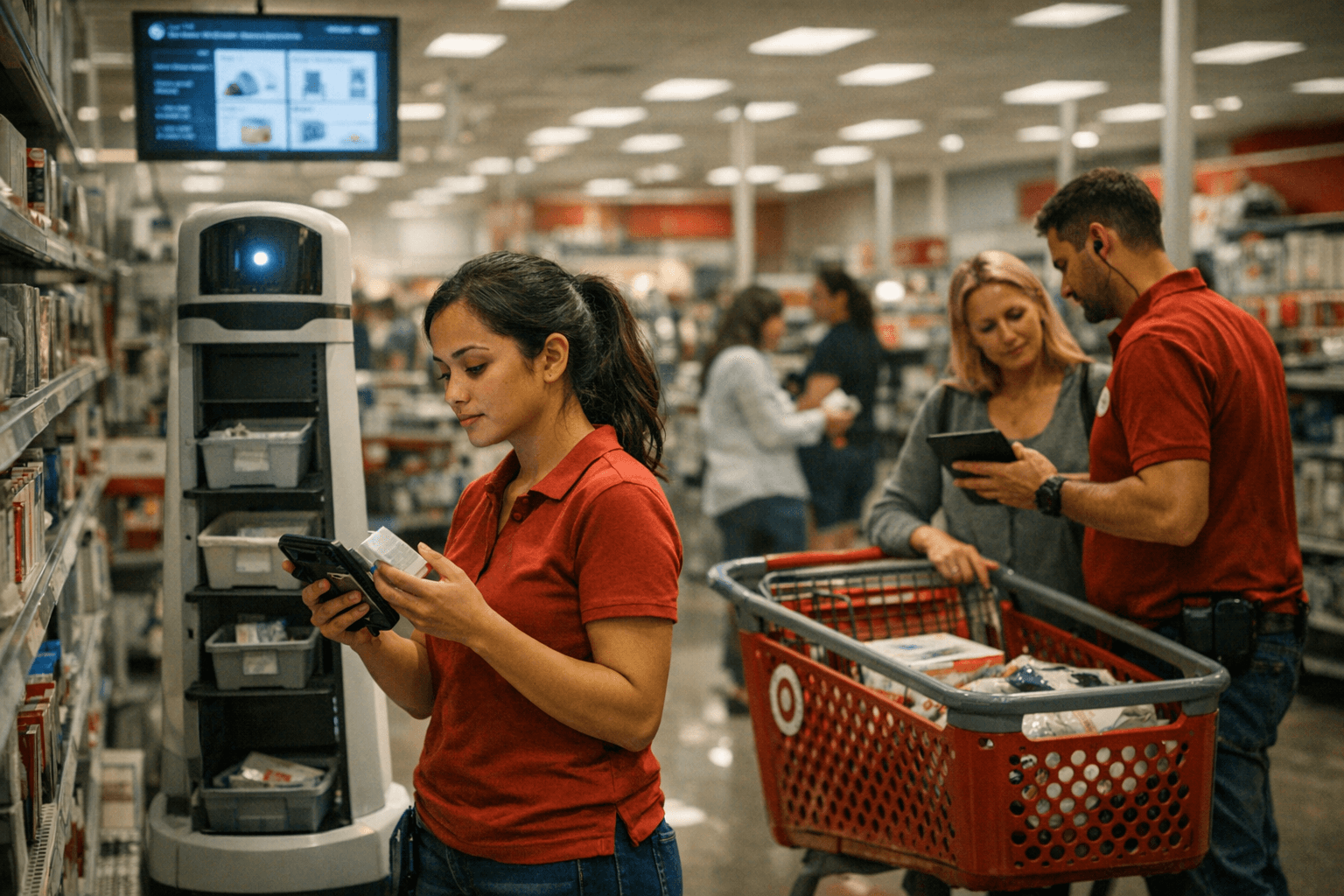
What changes first on Target’s floor
The first sign that AI is changing Target is not a flashy machine at the front end. It is a handheld device telling a team member how to solve a problem faster during a busy shift. Target has already put that idea into stores with Store Companion, its GenAI-powered chatbot for nearly 2,000 stores, and the tool is built to answer process questions, coach new team members, support store operations management, and help teams work more quickly and efficiently.
That matters because the earliest changes are not abstract. They will show up in the everyday work that already slows down a rush: product lookup, inventory checks, fulfillment handoffs, guest questions, and the constant need to decide what gets fixed now and what can wait. In practice, AI is becoming a task-shifter, taking over routine lookups and guidance so team members can spend more time on judgment calls, exception handling, and guest recovery.
The tasks most likely to move first are the ones where speed and accuracy matter most:
- Search and product lookup, especially when a guest wants an answer before leaving the aisle.
- Fulfillment, including Order Pickup and Drive Up work that depends on fast, correct picks.
- Customer questions, from store policies to where an item is located and whether it is in stock.
- Scheduling and labor planning, where demand patterns can be matched more tightly to traffic.
- Replenishment and store execution, where better data can reduce missed locations and avoidable stockouts.
That shift changes the rhythm of the sales floor. The expectation becomes less about knowing every answer from memory and more about using tools well, moving quickly, and escalating the right problems to the right person.
Why the store still sits at the center
This is not a story about stores losing relevance. It is a story about stores being asked to do more. Target’s 2024 annual report says stores fulfill the majority of digitally originated sales and support Order Pickup, Drive Up, and Shipt. It also says stores have fulfilled more than 96% of total merchandise sales in each of the last three years, a striking reminder that the physical store is still the operating core of the business.
Target’s digital business has also become large enough to change how store labor works. The company said it has built a $20 billion first-party digital business, and that it continues to grow with double-digit gains in same-day services like Drive Up and same-day delivery through Target Circle 360. For team members, that means the store is no longer just a shopping destination. It is also a fulfillment engine, and that puts more pressure on execution, speed, and handoff quality.
That is why AI at Target should be read as a store-floor issue first, not a back-office experiment. If more sales begin online and more orders still flow through the building, then the employee who can locate, pull, pack, and resolve a problem faster becomes more valuable. The same is true for leaders who can use data to match staffing to traffic instead of reacting after the aisle is already backed up.
How Target is already reshaping shopping behavior
Target has been pushing shoppers toward a more automated and personalized experience for some time. In March 2024, the company said Target Circle would evolve into three membership options and that deals would be applied automatically at checkout. That is a small operational detail with a large cultural effect: it reduces friction for guests, but it also raises the bar for how smoothly stores and registers have to work.
In March 2025, Target said it aimed to drive more than $15 billion in sales growth by 2030. The plan centered on making Target a destination for discovery while blending physical, digital, and social commerce experiences. The company also said it would reimagine key categories beginning in 2025, including gaming, sports, and toys. For the sales floor, that means the assortment itself is becoming part of the growth strategy, with displays, category storytelling, and in-store experience expected to pull shoppers deeper into the store.
McKinsey’s April 27 report, built with ICSC and a survey of more than 3,000 U.S. consumers, says the store’s role is changing and retailers will need to decide whether each location is mainly about convenience or discovery, then shape format, portfolio, and investment around that mission. The report says the next three to five years will be decisive for which stores keep their place in shopping. BCG reaches a similar conclusion, saying AI is changing how customers shop, how retailers operate, and where profit flows, and that the winners will redesign their customer value propositions, economics, capabilities, and tech stacks around AI rather than simply layering tools onto the old model.
For Target, that means the choice is not whether AI exists in stores. It is whether stores use AI to become faster convenience hubs, stronger discovery destinations, or some mix of both.
What that means for performance, training, and payroll
The labor impact is already visible in Target’s own investment plans. In March 2026, the company said it would invest an incremental $2 billion in 2026, including more than $1 billion in additional capital expenditures and $1 billion in additional operating investments. Target said those plans would bring more changes within all stores than any year in the last decade, alongside hundreds of millions of dollars in additional payroll and training.
That combination tells you where the pressure will land next month and beyond. More payroll suggests more labor where the work is hardest. More training suggests the company knows AI and store redesign only help if team members know how to use them. And more capital spending means store layouts, displays, and operational zones are going to keep changing, which can make the floor feel less static and more like a live system that needs constant adjustment.
The consequence for performance expectations is straightforward: routine work will need to be done faster, with fewer misses and better use of the tools in hand. Team leads will likely spend more time coaching to data, not just walking the floor by instinct. For hourly workers, the skills that matter most will be the ones AI cannot replace: calming a frustrated guest, handling a weird exception, making judgment calls on merchandising execution, and keeping the store moving when the system and reality do not line up perfectly.
Where human judgment becomes more valuable
The more Target automates routine guidance, the more valuable the human moments become. A chatbot can explain a process, but it cannot read a guest’s frustration, reroute a crowded pickup flow, or decide how to recover a bad experience in real time. It can support a new team member, but it cannot build trust on a crowded Saturday when three things are broken at once.
That is also why accessibility and service design matter. In September 2025, Target announced a first-of-its-kind accessible self-checkout experience nationwide, designed with and for guests with disabilities and rolling out across stores beginning in the holiday season and continuing into early 2026. It is another sign that the company is using technology to reshape the front end of the store, but it also reinforces the need for team members who can step in when the guest needs a person, not a prompt.
Target’s workforce is large enough that these shifts touch nearly every corner of the business. The company said in its 2024 annual report that it had more than 400,000 team members. In a company that size, even small changes in how people look up information, fulfill orders, or resolve guest issues can alter the pace of an entire shift.
The bottom line for the sales floor is clear: AI is not replacing the store, it is redefining what the store is for. At Target, the next phase looks less like a technology rollout than a new operating model, one where the fastest workers are not the ones who know everything by heart, but the ones who know how to turn better tools into better service.
This article was produced by Prism’s automated news system from verified source data, official records, and press releases, then run through automated quality and moderation checks before publishing. The system is built and supervised by the people who set the standards it runs under. Read our full AI policy.
Did this article answer your question?