Target Pay Ranges Revealed, From Cashiers to Store Leaders Nationwide
A pay breakdown puts real numbers on Target roles from cashier to store leader; the geographic spread alone can mean $18,000 more per year for the same job title.
If you've been running Drive-Up orders through a Target parking lot and quietly wondering whether to push for a Team Lead role, a recently published pay guide finally puts a dollar figure on that decision. The jump from general team member to hourly Team Lead can be as wide as $9 to $15 per hour depending on your market. At full-time hours, that's a difference of more than $25,000 a year, for a move you may be able to make internally, without changing employers. Knowing that number before you walk into a conversation with your ETL changes the entire dynamic.
The Gridwise pay guide, published in late March 2026, aggregates publicly available compensation data for Target's most common store and distribution roles across the country. It's built for three audiences: job seekers evaluating offers, current team members mapping a path to a higher pay band, and people leaders benchmarking local wages against competitors. All three will find something actionable in the numbers.
What the ranges actually look like, role by role
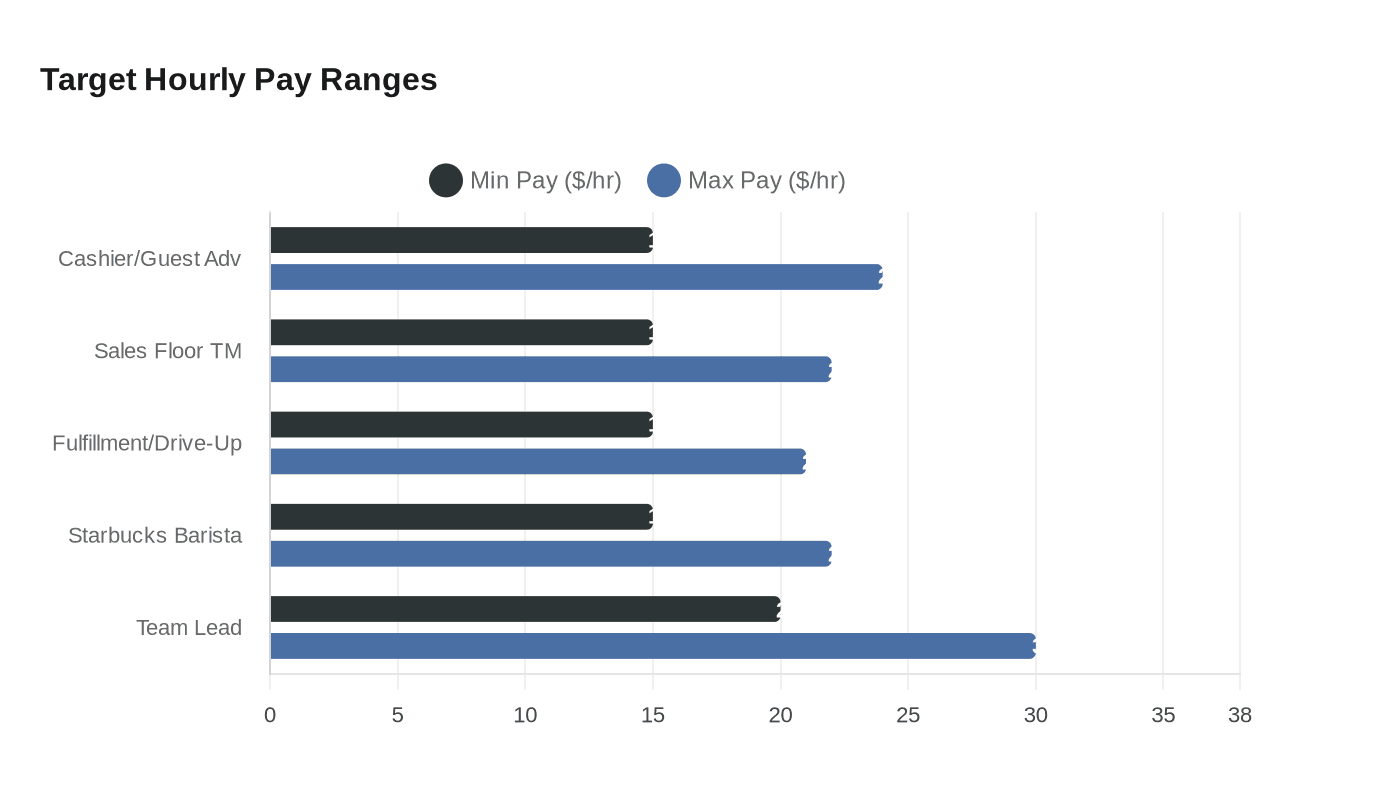
Target set a company-wide wage floor of $15 per hour in 2020 and structured higher starting levels by market above that threshold. Six years later, the floor holds in price-competitive markets, but the ceiling has moved. The Gridwise data puts current national ranges at:
- Cashier/Guest Advocate: $15–$24/hr (national average clusters around $16–$17)
- Sales Floor Team Member: $15–$22/hr
- Fulfillment/Drive-Up Associate: $15–$21/hr
- Starbucks Barista (Target-operated locations): $15–$22/hr, set by Target rather than Starbucks corporate
- Team Lead (hourly department lead): $20–$30/hr
- Executive Team Leader (ETL, entry-level salaried): approximately $65,000–$85,000 per year
PayScale's self-reported data puts the company-wide hourly average at $17.23, with Team Lead Operations positions averaging $21.57/hr. Glassdoor figures for ETL roles show the real range is wider in practice: the 25th-to-75th percentile for that position spans roughly $59,000 to $103,000 annually, with top earners at high-volume stores exceeding the $85,000 midpoint. For team members eyeing that path, the ETL band is meaningfully broader than the Gridwise snapshot alone suggests.
Distribution center roles carry a distinct pay profile. Glassdoor salary data shows Target DC warehouse associates starting around $20/hr nationally, while posted wages at a Target food distribution center in the Washington, D.C. corridor show warehouse worker positions opening at $24.25/hr and stretching to $28.66/hr, with shift differentials of $2.00 to $3.50 per hour added for overnight and weekend coverage. That premium reflects tight warehouse labor markets in high-cost metros and is worth factoring into any store-versus-DC comparison.
The geography gap: your zip code outweighs your tenure
The single most decisive variable in Target pay is location. A cashier in a rural Midwest market may start at $15/hr. That same job title at a high-volume store in New York City or Los Angeles reaches the top of the $15–$24 band. At 40 hours a week and 52 weeks a year, the difference between those two ends of the spectrum is approximately $18,720 annually, for the same role, the same title, the same responsibilities. That spread is the most striking figure in this data and the one most worth verifying before accepting or declining any offer.
The gap compounds when you cross from store to DC. Distribution center roles in competitive corridors carry starting wages that would qualify as Team Lead-level pay in lower-cost store markets. For team members within commuting range of a Target DC, that comparison is worth running before assuming the store track is the only internal option.
The biggest pay jump available without leaving Target
For most hourly team members, the largest single pay increase available without changing companies is the move from general team member to Team Lead. The Gridwise data quantifies that gap at roughly $5 to $14 per hour depending on starting rate and market. What unlocks the jump isn't just time on the job. TLs who advance fastest tend to have cross-trained across departments, taken on key-holder or opening/closing responsibilities, demonstrated reliability during peak demand windows, and built a visible record of coaching peers informally before formally asking for the role.
Skills and experience that tend to support that promotion conversation:
- Cross-department training, particularly between Sales Floor and Fulfillment
- Key holder or opening/closing lead experience
- Consistent productivity metrics, especially in Drive-Up and fulfillment during Q4 or back-to-school
- Informal coordination responsibilities, such as onboarding new team members or covering absent leads
- Food safety certification for team members targeting a Food and Beverage TL role
Store versus DC: mapping the tradeoffs
For team members weighing whether to pursue an internal DC opportunity, the comparison isn't purely about pay rate. DC roles generally offer higher starting hourly wages, more structured shift formats (many sites run 4x10 or 3x12 schedules), and overtime opportunities with differential pay during peak periods. The tradeoff is that the work is physically demanding, tied to throughput and productivity metrics, and carries mandatory overtime obligations during holidays that, as one DC team member noted in a job review, "can be brutal during peak seasons with very little choice in which days you'll end up working."
Store roles offer more scheduling flexibility, more direct pathways to salaried leadership through the ETL and Store Director tracks, and greater day-to-day guest interaction, which matters significantly to some team members. The Gridwise data suggests the DC pay premium is most pronounced in high-cost metro corridors where warehouse labor is genuinely competitive, and is less dramatic in lower-cost markets where store and DC ranges converge.
How to sanity-check a third-party pay guide
The Gridwise ranges are a credible baseline, but no external guide captures exactly what a specific store or district is paying right now. Here's how to verify before or during a pay conversation:
1. Pull Target's own job postings. Fourteen states now have pay transparency laws requiring employers to post salary ranges, including California, Colorado, New York, Illinois, Hawaii, Washington, Minnesota, and Connecticut.
Search careers.target.com, filter to your state, and read the posted range directly from the listing. That number is the most reliable single data point available.
2. Cross-reference multiple aggregators. Glassdoor, Indeed, and PayScale each draw from different self-reported samples with different methodologies.
If the Gridwise midpoint, the PayScale average, and the Glassdoor median all land near the same figure, you have a reliable signal. If they diverge sharply, weight posted job-listing ranges most heavily.
3. Ask internally about wage bands. Many Team Leads and ETLs can discuss the general pay band for a role without disclosing individual pay.
A direct question, "Can you walk me through the pay range for a Team Lead in this district?", is a professional ask, not a confrontational one. In most jurisdictions, employees also have the legal right to discuss their own pay with coworkers.
4. Account for the full offer. Target's benefits package carries real dollar value.
Health insurance eligibility begins at 25 hours per week for many hourly roles, and the 401(k) match, team member discount, and paid time off accrual each add to the effective compensation picture. A $1/hr gap in base pay between Target and a competitor may close or reverse once benefits access is factored in.
Questions to bring into your TL or HR conversation
Arriving with specific questions signals preparation and shifts the conversation from general to actionable:
- What is the posted pay range for this role in this store or district, and where in that range would I land at hire or promotion?
- What criteria move someone from the bottom to the midpoint of the band, and is there a documented timeline for that progression?
- Is there a formal review cycle for pay advancement, or does progression primarily happen through role changes?
- For Team Lead candidates: what does the internal promotion process look like from expressed interest to decision?
- For fulfillment and Drive-Up team members: does peak-season performance create a formal record that supports future pay conversations?
What people leaders should do with this data
For ETLs, district HR partners, and anyone managing labor budgets, the important thing to understand about the Gridwise guide is not the numbers themselves but the fact that your team already has them. The pay conversation is happening regardless. The question is whether your store is shaping it proactively or responding to turnover after the fact.
Fulfillment and Drive-Up roles carry the highest churn risk during peak periods. They are physically demanding, metric-driven, and in most markets pay within the same band as less physically intensive Sales Floor positions. A team member earning $17/hr doing harder work than a peer at the same rate has the data to make that comparison; so does every other retailer in your market. Communicating clear pay-progression criteria, building a credible timeline to Team Lead for high performers, and delivering scheduling predictability during peak windows are the levers that determine whether seasonal hires convert to year-round team members and eventually TL candidates.
Target's public messaging has consistently emphasized market-competitive pay. Whether that holds true for any individual team member depends entirely on market, role, and whether store leadership has made the path to higher pay visible and navigable. The data is now more accessible than ever, and the expectation on both sides of that conversation should be the same.
This article was produced by Prism’s automated news system from verified source data, official records, and press releases, then run through automated quality and moderation checks before publishing. The system is built and supervised by the people who set the standards it runs under. Read our full AI policy.
Know something we missed? Have a correction or additional information?
Submit a Tip