Target proxy statement highlights CEO succession and board accountability
Target's proxy puts CEO succession and board accountability in focus as investors weighed pay, directors and a failed push for an independent chair.
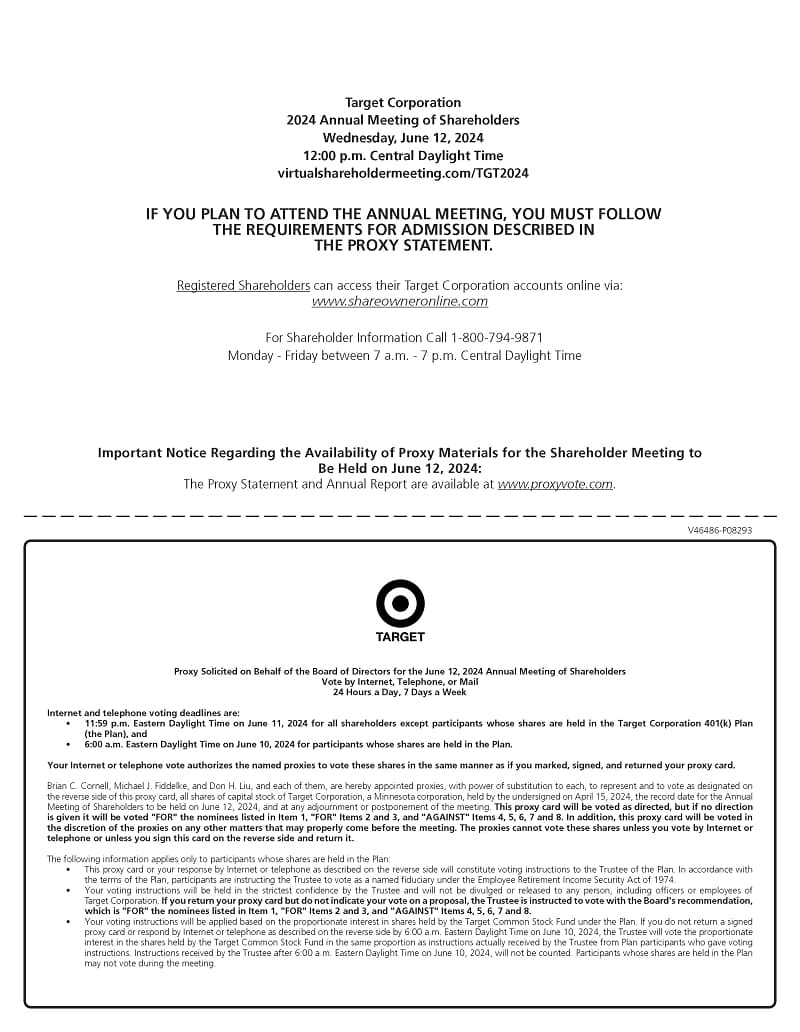
Target’s 2026 proxy statement is more than a vote packet. It shows who is responsible for the company’s direction, how leadership is being judged, and which board choices can ripple down to stores, field leadership, and corporate teams. The annual meeting was scheduled for Wednesday, June 10, 2026 at 12:00 p.m. Central Daylight Time and held online at virtualshareholdermeeting.com/TGT2026.
What the proxy puts on the table
For Target team members, the proxy is the clearest public snapshot of how the board is governing through a period of leadership change and sales pressure. The 2026 annual meeting materials, as listed in Boardroom Alpha’s meeting summary, included 15 nominees and 7 ballot items. Those ballot items covered election of 12 directors, ratification of Ernst & Young LLP as independent auditors, advisory approval of executive compensation, approval of the Amended and Restated 2020 Long-Term Incentive Plan, and three shareholder proposals.
That mix matters because it shows how much of the company’s direction sits with the board rather than with day-to-day operations. Director elections decide who has oversight power, the auditor vote checks financial reporting, Say on Pay measures support for executive compensation, and the long-term incentive plan shows how the company wants to reward top leadership over time. For workers who live inside Target’s operational culture, those are not abstract votes. They shape the standards executives are incentivized to chase.
Succession planning is the board’s main signal
The strongest theme in the proxy is CEO succession. In a letter included with the statement, Target’s Lead Independent Director wrote that over the last several years, the board had executed “a deliberate and thoughtful CEO succession process.” That phrase matters because it frames succession as a multi-year governance exercise, not an emergency response.
In retail, that kind of planning affects stability. When the board signals that it has mapped leadership transitions carefully, it reduces the sense that strategy could swing overnight with each earnings cycle or management shuffle. Team members feel that less in a boardroom memo than on the sales floor: clearer priorities, less whiplash in execution, and fewer abrupt changes in how labor, training, and operations are pushed through stores.
Target also refreshed its board earlier in the year. Reuters reported on January 22, 2026 that Target expanded its board with ex-Nike and HanesBrands leaders, a move that points to a search for outside operating and consumer experience expertise. A March 2, 2026 local business report added that Target was proposing management changes amid sales decline, which gives the succession language even more context. The board was not just describing a process; it was signaling that leadership and performance were under active review.
The ballot items show where accountability really sits
The annual meeting agenda also reveals what the board expects to be accountable for. Ratifying Ernst & Young LLP as independent auditors is routine, but it still matters because it ties the board to the integrity of Target’s financial reporting. Advisory approval of executive compensation is more visible to investors and employees alike because it is one of the clearest checks on whether leadership pay matches performance.
The approval of the Amended and Restated 2020 Long-Term Incentive Plan is especially important for understanding how the company rewards top executives over time. Long-term incentive plans are where boards decide what they want leaders to optimize for, whether that is growth, margin discipline, customer experience, or stock performance. For employees who hear corporate messaging about culture, pay, and accountability, the incentive plan is often the truest read on what the board actually values.
The three shareholder proposals made the meeting even more pointed. One of those proposals sought a policy requiring the board chair to be independent, a change that would separate more power from the executive chair structure. That kind of proposal is not a technical footnote. It is a direct challenge to how much influence one leadership role should hold.
The independent chair fight became a real contest
That challenge was not hypothetical. Trillium Asset Management, LLC sent a letter on May 13, 2026 urging shareholders to vote against Executive Chair Brian Cornell and Lead Independent Director Christine Leahy. The letter put the board’s leadership structure squarely in the crosshairs and helped turn the proxy season into a test of how much oversight investors wanted from Target’s board.
Reuters reported on June 11, 2026 that Target investors rejected the independent board chair proposal. Reuters then reported on June 12 that support for the idea had risen, but still stayed below a majority. That split is revealing. It shows that shareholders were willing to press the board harder on structure, but not enough to force a change in how Target was led.
For workers, that matters because board structure affects who can check the executive chair when strategy, pay, or performance starts to drift. An independent chair proposal is not about symbolism alone. It is about whether the board has enough distance from management to challenge it when needed, especially during periods when sales are soft and management changes are being discussed.
What Target employees should take from the proxy
If you work in a store, lead a team, or sit in a corporate function, the proxy is the document that tells you where responsibility sits when the company shifts direction. It shows who the board has chosen to oversee audits, compensation, and director elections, and it shows how seriously the board is treating succession after several years of planning. It also shows that investors are paying attention to governance mechanics, not just quarterly numbers.
The practical takeaway is simple: when Target changes course, the proxy tells you who approved the framework behind that change. That includes the board members, the pay philosophy for executives, the long-term incentive plan, and the structure of executive oversight. In a company this large, those choices do not stay at the top. They shape the pressure points that eventually reach the store floor and the corporate office alike.
This article was produced by Prism’s automated news system from verified source data, official records, and press releases, then run through automated quality and moderation checks before publishing. The system is built and supervised by the people who set the standards it runs under. Read our full AI policy.
Did this article answer your question?