Trader Joe’s gains share as shoppers shift toward specialty grocers
Trader Joe’s grew more than 3% while overall grocery spend fell about 3%, underscoring why its crew-heavy, curated model keeps winning shoppers.
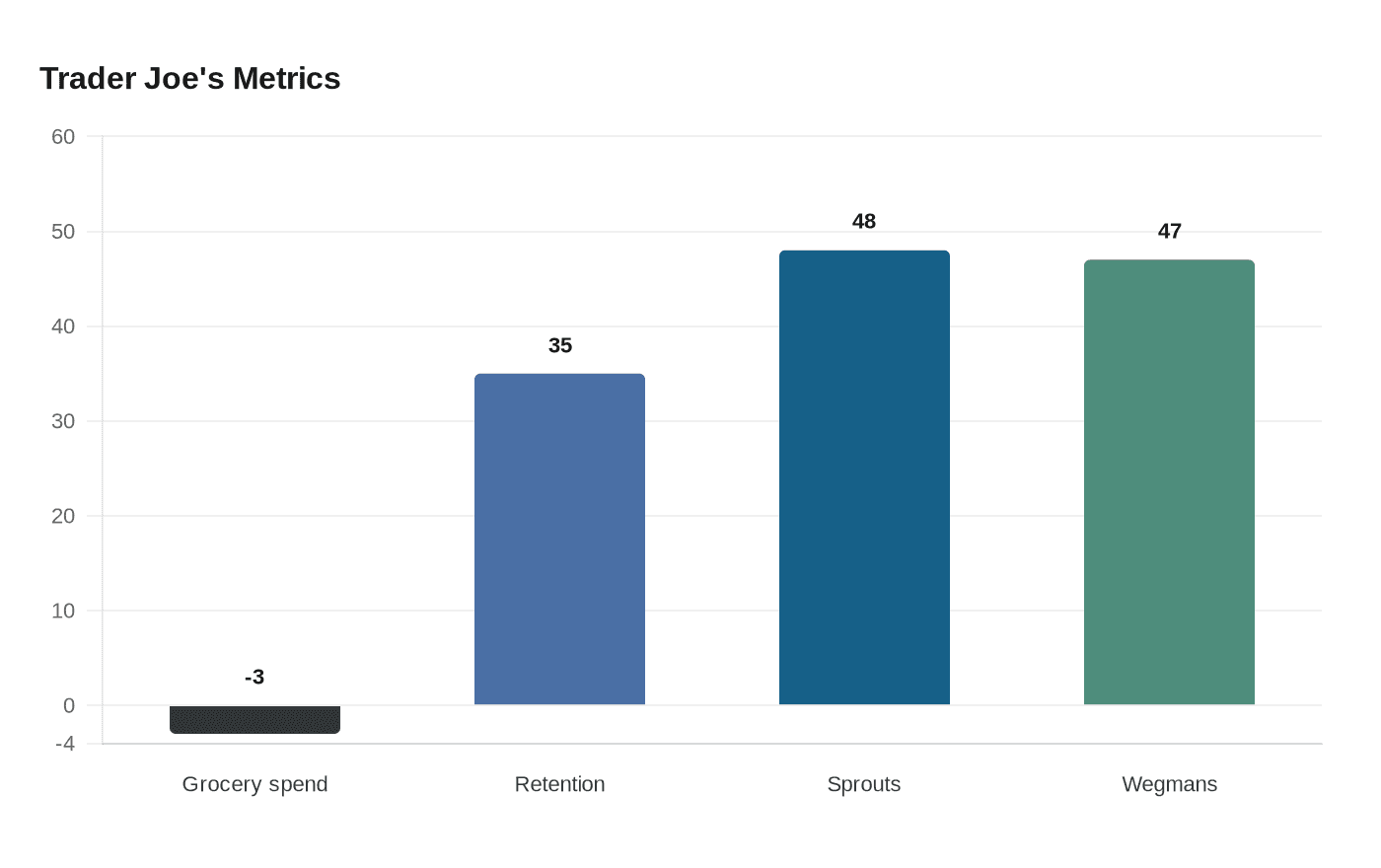
Trader Joe’s is gaining share at a time when the grocery aisle is getting sharper, more selective and less forgiving. Consumer Edge’s U.S. Grocery Outlook 2026, released April 22, showed U.S. grocery spending down roughly 3% year over year in the 12 months ended Feb. 28, 2026, even as Trader Joe’s grew more than 3%, about 6 percentage points ahead of the sector.
That gap matters inside stores as much as it does on Wall Street. Consumer Edge said shoppers are not simply cutting back, they are concentrating spending with retailers that deliver either clearer value or a more differentiated experience. Trader Joe’s has built its business around exactly that formula: a tight assortment, a heavy private-label mix, and a store experience built to feel distinct from the conventional supermarket run. The chain says it has been transforming grocery shopping since 1967 and positions itself around outstanding value and best everyday prices.
The loyalty numbers help explain why the model still travels. Consumer Edge said Trader Joe’s had a 35% retention rate four quarters after first purchase, a strong sign that first-time shoppers are coming back. The report also found that specialty-grocery shoppers are increasingly cross-shopping Trader Joe’s into their regular routines. Sprouts Farmers Market shoppers allocate 48% of their specialty grocery spend to Trader Joe’s, while Wegmans shoppers allocate 47%. That kind of overlap suggests Trader Joe’s is not just a destination for an occasional treat run; it has become part of the core basket for shoppers already spending in specialty channels.
For crew members, the significance is practical. Specialty grocers are gaining across low-, middle- and high-income households, while Consumer Edge said discount-grocer share plateaued after mid-2025. That puts more weight on the store-level execution Trader Joe’s is already known for: product curation, fast-moving seasonal items, and crew recommendations that keep the shopping trip feeling personal. It also means more pressure to keep shelves tight, signs clear and the product mix disciplined, because the brand’s edge depends on making the store feel different every time a customer walks in.
The growth story is not limited to same-store demand. Trader Joe’s announced a new store in McKinney, Texas, on April 21, one day before the Consumer Edge report landed, and industry coverage said the company plans to open more than 20 stores in 2026 after opening 34 in 2024 and 43 in 2025. The expansion reinforces what the market data already suggests: Trader Joe’s is still one of the few grocers pulling traffic while the broader category softens, and that can translate into more openings, more internal opportunity and more store-level workload as the chain keeps pushing into new neighborhoods.
Know something we missed? Have a correction or additional information?
Submit a Tip