Viral Thread 'Exposes' Trader Joe's Private Label as Big Food Rebrands
A post with 25K+ likes claims TJ's private labels are just PepsiCo products in disguise. The reality is more complicated, and crew members are fielding it on the floor.

A social media post racking up more than 25,000 likes declared that Trader Joe's private-label products are little more than big-food rebrands, with PepsiCo named as a central culprit. The claim landed hard with TJ's shoppers precisely because it cuts at the chain's core identity: the idea that what's on those shelves is curated, different, and somehow more honest than what you'd find at a conventional supermarket. Crew members, predictably, are the ones absorbing the fallout at the register.
The part of the thread that's true is this: more than 80% of Trader Joe's private-label items are manufactured by outside companies, and some of those companies are household-name multinationals. Stacy's, a division of PepsiCo's Frito-Lay, made Trader Joe's pita chips, and an ingredient-by-ingredient comparison found the sea salt variety to be identical to Stacy's Simply Naked. On the East Coast, Danone's Stonyfield Farm supplied much of the chain's yogurt. A 2016 salmonella recall issued by Wonderful Pistachios disclosed that the company also produced three Trader Joe's nut products, including dry roasted and unsalted pistachios. A 2022 recall tied Trader Joe's snickerdoodle cookies to Enjoy Life Foods. The manufacturers are real. The relationships are real.
What the thread got wrong is the logical leap from "made by" to "same as." Private label and co-manufacturing are not the same thing. Under a private-label arrangement, the retailer sets the product specifications, meaning Trader Joe's controls the formula, not just the packaging. A co-manufacturer producing for Trader Joe's is not necessarily running the same line it uses for its national brand equivalent. Trader Joe's has publicly stated it prohibits MSG and artificial flavors across its product line, standards that can and do result in formulas that diverge from what the manufacturer sells under its own label. "Made by a big company" is not evidence of "identical to what that company sells at Kroger."
The ultra-processed question is a separate argument entirely, and conflating it with manufacturer identity muddies both debates. A pistachio supplied by Wonderful is still a pistachio. The relevant question is what's in the product, not which corporation's trucks delivered it to the warehouse.
For crew fielding this on the floor, three scenarios come up most:
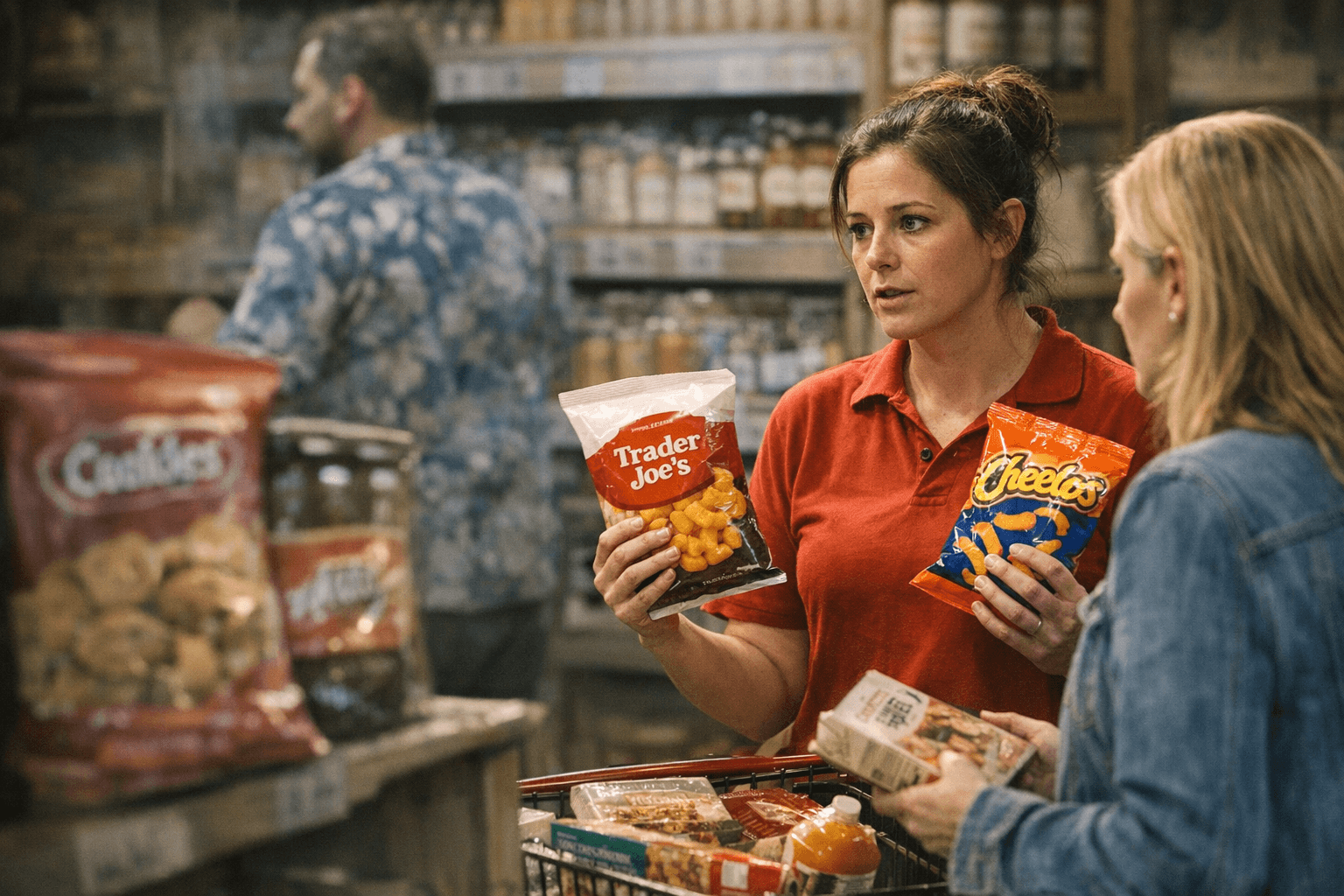
When a customer says "Is this just PepsiCo?" the honest answer is: the manufacturer may be, but Trader Joe's sets the recipe and ingredient standards, and those can differ from what PepsiCo sells under its own brand. When a customer asks "Is it ultra-processed?" the answer has nothing to do with who made it: check the ingredient list, which is right there on the package. When a customer says "Why doesn't TJ's just tell us who makes these?" the answer is standard industry practice: almost no major retailer discloses co-manufacturing partners, including competitors with no particular claim to authenticity.
Trader Joe's private-label products cost an average of 37% less than their name-brand equivalents, which is the direct result of negotiating volume manufacturing contracts with companies that already own the equipment and supply chains. The chain's own podcast has framed elevated customer expectations as the point: there are things Trader Joe's says it doesn't allow in its products that appear in many national brands, including MSG and artificial flavors.
None of that makes the viral thread irrelevant. Consumer skepticism about "healthy" grocery branding is legitimate, and TJ's distinctive image does carry a premium of trust that warrants scrutiny. But a 25K-like post that treats manufacturer identity as proof of product equivalence is doing something specific: collapsing a nuanced supply-chain reality into a satisfying gotcha. Crew members who understand the actual mechanics of private label can redirect that conversation toward the ingredient list, which is where the real debate belongs.
This article was produced by Prism’s automated news system from verified source data, official records, and press releases, then run through automated quality and moderation checks before publishing. The system is built and supervised by the people who set the standards it runs under. Read our full AI policy.
Did this article answer your question?