Congress Targets Walmart with 'Fair Prices for Local Businesses Act'
A Senate bill targeting retailers with $100M+ in annual sales could reshape how Walmart and Sam's Club negotiate prices with suppliers — and what shoppers pay at checkout.
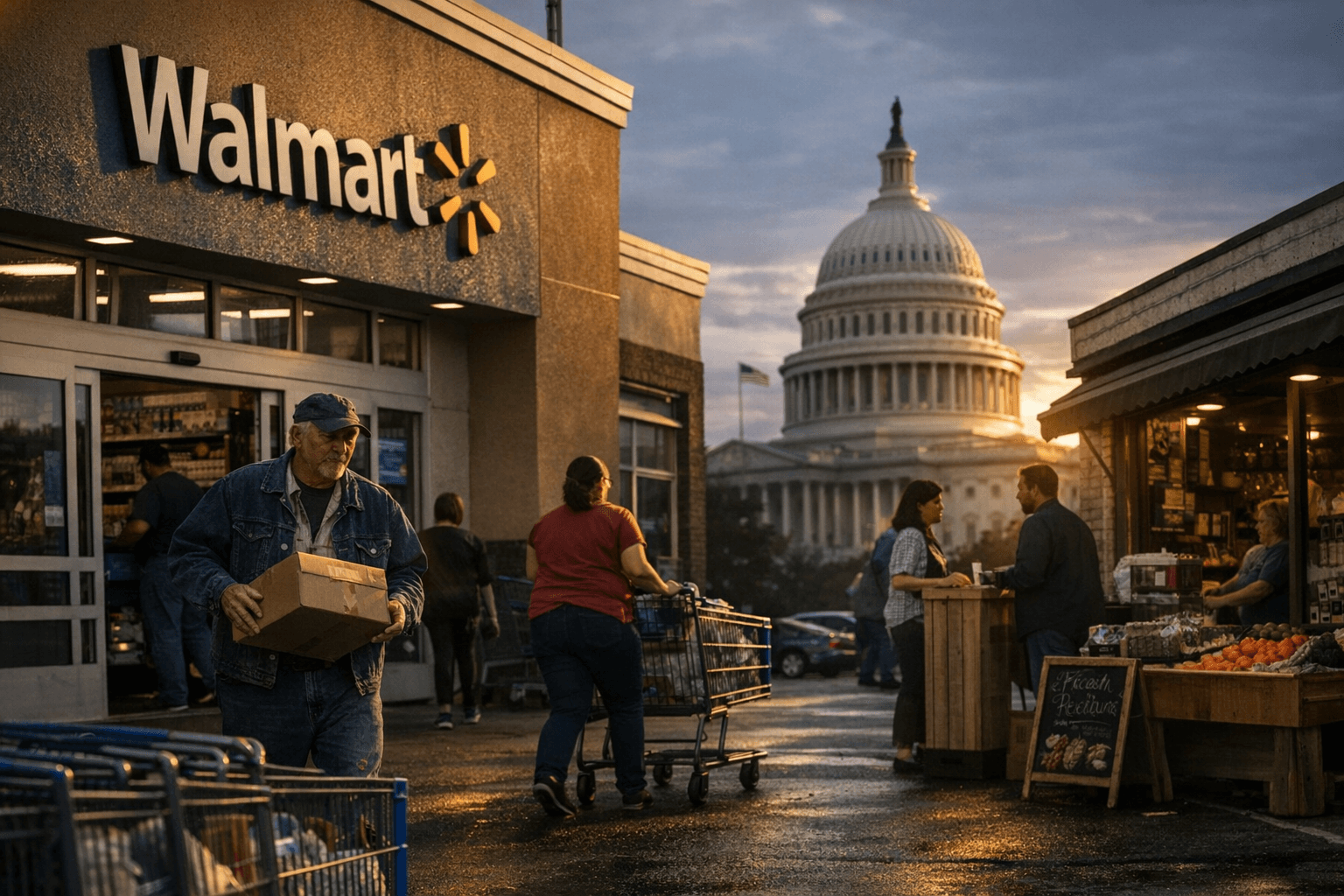
The Senate bill that could remake how Walmart prices its shelves has a name that sounds like it has nothing to do with the world's largest retailer: the Fair Prices for Local Businesses Act. But S. 4147, introduced by Sen. Chris Murphy (D-Conn.) on March 19 and now sitting before the Senate Judiciary Committee, takes direct aim at the supplier deals that have made Walmart's everyday low-price model possible for decades.
The legislation would strengthen the Robinson-Patman Act of 1936, a Depression-era law that bars suppliers from charging competing buyers different prices for identical goods when doing so harms competition. The law has gone almost entirely unenforced since the 1980s. Murphy's bill would close the legal loopholes that allowed that to happen, and it explicitly removes a carve-out for retailers with more than $100 million in annual sales. That threshold captures Walmart, Sam's Club, Amazon, Costco, Kroger, Home Depot, CVS, Walgreens, and Target.
"For decades, corporations have been allowed to break the law and rig the system to make small businesses pay higher prices for the exact same products," Murphy said. The bill is co-sponsored by Senators Richard Blumenthal (D-Conn.), John Fetterman (D-Pa.), Ruben Gallego (D-Ariz.), and Peter Welch (D-Vt.). On the House side, Rep. Josh Riley (NY-19) helped introduce companion legislation, framing it as a crackdown on "sweetheart deals with suppliers while pushing them to charge small businesses more."
The specific context for the bill's introduction traces back to an FTC action under former chair Lina Khan. The FTC uncovered how Pepsi and Walmart allegedly colluded to drive up the price of Pepsi products at grocery stores competing with Walmart, while existing laws were supposed to stop big corporations from using their size to force suppliers into charging smaller businesses more. Trump's FTC, now led by Andrew Ferguson, recently threw out a similar case against PepsiCo, with the agency under Biden having alleged that Pepsi was violating the Robinson-Patman Act by providing discounts to big-box stores.
Murphy said he does not expect the current administration to back his bill, citing Trump's record of favoring large corporations, but was equally critical of his own party, noting the Obama Justice Department brought zero Robinson-Patman lawsuits. "Democrats and Republicans in Washington have both let this law languish," he said.
The opponents of the bill argue that it is consumers, not small businesses, who would ultimately pay the price. Bulk discounts are the backbone of modern retail, critics say. A big reason why warehouse clubs like Costco or large retailers like Walmart have attractive prices is that they negotiate lower prices from suppliers in exchange for large orders, with those savings passed along to consumers. If regulators succeed in disrupting that arrangement, the result won't be greater fairness, it will be higher prices. National Review published a piece making that case directly, headlined "Government Antitrust Pricing Law Threatens Costco, Walmart Business Model." Carbonated beverage giant Pepsi has even said in SEC filings that losing Walmart "would have a material adverse effect" on its business, a measure of the kind of market power the bill's backers say requires legal restraints.
The backdrop of retail closures gives both sides urgency. Retail store closures hit their highest level since the pandemic in 2024, with 7,325 stores shuttered nationwide, according to retail research firm Coresight Research. Projections suggest as many as 15,000 more could close in 2025. Among supermarkets, 60% of sales occur at just five chains, with Walmart alone controlling 21% of the market.
What This Could Mean on the Floor
If the bill advances, the most immediate pressure on Walmart and Sam's Club would come from suppliers who could no longer offer the chain exclusive volume discounts without offering comparable terms to smaller buyers. Whether Walmart would absorb those cost changes, pass them to shoppers, or renegotiate its entire supplier structure is a question no one outside Bentonville's strategy team can answer with confidence. Membership value at Sam's Club, built heavily on the perception of exclusive low prices unavailable elsewhere, would face a reputational test even before any price tag moves.
What is known: the bill targets the procurement mechanism, not Walmart's retail prices directly. What is speculative: whether supplier renegotiation would raise shelf prices by a measurable amount, and over what timeline.
Timeline and Watchlist
March 19, 2026: S. 4147 introduced; referred to Senate Judiciary Committee. April 8, 2026: House companion introduced by Rep. Riley. Next milestones to watch: a Judiciary Committee markup hearing, which has not been scheduled; any co-sponsor additions from across the aisle, which would signal bipartisan traction; and whether the Trump FTC weighs in against the legislation, which Murphy himself anticipates.
Given the current Senate composition and the administration's track record of pulling back on Robinson-Patman enforcement, the bill faces long odds of passing in this session. Its more immediate effect may be setting a policy marker for future antitrust enforcement should enforcement priorities shift.
Associate FAQ: If a Customer Asks About "Fair Prices"
Customers who have read coverage of the bill may ask whether Walmart's prices are fair, whether the store is being investigated, or whether prices will go up. Here is how to handle those questions without taking sides on pending legislation.
If asked "Is Walmart being sued over prices?": The FTC under the Biden administration raised concerns about a supplier pricing arrangement involving Walmart and Pepsi. That specific case was dropped earlier this year. No current lawsuit against Walmart on this issue is pending.
If asked "Will this new law raise prices?": Explain that a bill has been proposed in the Senate, but it has not passed and has not been signed into law. It's in committee. You can direct them to Walmart's corporate communications if they want an official statement.
If asked "Does Walmart get better deals than small stores?": That's the core of the legislative debate. You don't need to answer it. A neutral response: "That's what Congress is debating right now. I don't have a position on pending legislation, but I'm happy to help you find what you're looking for today."
The bill's next move belongs to the Senate Judiciary Committee; whether it goes anywhere after that depends on a political environment that, for now, is not inclined to pick a fight with the country's largest employer.
This article was produced by Prism’s automated news system from verified source data, official records, and press releases, then run through automated quality and moderation checks before publishing. The system is built and supervised by the people who set the standards it runs under. Read our full AI policy.
Did this article answer your question?