Western Union’s USDPT stablecoin lands first major Bybit integration
Bybit became the first major crypto exchange to integrate Western Union’s USDPT, giving the remittance giant a live stablecoin distribution channel.
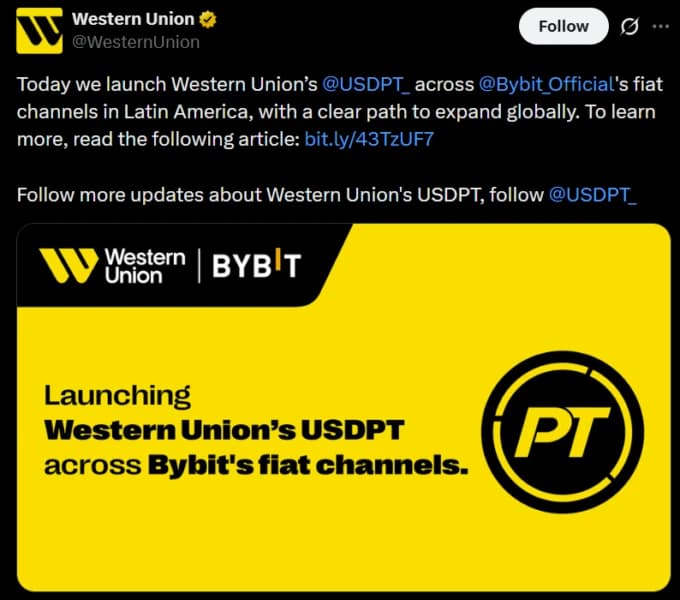
Bybit became the first major crypto exchange to integrate Western Union’s USDPT stablecoin, giving the remittance giant a live distribution channel inside a major crypto venue. The move turns Western Union’s digital-asset push from a product announcement into an operating question: whether USDPT becomes part of actual money movement, or stays a contained experiment.
Western Union announced USDPT on May 4, 2026 as a U.S. dollar-denominated stablecoin on Solana, issued by Anchorage Digital Bank, N.A. The company said each token is redeemable 1:1 for U.S. dollars and backed by reserves that include bank deposits, U.S. Treasury bills, and similar cash equivalents. That design matters for a company built on predictable settlement: if the token is going to sit anywhere near its remittance network, treasury, liquidity and reconciliation teams have to treat it like a new rail, not a side project.

For Western Union staff, the real work is in the control stack around the token. Engineers and operations teams have to understand wallet flows, counterparties, custody arrangements and transaction monitoring. Compliance teams have to think through sanctions exposure and the rules that attach when a regulated money transfer brand touches blockchain infrastructure. Support, marketing and frontline compliance will also need consistent answers for customers who may not care that a digital asset sits underneath a transfer, but will care very much if something breaks or fees change.
The company has already said the first USDPT rollout would begin in the Philippines and Bolivia, with expansion planned throughout 2026. Western Union also said it is using Fireblocks to operationalize the rollout across its global agent network, a sign that the company is not just testing a token but wiring it into the systems that already handle cash-in, cash-out and cross-border transfers. Bybit’s integration, with an initial focus on Latin American markets, extends that logic into a new customer channel and gives Western Union another way to distribute the token without rebuilding its entire retail footprint.
The timing also puts Western Union in a faster-moving stablecoin race. MoneyGram launched its own stablecoin, MGUSD, on Stellar in June 2026, which means the big remittance brands are no longer treating digital dollars as a hypothetical future. Western Union’s version is still small compared with its core business, but the Bybit tie-up shows the company is trying to build optionality at the edge of crypto while keeping the trust, controls and operational discipline that define the rest of its network.
This article was produced by Prism’s automated news system from verified source data, official records, and press releases, then run through automated quality and moderation checks before publishing. The system is built and supervised by the people who set the standards it runs under. Read our full AI policy.
Did this article answer your question?