How One Autumn Painting Inspired a Complete, Wearable Capsule Wardrobe
A 150-year-old painting by Albert Pinkham Ryder holds the key to a 10-piece April wardrobe that dresses you from cool mornings to warm afternoons without a single wasted piece.
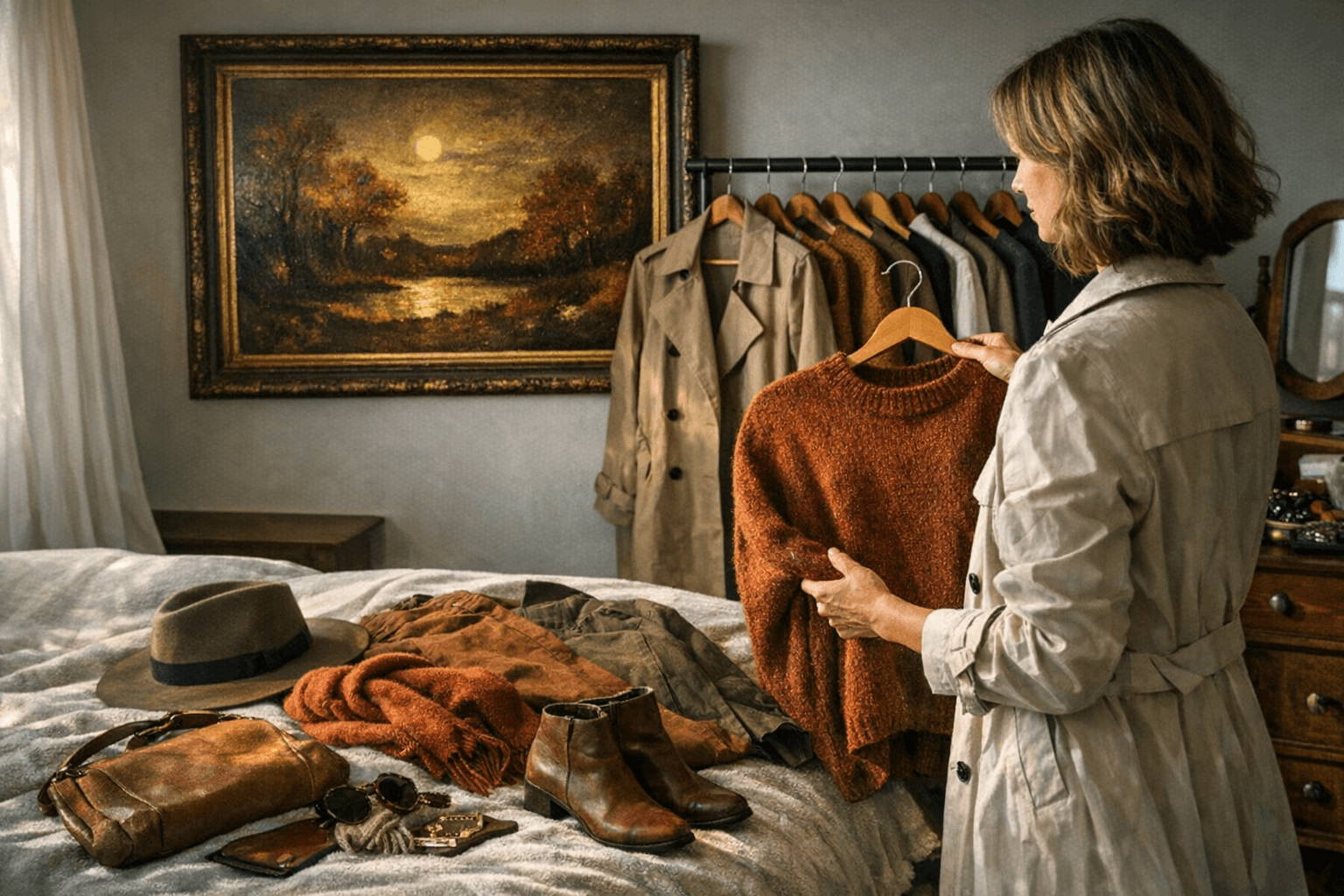
Building a wardrobe for April feels like trying to pack for a trip you cannot quite research. The mornings want a knit, the afternoons want linen, and the whole month refuses to commit. The solution, it turns out, is a painting made in 1875.
Albert Pinkham Ryder's *Spirit of Autumn*, painted around 1875, presents a shadowed female figure whose muted colors and obscured form evoke a sense of loss, maybe even resignation to the passing of time and seasons. There is something haunting about her stance and shadowed face. There is almost a glow about the composition, as though autumn itself, not necessarily the figure, becomes an enduring entity. The work now hangs in the Columbus Museum of Art in Columbus, Ohio, and it is, on the surface, not the kind of thing you consult before getting dressed. Spend time with it, though, and you begin to see a capsule wardrobe hidden in plain sight: a tightly controlled palette, a restraint in texture, and a mood specific enough to give a whole closet a point of view.
The style blog The Vivienne Files, which has spent months tracking one fictional protagonist's wardrobe build around this exact painting, has proven that the approach works. At the end of a 12-piece starting wardrobe, the closet feels almost infinitely versatile: "One could get dressed in the dark with this in your closet, and never look truly bad." That is the promise of the art-to-closet method. Here is how to apply it for April.
Reading the Palette
In a painting like *Spirit of Autumn*, the natural seems to be more dream-like than real, and the overall effect is delicate, restrained, and introspective. Ryder's forms evoked moods that drew him towards abstract fields of dense, muted color, and that restraint is exactly what makes this palette so wearable: it never shouts.
The two neutrals are chestnut brown and warm ivory. Brown is the anchor, deep and earthy, what readers of this wardrobe series have consistently described as a genuinely cheerful shade rather than a corporate or funereal one. Ivory sits at the opposite end of the value range, soft and luminous, the warmth of a late-season afternoon in a single color. Neither is cool-toned; both carry the low glow of the painting itself.
The three accent colors are where the wardrobe gains personality:
- Rust/copper/amber: The warmest register in the palette, drawn from the painting's luminous center. It reads as terracotta in some lights, burnished red in others, and it grounds everything around it.
- Teal/aqua: The palette's surprise. The soft, changeable aqua is what keeps the wardrobe from feeling monolithic, a blue-green that sits somewhere between sea and sky. The painting uses it sparingly, and that restraint is exactly how it should appear in a closet: as an accent, not a foundation.
- Warm gold/bronze: A subtler tone pulled from the painting's ambient light. In clothing, this translates as a burnished amber knit, a caramel-washed linen, or a dark honey merino.
The 10-Piece Capsule
Every item below earns its place by pairing with at least four others. Nothing is a solo act.
1. Rust knit turtleneck. The cold-morning workhorse. The lightweight "layering" turtleneck is a consistent preference in this wardrobe build because it functions as both a standalone top and a base layer under an open cardigan. A Coldwater Creek-style rust version sets the tone.
2. Dark teal merino top. The palette's accent piece and its most versatile top. The dark teal turtleneck gets snapped up even as cold weather fades because it transitions effortlessly: tuck it into the linen skirt for a polished daytime look, add the cardigan for a cool evening.
3. Brown cashmere cardigan. The layer you put on at 7am and remove by noon. Aritzia's brown cashmere cardigan is a benchmark reference in warm chestnut: luxurious enough to elevate a simple tee, relaxed enough to wear open over a turtleneck.
4. Ivory tee. Plain, fitted, fully washable. The reset button between every other item in the capsule.
5. Rust or maple corduroy trousers. J.Crew's vibrant maple corduroy pants are a benchmark here: the ribbed texture adds visual depth, and the warmth of the color pairs with every other piece on this list.
6. Brown linen-blend skirt. The GAP brown linen-blend skirt proves that linen does not have to mean summer. A straight or gently A-line cut in warm chestnut works across office and weekend alike.
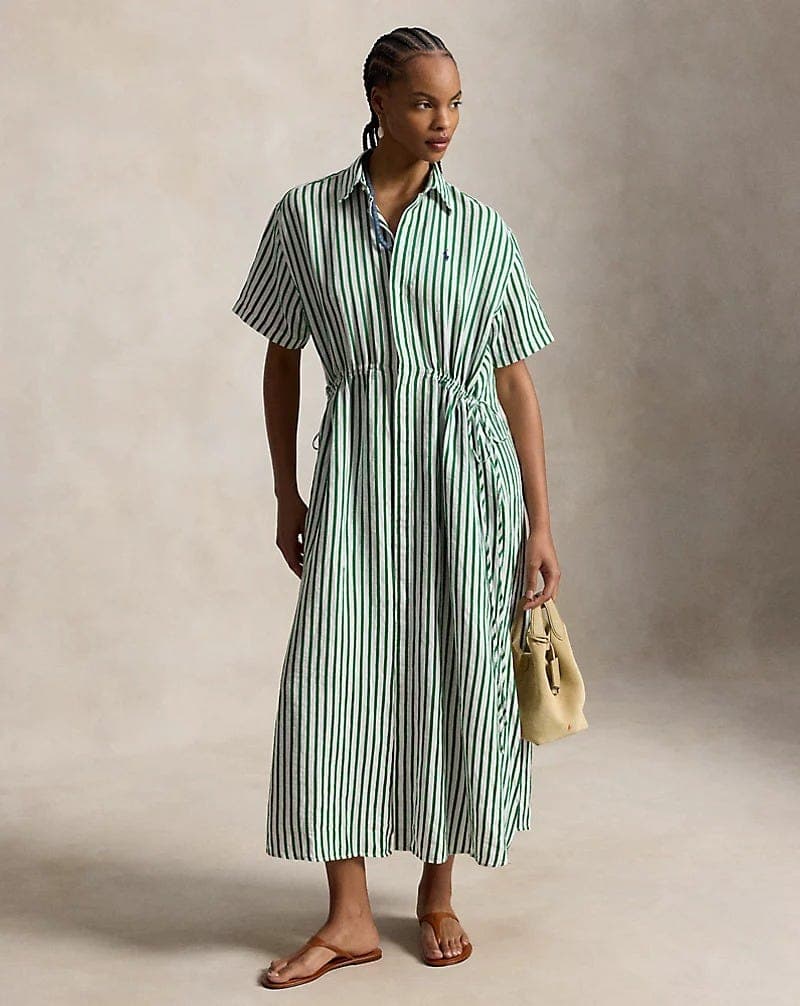
7. Chestnut and ivory striped shirt dress. The single-piece outfit for warmer April days, and the capsule's only pattern. A Boden dress in chestnut and ivory stripes reads as incredibly useful across the whole wardrobe, adding visual interest without breaking the palette.
8. Brown loafers. The footwear anchor. Whether suede or smooth leather, a flat brown loafer connects every lower half in the capsule. SoftWalk offers a reliable version for all-day wear.
9. Ivory ballet flat. The lighter alternative for the skirt and the shirt dress. More delicate, appropriate once the weather holds above 15 degrees.
10. Amber-toned wool scarf. The Santorus scarf is "perfection" in the context of this palette because it bridges brown and rust without competing with either, and functions as a visual connector across the whole wardrobe.
Five Outfit Formulas for April's In-Between Days
The mark of a well-built capsule is that outfit assembly takes seconds, not decisions.
1. The layered morning: Rust turtleneck + corduroy trousers + brown loafers + cashmere cardigan draped open. Remove the cardigan by midday; keep the amber scarf if the wind picks up.
2. The teal pivot: Dark teal merino top tucked into the brown linen skirt + ivory ballet flats + cashmere cardigan. The capsule's most visually striking combination; the accent color takes the lead.
3. The effortless stripe: Chestnut and ivory shirt dress + brown loafers + amber scarf loosely tied at the neck. One piece, fully dressed. The loafer's weight grounds the lightness of the dress.
4. The tonal column: Brown cashmere cardigan over ivory tee + corduroy trousers + brown loafers. All warm neutrals, three different textures. The corduroy's ribbing and the cardigan's softness create enough variation that the outfit never reads flat.
5. The weekend edit: Ivory tee + brown linen skirt + ivory ballet flats + amber scarf tucked into a bag. Lightweight, relaxed, completely coherent. Add the rust turtleneck underneath if the temperature drops below 12 degrees.
Why Art Beats a Trend Report
In *Spirit of Autumn*, the natural seems dreamlike rather than literal, and that quality, the sense of a mood distilled rather than documented, is precisely what a wardrobe built from it reproduces. A palette drawn from a painting has an internal logic that no algorithm or trend forecast can replicate: every color already belongs with every other color, because they already coexist on a single canvas.
Brown and rust echo warm hair and skin tones; the changeable aqua of the teal accent reads differently in different lights, which is exactly what makes a small wardrobe feel larger than it is. The textures, corduroy against merino against linen against cashmere, supply the visual complexity that the narrow palette deliberately withholds.
Ryder spent years reworking his canvases, returning to the same palette until the result felt inevitable rather than labored. A wardrobe built on those tones earns the same quality: not effortful coordination each morning, but a style signal so consistent it begins to feel like yours.
This article was produced by Prism’s automated news system from verified source data, official records, and press releases, then run through automated quality and moderation checks before publishing. The system is built and supervised by the people who set the standards it runs under. Read our full AI policy.
Did this article answer your question?