Backless Loafers Are Spring 2026's Easiest Route to Polished, Effortless Style
Backless loafers landed on five spring 2026 runways at once. Here's how they outperform sneakers and mules, and exactly how to wear them.
The Shoe That Conquered Five Runways Simultaneously
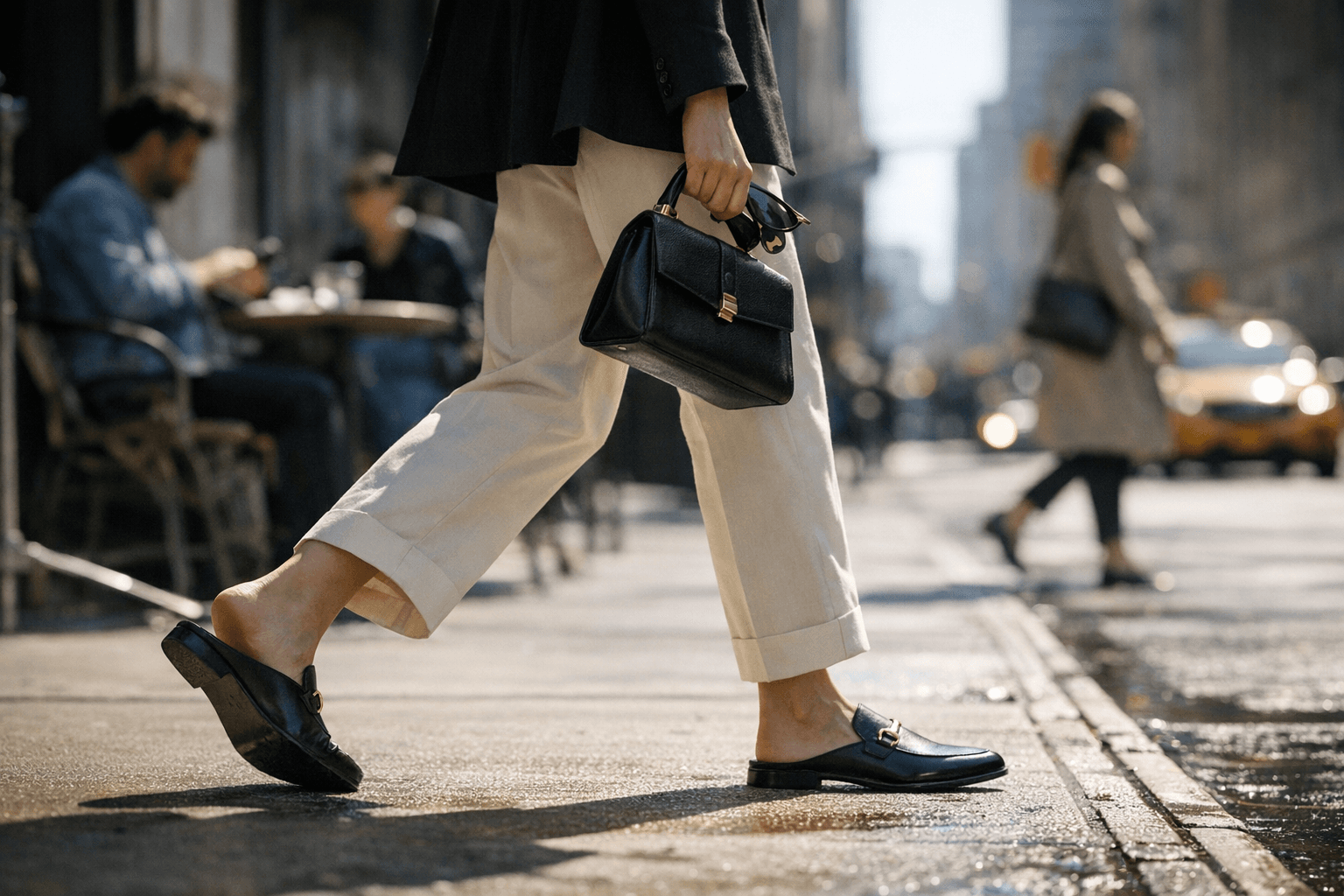
Five runway collections. One shoe silhouette. That kind of consensus doesn't happen by accident. At Ferragamo, the penny loafer lost its ankle support and gained a new kind of cool. At Celine, croc-embossed leather slippers took the same open-heel logic somewhere quieter and more luxurious. Tod's sent out backless boat shoes. Bottega Veneta went flat with soft leather trim. Victoria Beckham put the silhouette on block heels with knife-sharp pointed toes. The detail that tied every single pair together: nothing at the back. Just structure at the front, open at the heel, and an instant answer to the eternal spring question of how to look put-together without trying too hard.
This isn't the backless loafer's first moment. Most people's earliest memory of the silhouette is Gucci's fur-lined Princetown, which had a different energy entirely: intentionally sloppy, deliberately luxe-casual. What's happening for Spring 2026 is a harder reset. The shapes are either slouchy and suede or sharp and structured, but they're uniformly pared back. No fur, no excess hardware, no statement. Just a clean loafer vamp and an open heel that reads as chosen, not compromised.
Why It Beats Sneakers and Mules at Their Own Game
The commuter who reaches for a white sneaker every morning is solving a real problem: comfort, speed, versatility. But sneakers carry weight in an outfit, visually and tonally. They pull everything toward casual. The backless loafer solves the same problem (slip on and go, no laces, no fuss) while keeping the look on the polished side of the line. Fashion editors at Who What Wear put it plainly: cool dressers are wearing backless loafers "instead of sneakers" this season, which is a meaningful shift given how dominant the clean sneaker has been for the past four years.
Mules are the other obvious comparison, and it's worth being specific about the difference. A mule opens across the top of the foot; a backless loafer keeps that closed, structured toe box that gives it a business-in-the-front quality. That loafer vamp is the whole point. It's what makes the shoe read corporate-appropriate in a way that a slip-on sandal or a flat mule simply cannot. The backless loafer occupies a precise middle lane: more structured than a mule, less committed than a full loafer, faster than either sneaker or lace-up flat.
On silhouette, the current iterations win through subtraction. Low-slung profiles, minimal detailing, no chunky platforms (though a handful of suede round-toed versions are offering a deliberately slouchy alternative). Calvin Klein and Bottega Veneta's interpretations, in particular, are the kind of shoes that would work overtime in a professional rotation without ever demanding attention. That invisibility is exactly the point.
The Fit Guide: Solving Heel Slip Before It Ruins Everything
The honest conversation about backless loafers starts here, because the silhouette's one real liability is fit. Without a heel counter, the shoe has no mechanical grip on your foot. A pair that's even slightly too large will slip with every step, and that's a blister waiting to happen. Here's how to handle it:
- Size down if you're between sizes. Unlike a closed loafer where you can wear thicker socks to compensate, a backless style needs to sit snugly on the forefoot from day one. The toe box should feel secure, not roomy.
- Add heel grips. Stick-on heel pads, available in leather or foam, narrow the gap between your heel and the shoe's back opening. They're the single most effective fix for a pair that's technically the right size but still slips on harder floors.
- No-show socks with silicone heel grips. The best option for all-day wear: a liner sock that's invisible above the shoe but has a non-slip strip at the heel. They handle both moisture and slippage, which means no friction blisters on a commute that runs longer than expected.
- Tongue pads or insoles for forefoot fit. If the loafer gaps at the front, a thin tongue pad pushes your foot back and creates a more stable base. Cushioned insoles also make a flat-soled loafer significantly more comfortable on city pavement.
- Skip the socks only after break-in. Going barefoot in a brand-new leather backless loafer is a one-way ticket to raw heels. Wear liner socks for the first week, let the leather soften to your foot shape, then reassess.
3 Outfits That Make Them Look Modern
The styling logic is straightforward once you accept that the backless loafer does the polish work for you. The outfits that work best are ones that let the shoe be the most structured thing in the look.
Tailored trousers: A cropped or full-length tailored trouser paired with a backless loafer is the closest thing fashion has to a uniform formula right now. The contrast between the sharp trouser break and the open-heeled shoe creates exactly the kind of deliberate tension that reads effortless rather than stiff. Stick to tonal dressing (black loafer, charcoal trouser, ivory top) or go for a texture contrast, the way smooth leather loafers read sharper against a heavier wool or linen blend. Either way, keep the top half relaxed: an untucked shirt or a soft knit prevents the look from veering toward costume.
Straight-leg denim: The puddled or slightly cropped straight leg is the denim cut that works hardest here. Avoid skinny fits (the loafer disappears) and wide-leg silhouettes that bury the shoe entirely. A mid-rise straight jean with the loafer peeking out at the hem is a clean, current combination: the kind of outfit Selena Gomez, who was recently spotted in LA wearing a backless loafer variation, makes look accidental. Dark rinse or raw indigo keeps it sharp; if you're working with a lighter wash, lean into it with a matching denim top for a tonal moment that's been everywhere from the streets of London to the Paris boutique circuit this spring.
Slip skirt: This is where the backless loafer earns its reputation for effortless polish most convincingly. A bias-cut or straight midi slip skirt in silk or satin already has an inherent dressiness; the loafer brings it back to earth without sacrificing the silhouette. The combination works because both pieces share the same underlying logic: minimal, liquid, no excess. A fitted tank or simple crewneck on top keeps the proportion balanced. Avoid anything too oversized or structured up top, because the slip skirt and backless loafer combo is doing its work through simplicity, not layering.
The Bigger Picture
What the backless loafer's Spring 2026 moment actually signals is a broader recalibration of what "polished" means. The shoe doesn't ask you to dress around it. It doesn't demand a specific heel height, a particular silhouette, or even a matching bag. It works in denim, in suiting, in silk. It slip on in three seconds. It reads professionally. And it's available right now at price points from Steve Madden and Madewell all the way up to Celine. Five runway appearances, one unambiguous direction: spring's smartest shoe move requires almost no effort at all.
Here is the formatted final response:
The Shoe That Conquered Five Runways Simultaneously
Five runway collections. One shoe silhouette. That kind of consensus doesn't happen by accident. At Ferragamo, the penny loafer lost its ankle support and gained a new kind of cool. At Celine, croc-embossed leather slippers took the same open-heel logic somewhere quieter and more luxurious. Tod's sent out backless boat shoes. Bottega Veneta went flat with soft leather trim. Victoria Beckham put the silhouette on block heels with knife-sharp pointed toes. The detail tying every single pair together: nothing at the back. Just structure at the front, an open heel, and an instant answer to the eternal spring question of how to look put-together without trying too hard.
This isn't the backless loafer's first moment. Most people's earliest memory of the silhouette is Gucci's fur-lined Princetown, though this time around there's more variety on offer, from chunky suede round-toed styles to structured collapsibles. What's happening for Spring 2026 is a harder reset. The backless loafer has returned with a more relaxed edge, echoing the overarching theme of SS26. Silhouettes are either slouchy or chunky, bringing a polished ease that can be styled up or down. No fur, no excess hardware, no statement: just a clean loafer vamp and an open heel that reads as chosen, not compromised.
Why It Beats Sneakers and Mules at Their Own Game
The commuter who reaches for a white sneaker every morning is solving a real problem: comfort, speed, versatility. But sneakers carry weight in an outfit, visually and tonally. They pull everything toward casual. The backless loafer solves the same problem (slip on and go, no laces, no fuss) while keeping the look on the polished side of the line. Influencers have been sporting the trend with their simple outfits, elevating their looks by just slipping on backless loafers. Fashion editors have framed it directly: cool dressers are reaching for backless loafers instead of sneakers this season, which is a meaningful shift given how dominant the clean sneaker has been for the past four years.
Mules are the other obvious comparison, and it's worth being specific about the difference. Unlike open mules, backless loafers keep a closed, structured toe box that gives them a business-in-the-front quality. Easy slip-ons from Bottega Veneta, Calvin Klein, and Celine work overtime in a professional rotation. The backless loafer occupies a precise middle lane: more structured than a mule, less committed than a full loafer, faster than either sneakers or lace-up flats. Backless loafers and mules offer structure up front with breezy, effortless comfort in the back, but the loafer vamp is what tips the balance toward polish when you need to walk into a meeting or a dinner without changing shoes.
The Silhouette Logic
On proportion, the current iterations win through subtraction. Each fashion house had its own design prerogative, but every pair highlighted what makes loafer mules so compelling: they're an easy slip-on-and-go shoe. Unlike house slippers you'd wear outside in a pinch, these were polished and professional, even suitable for a corporate office. Low-slung profiles, minimal detailing, and a deliberate absence of ornamentation define the look. The shoe doesn't fight for attention; it earns it by not trying.
The Fit Guide: Solving Heel Slip Before It Ruins Everything
The honest conversation about backless loafers starts here, because the silhouette's one real liability is fit. Without a heel counter, the shoe has no mechanical grip on your foot. A pair that's even slightly too large will slip with every step, and that's a blister in the making. Here's how to handle it:
- Size down if you're between sizes. Unlike a closed loafer where thicker socks compensate, a backless style needs to sit snugly on the forefoot from the start. The toe box should feel secure, not roomy.
- Add heel grips. Stick-on heel pads, available in leather or foam, add comfort and narrow the gap between your heel and the shoe's back opening — the single most effective fix for a pair that's technically the right size but still slips on smooth floors.
- No-show socks with silicone heel grips. No-show socks can provide the benefits of regular socks without being visible, reducing heel slip and blister friction for all-day wear. Opt for a liner with a non-slip silicone strip at the heel rather than a standard cotton ankle sock.
- Tongue pads or insoles for forefoot fit. Wearing socks can also improve fit if loafers feel slightly roomy. A thin tongue pad pushes your foot back for a more stable base, and a cushioned insole makes a flat-soled loafer significantly more comfortable on city pavement.
- Break them in before going barefoot. A well-fitted pair of loafers should hug your feet like gloves. As time goes by, the insoles wear down and the heel cups soften, conforming to the shape of your foot. Wear liner socks for the first week, let the leather adapt, then reassess the bare-foot option.
3 Outfits That Make Them Look Modern
The styling logic is straightforward once you accept that the backless loafer does the polish work for you. The outfits that land best let the shoe be the most structured thing in the look.
Tailored trousers: A cropped tailored trouser and a pair of loafers are a match made in heaven, one of the classic combinations that has stood the test of time. The contrast between the sharp trouser break and the open-heeled shoe creates exactly the kind of deliberate tension that reads effortless rather than stiff. Stick to tonal dressing (black loafer, charcoal trouser, ivory top) or go for texture contrast: smooth leather loafers read sharper against a heavier linen or wool blend. Keep the top half relaxed with an untucked shirt or soft knit to prevent the look from tipping into costume.
Straight-leg denim: The mid-rise straight leg is the cut that works hardest here. Avoid skinny fits (the loafer vanishes into the hem) and wide-leg silhouettes (the shoe disappears entirely). Backless loafers were seen at Calvin Klein and Bottega Veneta, while there's a clear shift away from chunky soles to a slimline profile that shows best beneath a clean denim hem. Selena Gomez was recently spotted in LA wearing a backless loafer variation, keeping the rest of the outfit minimal so the shoe did its job quietly. Dark rinse or raw indigo keeps the combination sharp; a lighter wash works beautifully in a tonal denim-on-denim moment that's been moving from the streets of Paris to Brooklyn all spring.
Slip skirt: This is where the backless loafer earns its effortless-polish reputation most convincingly. A bias-cut or straight midi slip skirt in silk or satin already carries an inherent dressiness; the loafer grounds it without sacrificing the silhouette. Both pieces share the same underlying logic: minimal, liquid, nothing wasted. A pleated midi skirt paired with a tucked-in blouse is a natural spring combination, and swapping the expected ballet flat for a backless loafer immediately modernizes the proportion. Keep the top fitted and simple. The slip skirt and backless loafer combination works through restraint, not layering.
The Bigger Picture
What the backless loafer's Spring 2026 moment actually signals is a broader recalibration of what "polished" means on the commute and beyond. If you love a shoe that looks professional but feels like a slipper, this is your season. Backless loafers offer structure up front with breezy, effortless comfort in the back. The silhouette doesn't ask you to dress around it. It works in denim, in suiting, in silk. It slips on in under three seconds. And it's available right now at price points from Steve Madden and Madewell all the way up to Celine and Ferragamo. Five runway appearances, one unambiguous direction: spring's smartest shoe is also its easiest.
This article was produced by Prism’s automated news system from verified source data, official records, and press releases, then run through automated quality and moderation checks before publishing. The system is built and supervised by the people who set the standards it runs under. Read our full AI policy.
Did this article answer your question?