Tokyo Street Style Proves Layering Can Look Effortless and Inventive
Tokyo's April streets swing 13 degrees between dawn and dusk, turning a weather problem into the city's most-copied aesthetic. Here's the layering playbook.
13 degrees. That's the temperature gap between an early Tokyo morning this April and the mid-afternoon peak, a swing wide enough to make single-outfit dressing borderline impossible and smart layering an absolute necessity. What the rest of the world spends years chasing as a style "aesthetic," Tokyo's streets have developed out of sheer practical need, and the result is a masterclass in transitional dressing that translates directly to any city, any closet.
Why Tokyo's Layering Actually Works
The logic starts with the weather. April in Tokyo sits in what locals call 季節の変わり目 (kisetsu no kawarime), the in-between season when temperatures dip to 7°C at dawn before climbing toward 20°C by afternoon. You're not layering because it looks good; you're layering because a coat at 8am becomes genuinely unnecessary by noon. That constraint is everything. It forces proportion discipline, intentional color choices, and silhouettes that hold together even when the topper disappears. Tokyo's street style doesn't look effortless because it was thrown on carelessly. It looks effortless because every layer was chosen to survive without the others.
The neighborhoods producing the most interesting looks right now are Shimokitazawa and Koenji: low-rent, deeply thrifted, and completely unconcerned with trend cycles. Shimokitazawa runs on vintage finds sourced from US and European markets, with shops like Flamingo operating across five locations in the neighborhood under the philosophy "Wear 100-year-old clothes for another 100 years." The result is a street style language that mixes a 1990s Japanese domestic-label blazer with a Comme des Garçons tee and a vintage military surplus outer, without the combination reading as costume. The cohesion comes from silhouette discipline, not brand matching.
The Signatures on the Street
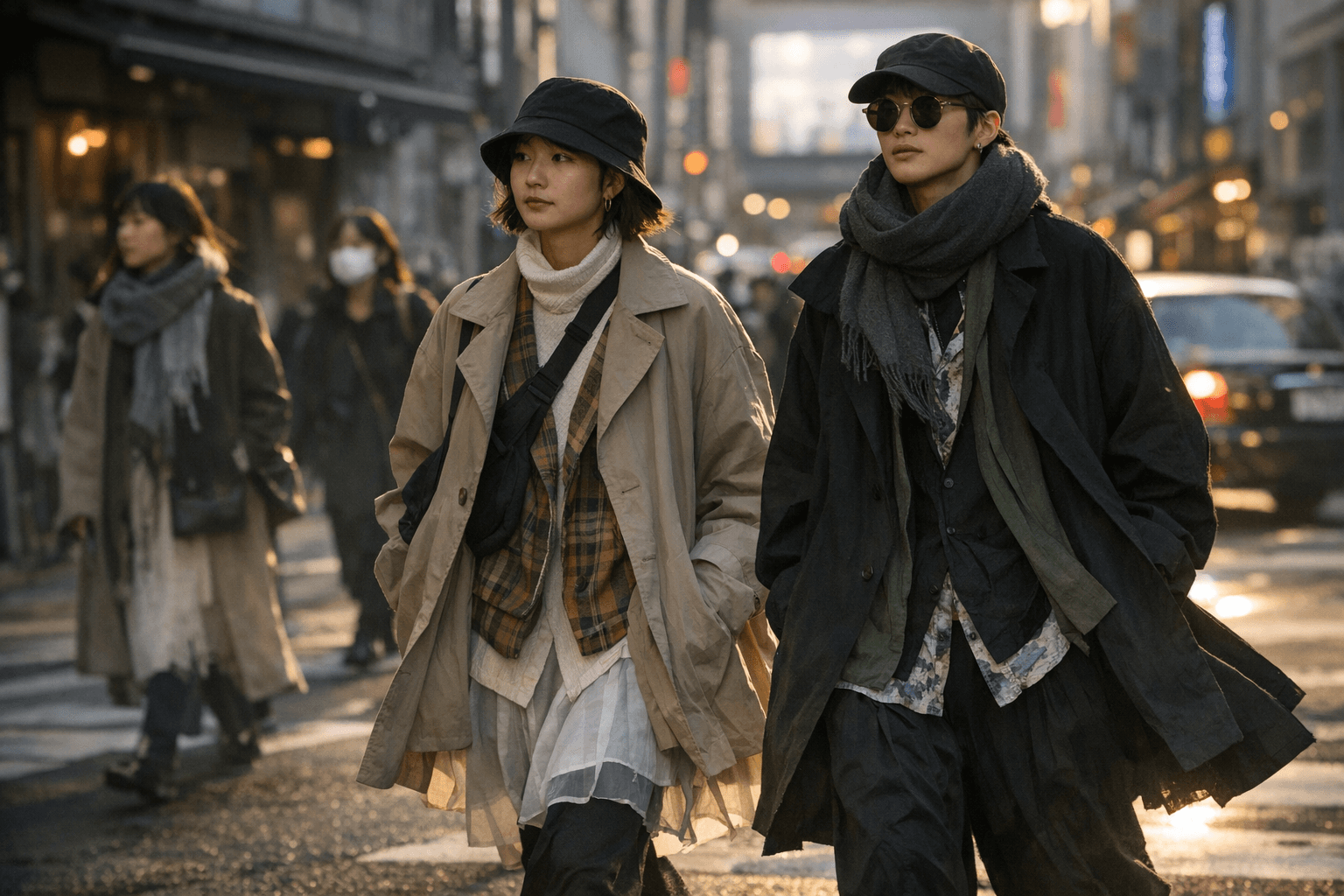
Walk Shimokitazawa or Harajuku any morning this month and the same structural ideas repeat across wildly different aesthetics. Oversized coats worn over deliberately sheer underlayers. Long silhouettes stacked under equally long silhouettes: a sheer midi over wide trousers, a maxi overshirt under a deconstructed blazer. Relaxed tailoring worn as though it were found rather than purchased. Scarves and knit vests deployed as proportion-breaking layers between the mid and the topper, adding a third visual plane without adding bulk.
Comme des Garçons and MM6 Maison Margiela pieces appear frequently across these neighborhoods, but rarely as the complete look. They're integrated into otherwise thrifted or indie-label outfits. Comme des Garçons' long-sleeve tees function as primary layering tools, worn under oversized jackets or statement vests that contribute visual depth without adding weight. MM6's deconstructed tailoring brings a quality of looking intentionally undone, which sits naturally alongside Shimokitazawa workwear finds and heavy vintage knitwear. Further downtown, Sacai and Undercover appear in outfits where technical fabrications and raw-hem detailing merge with luxury pieces in ways that feel observed rather than assembled. The common thread across all of it: volume is always answered with restraint somewhere else in the outfit.
The Layer Recipe Format
Tokyo street style breaks down into a repeatable structure: base layer + mid layer + topper + one styling trick. The styling trick is where the effortlessness actually comes from, the single small decision that makes a layered look feel unconsidered rather than overpacked. Here's how that translates into five formulas.
- Base: Sheer or semi-sheer tank, slip dress, or gauze long-sleeve in a neutral (ivory, grey)
- Mid: Fitted or slightly boxy knit vest or crewneck
- Topper: Voluminous coat, belted or left open
- Styling trick: Let the sheer layer extend visibly below both the mid and the topper. The exposed hem length is the point, not a mistake.
Formula 1: Sheer Base, Structured Mid, Oversized Topper
Weather logic: The coat comes off by noon; the sheer-and-knit combination carries the outfit through the warmer afternoon without looking like you forgot your outer layer at home.
- Base: Wide-leg trouser or maxi skirt in a muted solid
- Mid: Oversized button-down or deconstructed blazer, deliberately untucked and overlong
- Topper: Shorter coat or structured vest layered over the shirt
- Styling trick: Match the hem of the mid to the hem of the trouser in length but not exactly. The slight discrepancy reads as deliberate tension, not an accident.
Formula 2: Long-Over-Long
Weather logic: No single piece handles all the temperature work. The button-down manages the cool morning, the vest handles the evening breeze, and the trouser's width keeps air moving during the warm afternoon middle.
- Base: Simple ribbed long-sleeve or thin turtleneck in white or black
- Mid: Nothing, or a very thin, barely-there overshirt
- Topper: Statement vintage outer: military surplus jacket, oversized heritage blazer, worn-in field coat
- Styling trick: Keep everything beneath the outer so minimal it reads as a foil for the topper's character. The base layer should feel almost undergarment-clean in contrast.
Formula 3: Vintage Outer, Clean Inner
Weather logic: One heavy vintage piece instead of multiple light layers. In April Tokyo, this formula works from 14°C upward with the right base fabric.
- Base: Fine-gauge turtleneck or long-sleeve
- Mid: Wide-leg or relaxed-fit trouser, clean and uncomplicated
- Topper: Lightweight trench or oversized coat, left open
- Styling trick: Add a large-format scarf or wrap loosely across the shoulders, tucked under the coat, creating a third visual plane between neck and hem. This is a distinctly Tokyo move, borrowing the vest-layer logic but with more softness.
Formula 4: Scarf as the Third Layer
Weather logic: A scarf is the easiest piece to remove as temperatures climb without dismantling the entire outfit structure.
- Base: Fitted long-sleeve in sheer or gauze fabric
- Mid: Relaxed straight-leg trouser or midi skirt, kept minimal
- Topper: Knit or padded vest worn as the topmost layer, over a button-down or light jacket
- Styling trick: Size the vest up so it hits at hip or below. Right now on the streets, vests function as outerwear, not as something hidden beneath a coat.
Formula 5: Vest Over Everything
Weather logic: Vests add core warmth without sleeve bulk, which makes them uniquely suited to April's daytime highs. On, off, and back on again without disrupting anything underneath.
Translating It at Home
None of this requires specific brands. The Comme des Garçons tee and the Shimokitazawa vintage coat are illustrative, not prescriptive. What Tokyo is actually demonstrating is a philosophy: build for the day's full temperature range, not just its peak. Treat each layer as a separate compositional element with its own silhouette logic. Let proportion do the aesthetic heavy lifting, not color matching or logo placement.
The reason Tokyo's street style looks so consistently considered, even when it's built from thrift-store finds and indie domestic labels, is that it follows these structural rules instinctively. The fashion vocabulary is specific to the city; the layering grammar is entirely universal. Master the grammar and the vocabulary takes care of itself.
This article was produced by Prism’s automated news system from verified source data, official records, and press releases, then run through automated quality and moderation checks before publishing. The system is built and supervised by the people who set the standards it runs under. Read our full AI policy.
Did this article answer your question?