The Trench Coat Is Spring's Most Effortlessly Chic Outer Layer
Five styling moves separate a trench coat that reads "New York commuter" from one that reads "just flew in from Paris." Here's exactly which details matter.
The Coat That Makes New Yorkers Ask Which Arrondissement You Live In
Five moves. That is all that separates a trench coat that reads "commuter heading uptown" from one that stops people mid-sentence with a compliment they can't quite explain. Parisians treat the classic trench coat like an accessory: grasped in hand, draped haphazardly over the shoulders, or buttoned all the way to the top. Their instinct to contrast traditional spring outerwear with textural elements turns a predictable choice into something modern. That instinct, not the coat itself, is what your New York friends are responding to when they say you look Parisian.
The trench coat has been earning that compliment for nearly 200 years, and the story of how it became synonymous with effortless French elegance is more complicated, and more interesting, than most people realize.
From Battlefields to the Boulevard
The trench coat's origins date to the early 1820s, when Scottish chemist Charles Macintosh and British inventor Thomas Hancock pioneered the first waterproof coats. The two brands most associated with the modern version have been competing for precedence ever since. In 1853, Mayfair clothier John Emary developed and patented a water-repellant fabric and renamed his company Aquascutum, from the Latin "aqua" (water) and "scutum" (shield). Thomas Burberry, born in Surrey in 1835, founded his eponymous company in 1856, which is now celebrating its 170th anniversary. In 1879, inspired by the lanolin-coated waterproof smocks worn by Hampshire shepherds, Burberry invented gabardine: a breathable, weatherproofed twill made by coating individual fiber strands rather than the whole cloth. It was technical enough to outfit the British Army's field uniform in 1902 and to wrap Sir Ernest Shackleton for his 1907 Antarctica expedition. The trench coat as a distinct garment emerged during World War I as an alternative to heavy greatcoats, and many veterans returning to civilian life simply kept wearing them. That post-war crossover was the first time the coat moved from utility to culture.
Hollywood Built the Parisian Myth
The trench coat's French identity was not, in fact, born in France. It was projected there by cinema. Audrey Hepburn wore a Burberry trench in the climactic rain scene of Breakfast at Tiffany's, soaked to the skin searching for Cat in the street: exactly, as Sotheby's has noted, as Thomas Burberry originally intended the coat to be worn, "rain-soaked in a downpour." Sophia Loren wore one in The Key in 1958. Brigitte Bardot wore one in Babette Goes to War in 1959. Catherine Deneuve wore one in The Umbrellas of Cherbourg in 1964. Those four performances, across a single decade, fused the trench coat with a particular kind of windswept, slightly careless French femininity that no amount of marketing spend has since replicated. The phrase "je ne sais quoi," literally "I don't know what" in French, has been used to describe ineffable elegance since at least the 17th century; the trench coat may be the only garment that has genuinely absorbed it.
What the Spring 2025 Runways Confirmed
Some fashion observers are calling 2025 "the year of the trench," and the Spring/Summer 2025 runways backed the claim emphatically. Burberry showcased several iterations, including a high-low version complete with a scarf. Max Mara styled its spin alongside a matching maxi skirt. Ganni wrapped its creation with not one but two belts. Prada, JW Anderson, Sacai, Loewe, Vetements, and Coperni all showed short or cropped options, with Coperni, Rokh, and Sacai pushing into cape-like silhouettes, asymmetrical cuts, and leather panelling. At accessible price points, Mango, H&M, and & Other Stories all delivered strong on-trend interpretations. The dominant silhouette: shorter, boxier, and deliberately less formal than the classic knee-length version, while the traditional length held its ground as the more versatile choice.
The market data reflects the momentum. The global trench coat market is estimated at $1.4 billion in 2024 and is projected to expand to $2.5 billion by 2033, at a compound annual growth rate of 7.5%. Europe accounts for the largest regional share, driven by the garment's deep historical roots on the continent and the continued strength of French and British fashion industries.
The Five Details That Read "Parisian"
This is the teachable part. The gap between a trench coat that looks like outerwear and one that looks like a finishing touch comes down to five specific choices.
Length. The classic knee-length or just-below-knee coat creates the best silhouette when belted: a defined column of fabric with enough movement to feel relaxed. The cropped version, now all over the SS25 runways, delivers a more contemporary proportion. Whatever you choose, avoid anything that ends at mid-thigh; it interrupts the line without committing to either silhouette.
Lapel shape. Wide notch lapels worn slightly open read more effortlessly than a coat buttoned stiffly to the throat. The collar is meant to be popped: that slight lift at the neck is precisely the degree of drama Parisian dressing trades in. It signals wind, motion, and somewhere more interesting to be.
Belt treatment. This is the single detail that most separates polished from stiff. Avoid tying the belt in a formal bow at the front. The alternatives: draped loosely to one side, knotted at the back, or threaded through just one side loop and left to fall. Ganni's double-belted runway interpretation was the maximalist version of this same instinct: the belt as styling tool, not structural closure.

Sleeve push. Shove the sleeves up slightly, just below the elbow. This single micro-adjustment signals ease in a way that a precisely tailored, perfectly positioned sleeve cannot. It communicates that the coat was thrown on in transit, that you had somewhere more urgent to be.
The cape effect. Drop the coat entirely off your shoulders and let it rest across your upper back, held in place by posture or loosely gripped at the lapel. This is the move. It transforms the trench from something you're wearing into something you're carrying, which is the entire point of dressing the way Parisians do.
Five Outfit Upgrades for the Way New York Actually Works
A trench coat earns its place in a New York wardrobe by solving three specific transitions at once: the slick subway stairs on a wet April morning, the midday meeting that stretches into a late lunch, and the outdoor dinner that starts chilly and ends cold. Here is what to wear underneath it.
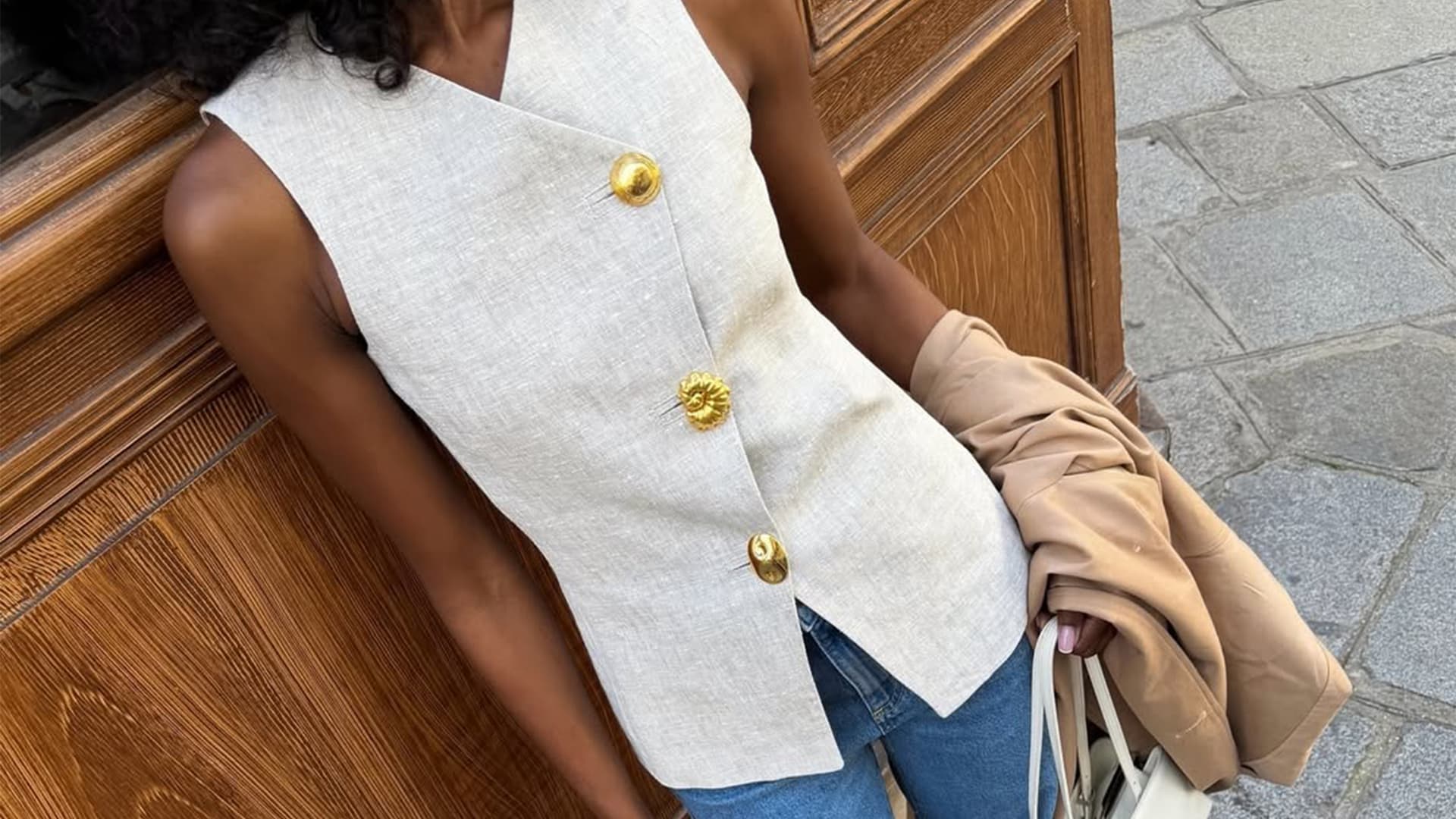
- Bootcut jeans + high-neck vest: The straight line of a bootcut balances the coat's volume below the hip. Belt the trench loosely and let the vest create a layered, tone-on-tone column underneath. This is the formula for a Saturday that starts at the farmer's market and ends at a gallery.
- Midi skirt + woven tote: A fluid midi skirt underneath a knee-length trench creates layered movement without any visible effort. The woven tote signals spring without a single floral print in sight, which is exactly the kind of restraint that reads French.
- Animal-print bag + trench: The trench's neutrality is its greatest structural asset: it makes a loud accessory look intentional. Leave the coat open and unbelted so the bag does the work, not the outerwear.
- V-neck sweater + slingbacks: The office-to-dinner formula. The V-neck keeps the neckline from reading too covered-up; slingback kitten heels add just enough heel to shift the register from daytime to evening without requiring a wardrobe change on a Tuesday.
- Buttoned-up shirt + wide-leg pants: Button the trench from collar to hem for what Josephine Hadjiloucas of Who What Wear describes as the "full khaki effect," then anchor the volume below with wide-leg trousers and heeled boots. It is the most architectural of the five formulas, and the one most likely to earn the compliment you're after.
Your Trench-Buying Checklist
Before committing to a coat, run through these details:
- Fabric: Cotton gabardine is the benchmark. It drapes well when open, holds structure when belted, and handles spring rain without losing its shape. Poplin is lighter and appropriate for warmer weeks; technical fabrics extend the coat's range but lose some of the characteristic drape.
- Length: Knee-length is the most versatile. Cropped works if you plan to layer underneath or run warm. Avoid anything that ends at the widest point of your hip.
- Belt and loops: The belt loops should be positioned at a height that creates a defined waist when tied. Too high and the coat bunches; too low and the proportion collapses entirely.
- Lapels: Wide enough to pop at the collar without looking theatrical. Narrow lapels sacrifice the Parisian proportion the garment depends on.
- Construction details: Storm flap, epaulettes, D-ring tabs, back vent. These are the markers of a properly built trench versus a coat that borrows the silhouette without the structure. If a manufacturer has eliminated them to reduce cost, the coat will show it within a season.
- Sleeve length: Should fall just past your wrist bone when worn normally, leaving enough fabric to push up without bunching.
- Lining: A removable lining extends the coat's usefulness into cooler weeks. A fixed, thin lining is lighter when the weather finally cooperates.
The trench coat spent its first century getting soldiers through rain and explorers through ice. It spent its second century getting Audrey Hepburn, Brigitte Bardot, and Catherine Deneuve through cinema. It will spend this spring getting you through the subway stairs, the spring showers, and the dinner reservation you're already running late for. The only question is whether you're wearing it, or whether it's wearing you.
This article was produced by Prism’s automated news system from verified source data, official records, and press releases, then run through automated quality and moderation checks before publishing. The system is built and supervised by the people who set the standards it runs under. Read our full AI policy.
Did this article answer your question?