Burlington's Chelsea Flagship Signals a Bolder, More Elevated Off-Price Era
Burlington opened an 80,000-sq-ft reimagined flagship at Manhattan's Siegel-Cooper building, where Gucci and Balenciaga now share shelf space with the off-price model's oldest contradiction.
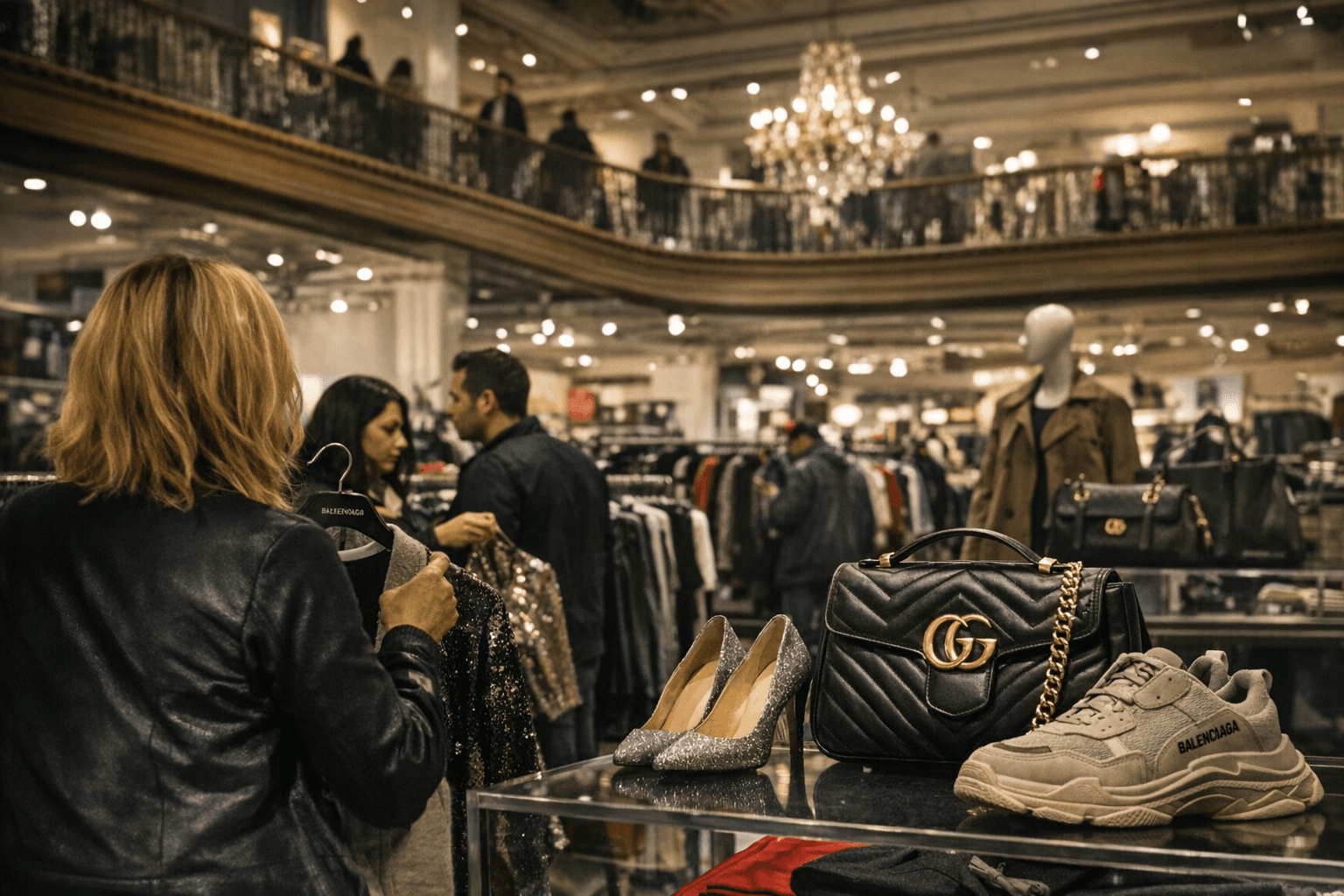
The off-price retail model has always operated on a quiet contradiction: it survives because brands produce too much. Burlington's new 80,000-square-foot Chelsea flagship, which opened April 3 inside the landmark Siegel-Cooper building at 620 Sixth Avenue, makes that paradox more visible than ever. This is the version of Burlington that carries Gucci and Balenciaga on the floor and sells them at up to 60 percent below retail. The question worth asking is whether that's a sustainability win or simply a more polished endorsement of the same overproduction cycle.
CEO Michael O'Sullivan cut the ribbon at 8:25 a.m. on a Friday, flanked by a $20,000 check made out to AdoptAClassroom.org to fund school supplies for local students. The first 100 customers through the doors received $10 bonus cards. The optics were warm and community-oriented. The store itself, however, is something more commercially ambitious: Burlington's most elevated physical format to date, two floors of neon-lit, NYC-iconography-inspired merchandising engineered to move shoppers faster and more deliberately through a curated assortment.
"We expect Chelsea to be among our top-volume stores," O'Sullivan told WWD ahead of the opening. "There's a lot of buzz about Chelsea. It's a very visible new store for us."
The Chelsea store is a relocation from Burlington's nearby location at 707 Avenue of the Americas, and it now occupies space vacated by Bed Bath & Beyond when that chain wound down in 2023. It is Burlington's 74th store in New York state and fifth in the borough of Manhattan, and it shares the Siegel-Cooper building with TJ Maxx and Marshalls, making 620 Sixth Avenue arguably the most concentrated block of off-price retail in the city.
What's physically different here is the execution of Burlington's Store Experience 2.0 initiative. The refresh includes organized aisles and signage that showcases trends, with an open layout designed to enhance the customer experience. Upgrades under Merchandising 2.0 are enabling more store- and climate-specific assortments. At Chelsea, that translated to an emphasis on premium brands and select elevated categories including handbags, sunglasses, and accessories, with Gucci and Balenciaga present during a visit by Jefferies analysts, who noted the sharpened format and navigation.
Barclays analyst Adrienne Yih, who toured the store and met with senior management, cited "tangible progress of Burlington 2.0 initiatives, including assortment elevation and operating efficiencies," and added that the Burlington 2.0 strategy "underscores the durability and scalability of the off-price model."
The durability of the model is not in doubt. What's worth scrutinizing is its environmental logic. Burlington capitalizes on the overproduction and excess inventory of brand-name goods, buying these products at a substantial discount and selling them to consumers at prices 20 to 60 percent lower than traditional department stores. On one reading, that's a genuine circularity story: merchandise that might otherwise be destroyed or landfilled finds a buyer. On another, it's a permission structure, one where brands overproduce knowing the off-price channel will absorb the surplus.
The Chelsea flagship raises those stakes considerably. When Gucci and Balenciaga product flows through Burlington's shelves in a two-floor store designed to maximize throughput, the category of "responsible off-price" gets harder to define. With fresh merchandise arriving each week at up to 60 percent off other retailers' prices, customers will discover something new every time they shop — which is precisely the kind of wardrobe churn the fashion industry's sustainability critics have spent years trying to slow.
Burlington is pushing ahead with its largest expansion yet, planning 110 new store openings in 2026, with Burlington expected to operate approximately 1,320 units by the end of the year. O'Sullivan said Burlington would "probably grow by about 10 percent in sales volume" this year, a projection that depends not just on consumers wanting deals, but on brands continuing to produce at volumes that generate surplus. The Chelsea flagship is the most compelling real estate Burlington has ever occupied. Whether it represents the future of sustainable retail or simply its most stylish contradiction is a question the off-price industry has yet to seriously confront.
This article was produced by Prism’s automated news system from verified source data, official records, and press releases, then run through automated quality and moderation checks before publishing. The system is built and supervised by the people who set the standards it runs under. Read our full AI policy.
Did this article answer your question?


