Lady Gaga and Doechii unleash maximalist couture in Runway video
Gaga and Doechii turn a film soundtrack launch into couture theater, where crystal corsets, spiked tailoring and Runway branding feel built to spill into real closets.
A fashion video with franchise-level ambition
Lady Gaga and Doechii do not just sing “Runway” in this video, they inhabit a whole fashion system. The first official pairing between the two Grammy winners lands with the kind of theatrical confidence that makes sense for The Devil Wears Prada 2, a sequel already leaning hard into the myth of its own magazine-world glamour. This is not a soundtrack cut tucked on the side. It is the campaign’s style statement, the shot that tells you the film wants its clothes to be part of the plot.
That matters because the franchise name still carries instant cultural shorthand: Miranda Priestly, Andy Sachs, Emily, boardroom severity, and the high-gloss cruelty of a world where a hemline can feel like a power move. “Runway” plugs directly into that legacy, but it does so with a more aggressive, more modern edge. Parris Goebel directs the video, and the visual language is all about impact, not restraint: striped studio energy, dramatic headpieces, couture gowns, a double-breasted suit built for two, and styling that feels red carpet-ready even when it is moving at pop speed.
Couture that reads from across the room
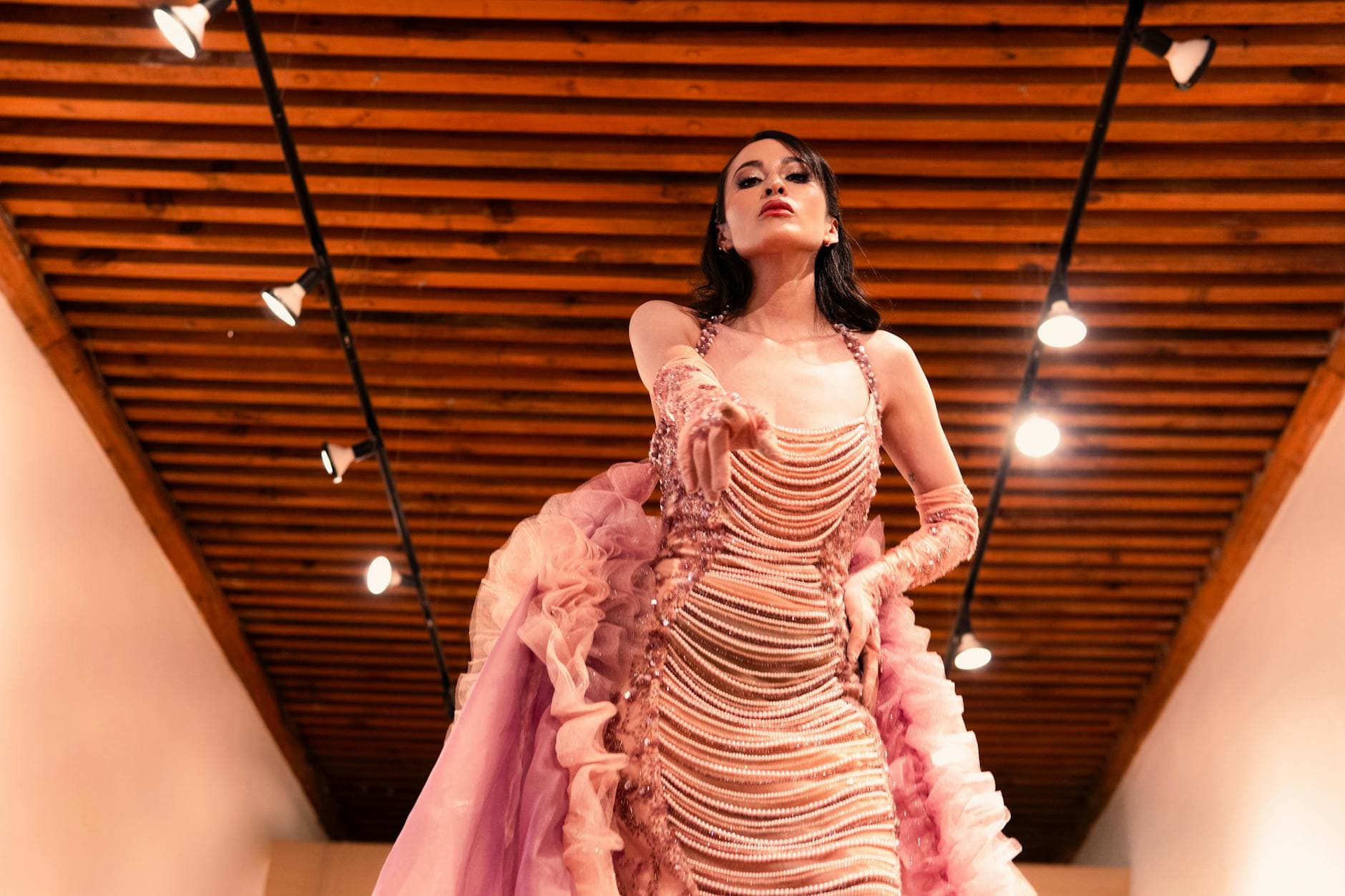
The strongest thing about the video is that it understands how fashion actually travels now. A look does not need to be wearable in the literal sense to become influential; it needs a sharp silhouette, a memorable texture and one detail that survives the scroll. Gaga’s pearl-toned corseted bodysuit has all three. Fully embellished and hand-encrusted with crystals and pearls, it gives her the sheen of something precious and armored at once, a body-construction that feels closer to jewelry than clothes.
Doechii’s answer is darker and more dangerous. Her black corseted bodysuit, layered with spikes and metal studs, pushes the visual into punk-luxe territory, the kind of styling that can mutate into everything from performance wear to after-hours dressing. Together, the two outfits create the video’s central tension: one is luminous and sculptural, the other sharpened and confrontational. That contrast is exactly what makes the clip feel like a trend engine rather than a one-off costume reel.
The scale of the work is part of the appeal too. The custom Gaurav Gupta couture reportedly took about 800 hours of handwork and more than 20 artisans to complete. That is not just an impressive production note. It explains why the garments have such authority on camera. They do not float past the body; they seem built around it, then amplified until each bead, spike and seam reads like a decision.
The looks that are likely to escape the video
What will travel beyond the screen is not every outfit, but the ideas inside them. The striped studio opener feels like a setup for a new kind of office glamour, where tailoring can be graphic and a workspace can look editorial without tipping into costume. The double-breasted suit built for two has real runway-to-real-life potential because it turns tailoring into a social gesture, not just a fit choice. It suggests power dressing that is collaborative, awkward, flirtatious and impossible to ignore.
The headpieces and red carpet-style styling are the other details with staying power. In a season already favoring visible ornament, anything that frames the face with a little absurdity has a strong chance of escaping the video and entering party dressing, editorial shoots and event looks. The fashion mood here is not quiet luxury, and that is precisely why it works. It is maximalist without feeling messy, disciplined without losing its theatrical pulse.
The beauty of this kind of styling is that it gives viewers a few easy takeaways even when the clothes themselves are fantasy-level. Pairing a sharp, double-breasted silhouette with one exaggerated accessory can deliver the same attitude. A corset can be softened with sheen, hardened with studs, or made ceremonial with pearls. That is the real trend lesson in “Runway”: not copy the look, but copy the conviction.
Why the release strategy is as stylish as the clothes
The rollout has been built with the same level of polish. “Runway” is the first track released from The Devil Wears Prada 2 soundtrack, and 20th Century Studios previewed it in the film’s final trailer on April 6, 2026. The music video premiered on Monday, April 27, 2026, and the official upload makes the intent obvious: the song is out now, and it is there to promote the sequel as much as it is to stand alone.
That fashion-first strategy deepens with the limited-edition promotional Runway magazine the studio unveiled as part of the campaign. It is a smart move because it blurs the line between object and aesthetic. A magazine, a trailer, a soundtrack release and a music video all share the same visual vocabulary, which means the franchise is not simply borrowing fashion imagery. It is building a branded universe around it.
The bigger mood: glamour as a public language
The reason this collaboration will be remembered is that it does what the best fashion moments do now: it offers an image people can immediately understand and want to repeat in their own way. You do not need the couture budget to borrow the posture of a crystal corset, the severity of spiked black tailoring or the confidence of a headpiece that refuses to apologize. You just need the willingness to dress like the room is already taking notes.
Lady Gaga and Doechii make maximalism feel less like nostalgia and more like a live wire. In a pop landscape where fashion references are often flattened into content, “Runway” restores a sense of consequence. The clothes are not there to decorate the song. They are the song’s argument: that fashion still has the power to command attention, shape identity and turn a film tie-in into a full-blown style event.
This article was produced by Prism’s automated news system from verified source data, official records, and press releases, then run through automated quality and moderation checks before publishing. The system is built and supervised by the people who set the standards it runs under. Read our full AI policy.
Did this article answer your question?


