ThredUp’s 2026 Resale Report Sees Secondhand Hitting $393B by 2030
More than half of U.S. consumers already shop secondhand. ThredUp projects the global market will hit $393 billion by 2030, growing twice as fast as new apparel.

The secondhand fashion market isn't just growing anymore. It's eating into the sales floor of traditional retail in ways that are measurable, accelerating, and increasingly hard for brands to ignore.
ThredUp's 14th annual Resale Report, drawn from research by analytics firm GlobalData, found that the global secondhand apparel market grew 13 percent in 2025, a year when sales of new clothing were nearly flat. The report projects the market will reach $393 billion by 2030, representing roughly 10 percent of total global apparel spend, growing two times faster than the overall apparel market. In the U.S., resale is growing four times faster than retail overall and is set to hit $78.8 billion by 2030. Fifty-nine percent of American consumers shopped secondhand apparel in 2025, up seven percentage points in three years.
The $393 billion figure merits scrutiny. GlobalData built the model on a January-February 2026 survey of 3,268 U.S. adults and a parallel canvassing of the top 50 U.S. fashion retailers and brands. That methodology captures declared intention better than actual transaction behavior. Projections for a market this fragmented, spanning peer-to-peer apps, luxury consignment platforms, and charity-shop inventory, are inherently difficult to calibrate. What the model assumes is continued supply growth, an assumption that runs directly into the report's most candid finding: supply is the bottleneck.
ThredUp estimates $23.3 billion in incremental U.S. market value will be unlocked by 2030 by making selling easier. Even among buyers who selected "nothing" would motivate them to resell clothing, a third changed their answer when presented with a simpler, more automated listing process. CEO James Reinhart has positioned artificial intelligence as the solution to both mechanical friction, including photography, pricing, and shipping logistics, and the psychological reluctance to part with pieces at all. "The next phase of this market will be defined by who can best unlock supply and use AI to connect that inventory with the next generation of shoppers," Reinhart said.
Online resale is expected to nearly double by 2030, reaching $48.3 billion from $29.7 billion in 2025, at a compound annual growth rate of 10 percent. That expanding availability of listed inventory applies soft downward pressure on what brands can realistically charge for new goods, particularly in the mid-market segments where secondhand alternatives are most accessible. Whether scale resale actually reduces production, rather than simply adding a secondary market alongside it, is a structural question the growth projections do not directly address. Among retailers, 66 percent view resale as a regulatory solution, while 30 percent see it as a strategic lever to improve product design going forward.
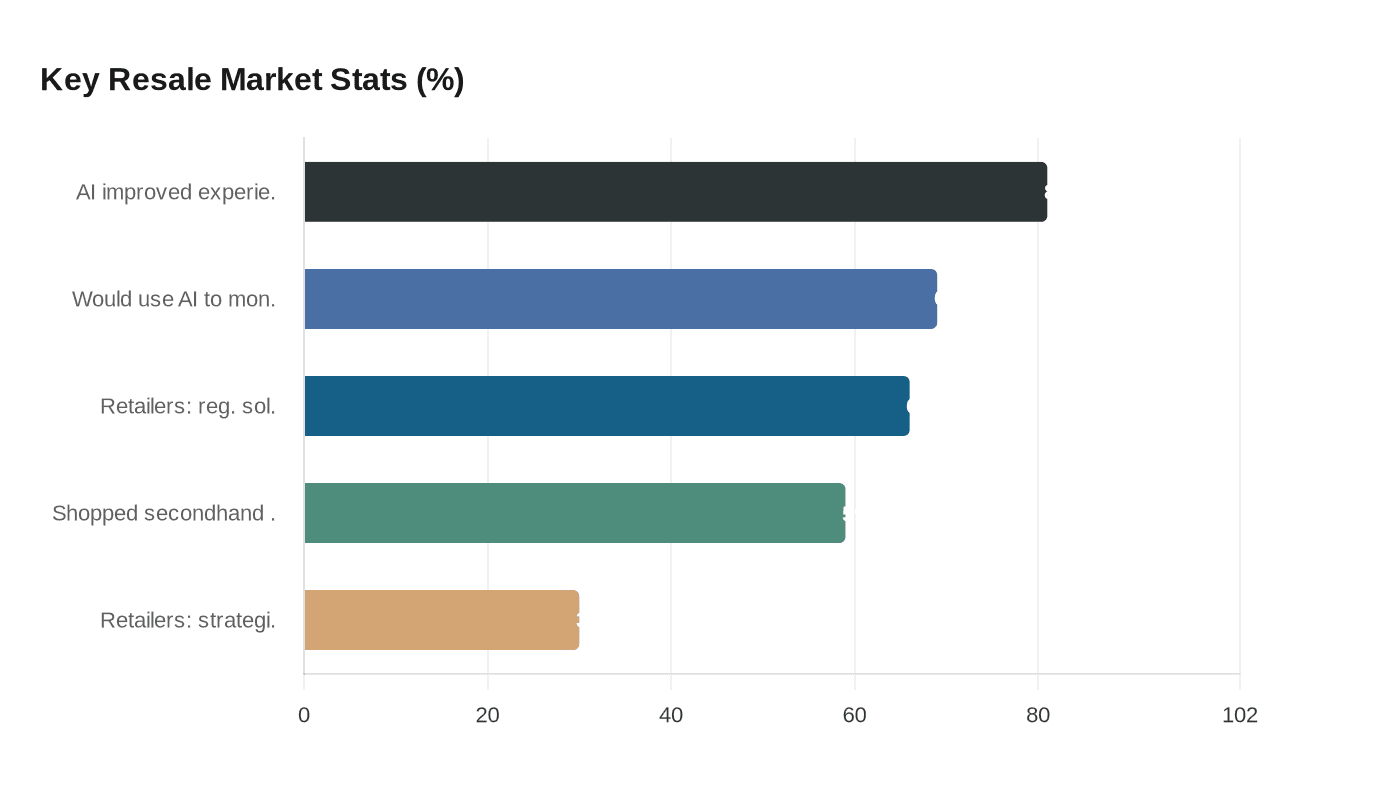
Eighty-one percent of consumers who use AI say it has improved their resale shopping experience, and 69 percent say they would willingly use AI to monitor platforms for hard-to-find items. Danielle Vermeer, ThredUp's head of product, framed the competitive stakes directly: "The next decade of resale will be won by platforms that turn inspiration into curated discovery, community, and a more engaging shopping experience." Gen Z and millennials are expected to drive more than 70 percent of market growth through 2030.
ThredUp's own financials underscore the tension between the bullish narrative and its execution. The company was fashion's fastest-growing stock last year, rising 354.7 percent to $6.32 a share. On the day the report was released, shares traded at $3.36, well below the 52-week high of $12.28. The market, apparently, is applying its own discount rate to the $393 billion story.
This article was produced by Prism’s automated news system from verified source data, official records, and press releases, then run through automated quality and moderation checks before publishing. The system is built and supervised by the people who set the standards it runs under. Read our full AI policy.
Did this article answer your question?


