Why the wrap dress remains fashion’s most enduring silhouette
The wrap dress endures because it solves fit, movement and polish in one piece. Diane von Furstenberg turned a borrowed shape into a smarter buy than most seasonal dresses.
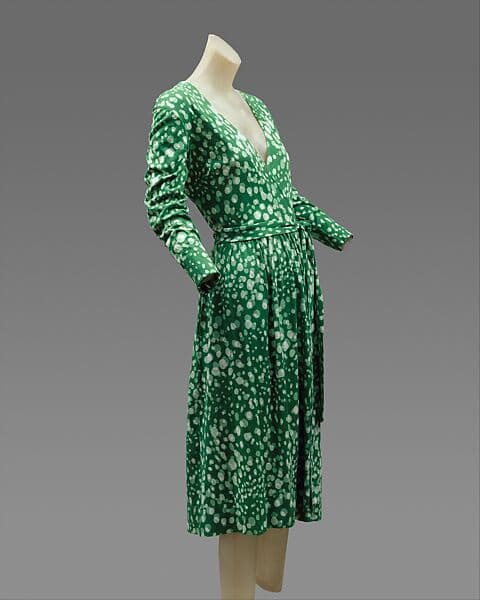
The best wrap dress does not ask you to choose between ease and polish. It cinches at the waist, opens a flattering V-neck, and moves with the body, which is why the silhouette has outlasted most occasion dresses and most of the trend cycles that tried to replace it.
From sportswear logic to modern wardrobe staple
The Metropolitan Museum of Art places Diane von Furstenberg’s wrap dress inside American designer sportswear, a tradition that came into its own in the early 1930s and continued to shape how women dressed into the 1990s. In the museum’s telling, the wrap was a climax to that tradition, not a bolt from nowhere. Its fundamental form was already deeply embedded in earlier American sportswear, and DVF’s breakthrough was to translate it into something more contemporary, more accessible, and far more glamorous.
That shift mattered because the new version was not just cut differently, it looked different. The Met notes that von Furstenberg updated the silhouette with 1970s fabrics and colors that were brighter, bolder, and more synthetic, with stretch that made the dress feel immediate on the body. That is the quiet genius of the wrap dress: it looks simple, but the simplicity is doing a lot of work. The adjustable waist solves fit, the wrap closure allows movement, and the neckline gives the dress shape without stiffness.
1974, and the dress that spread fast
Multiple sources identify 1974 as the year Diane von Furstenberg introduced the wrap dress, and the speed of its rise explains why it never read as a niche idea. Encyclopaedia.com calls it one of American fashion’s top sellers during the first half of the 1970s, and one secondary source says 5 million wrap dresses had been sold within two years of introduction. Those are not the numbers of a delicate fashion insider’s favorite. They are the numbers of a garment that solved a problem for a huge audience.
The New York Times added another useful layer to the story in 2024, noting that von Furstenberg’s design was inspired by early Asian wrap-style closures. That detail matters because it makes the dress feel less like a fixed museum object and more like a design translation, shaped by global precedent and then popularized through American sportswear. The same Times profile also noted that at 28, von Furstenberg was already a sensation with the phenomenally successful $86 wrap dress, which she had conjured after seeing Julie Nixon. By then, the dress had already become the rare fashion item that was both chic and widely legible.
Why it became cultural shorthand
The wrap dress became a symbol of women’s liberation in the 1970s because it offered freedom in a very literal way. It did not demand rigid tailoring or a single idealized body shape. Instead, the fit adjusted to the wearer, which made the silhouette feel less like a costume and more like permission.
That is also why the dress has survived so many returns to the spotlight. Younger women rediscovered wrap dresses in vintage shops in the late 1990s, and DVF responded by redesigning the style for a new generation. In 2015, The Metropolitan Museum of Art brought Diane von Furstenberg into its Atelier with Alina Cho series and identified her as the founder and chairman of DVF, a reminder that the woman and the silhouette are still intertwined in the public imagination. The dress is not just a relic from a loud decade. It is a case study in how design, branding, and wearability can reinforce one another for decades.
What to look for when you buy one now
If you are choosing one wrap dress to keep in rotation, the goal is not novelty. It is structure that behaves like clothing you will actually wear. The best versions are the ones that close cleanly, keep their shape across the torso, and still move when you do. That is where the original DVF idea remains smartest: one dress that can go to the office, then to dinner, then back into your closet without losing its line.
A good wrap should also feel intentional in the fabric. The Met’s emphasis on brighter, bolder, more synthetic and stretchy materials is a clue, not just a historical footnote. A wrap needs enough body to hold the crossover neatly and enough ease to avoid fighting the wearer. When those qualities are missing, the dress starts to look fussy, and the whole point disappears.
What to skip is just as clear. Pass on versions that rely on extra decoration to seem special, because the silhouette already has presence. Skip anything that collapses at the neckline or twists awkwardly at the waist. The wrap dress works best when it is allowed to do the one thing it has always done well: make the body look composed without making it feel restricted.
That is why the wrap dress still makes better wardrobe economics than chasing disposable seasonal pieces. One well-cut wrap solves fit, movement, and dressing up or down in a single stroke, and it does so with a silhouette that has already proved its longevity from the early 1930s sportswear tradition through DVF’s 1974 breakout and every vintage rediscovery since. In fashion, that is as close as a garment gets to a permanent answer.
This article was produced by Prism’s automated news system from verified source data, official records, and press releases, then run through automated quality and moderation checks before publishing. The system is built and supervised by the people who set the standards it runs under. Read our full AI policy.
Did this article answer your question?