AAFA Sets First Heat-Safety Rules for Garment Supply Chains
AAFA's new heat guide turns garment safety into a sourcing issue, pushing buyers and factories to share the cost of cooling the supply chain.

Heat is now a sourcing problem
AAFA has turned extreme heat into a supply-chain specification, and that is the real shift. Its new *Guide to Protecting Workers from Heat Stress*, published on April 17, is the first trade-group guidance to set maximum workplace heat thresholds for apparel, footwear and travel-goods supply chains, while also asking buyers and suppliers to share responsibility for what happens when the air turns dangerous.
That matters because this is not just another corporate wellness memo. The association says it has been working on supply-chain heat protections since 2024, and it plans to review the guide regularly and update it annually with new research, best practices and global standards. In other words, this is being written as a living rulebook, not a one-off statement.
What the guide asks the industry to do
AAFA’s guidance is practical in the way the best compliance tools are practical: it tells factories and buyers what has to change on the ground. The recommendations include maximum workplace heat thresholds, structural mitigation, workload adjustments based on heat conditions, more water and bathroom breaks, heat-stress education, medical monitoring, regular buyer-supplier discussions and stronger adherence to regional and national labor and public-health codes covering temperature, ventilation, humidity and room capacity.
That list tells you where the burden really sits. Fans, airflow, room capacity and hydration sound simple until you price them into a sourcing contract. The guide does not pretend heat protection belongs only to factory managers; it pushes brands and retailers into the conversation, which is where the money, scheduling power and purchasing leverage actually live.
If you want the shortest version of the new playbook, it looks like this:
- Set a hard ceiling for workplace heat, rather than leaving judgment calls to the hottest day of the year.
- Treat ventilation, airflow and room capacity as structural issues, not temporary inconveniences.
- Adjust output targets when heat rises, so breaks and water access match the conditions on the floor.
- Track heat illness with education and medical monitoring, instead of waiting for collapse to force the issue.
- Keep buyers and suppliers in regular discussion so mitigation costs do not land on one side of the contract alone.
That last point is the most consequential. Shared responsibility is an industry phrase that can sound polite, but here it has a blunt implication: the cost of heat protection is supposed to be shared, too. For brands that have long treated factory conditions as someone else’s problem, this is a new accounting line.
Why the stakes are so large
The International Labour Organization has already made clear that heat is not a niche risk. It estimates that excessive heat causes 22.87 million occupational injuries, 18,970 deaths and 2.09 million disability-adjusted life years lost each year. It also says more than 2.4 billion workers, or 70.9 percent of the global workforce, are likely to experience excessive heat at work.
Those numbers explain why a voluntary guide can still matter. When a risk touches so much of the global labor force, industry standards often arrive before formal regulation does. The fashion system knows this pattern well: once enough buyers start asking the same questions, the questions start to look like rules.
Why garment hubs are on the front line
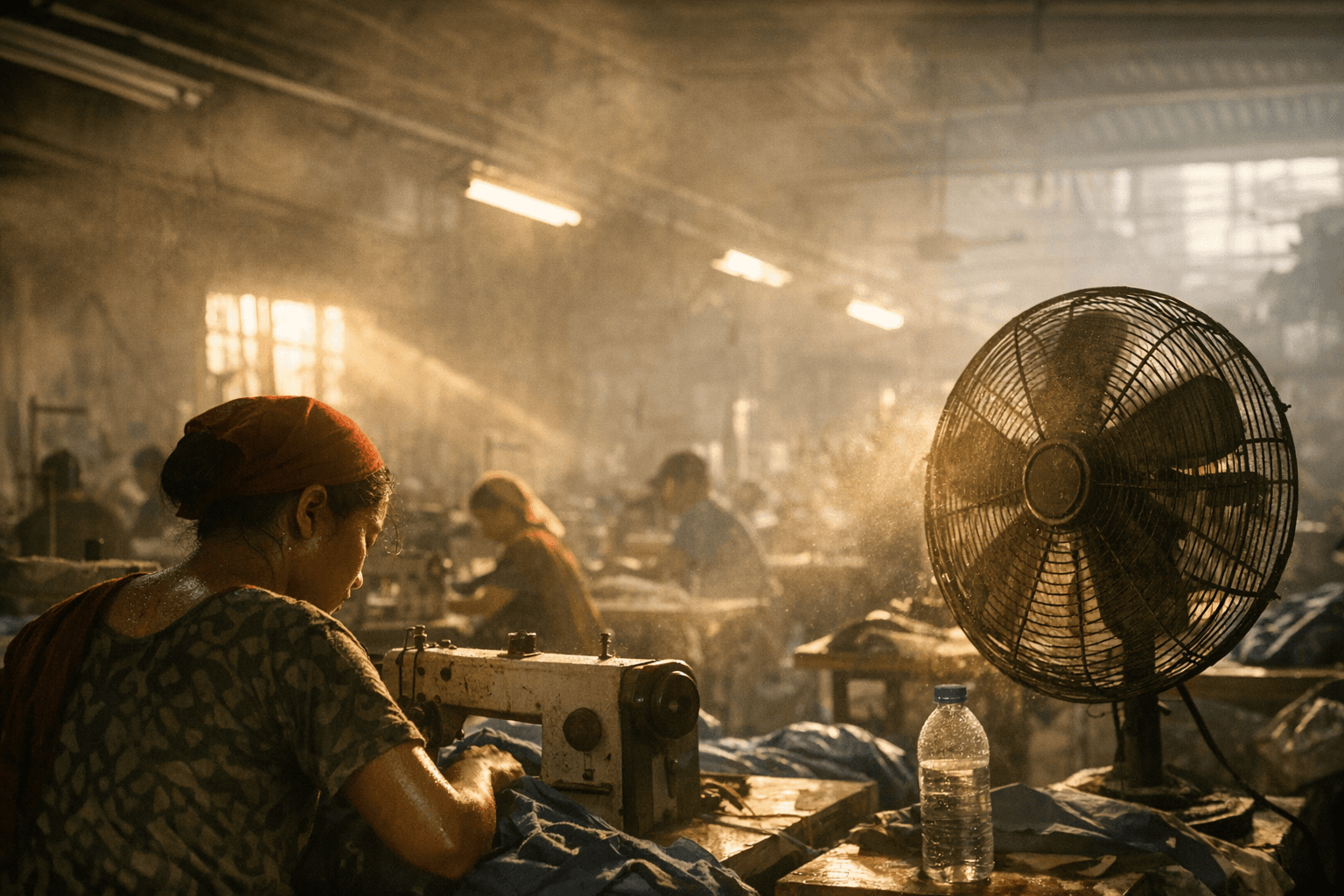
The apparel sector is especially exposed because its production geography overlaps with some of the hottest and most climate-stressed labor markets. ILO-backed research in 2025 examined major production centers including Dhaka, Phnom Penh, Karachi, Hanoi and Ho Chi Minh City, warning that rising heat and flooding can disrupt production, worker health and jobs.
Another industry report projected that nearly one million new apparel and footwear jobs could be foregone by 2030 in Bangladesh, Cambodia, Pakistan and Vietnam without adaptation investment. That is the kind of figure that changes the conversation from comfort to continuity. Heat is not only making work more miserable; it is threatening the labor pipeline that keeps the industry moving.
Bangladesh shows why this is so urgent. Climate Rights International’s work there describes high humidity, vulnerability to heat stress and worker testimony that brings the danger out of policy language and into the body. In a garment floor where machines never really stop and air movement can be thin, humidity turns a hard shift into a physical test of endurance.
How this fits into the wider labor-rights push
AAFA is not moving alone. The Clean Clothes Campaign issued its own heat-and-worker-rights guidance in October 2025, *Heat and Garment Workers’ Rights: Fashioning a Just Transition*, and flagged ten garment-producing countries at risk from heat stress: India, China, Indonesia, Pakistan, Bangladesh, Brazil, Cambodia, the Philippines, Uganda and Serbia. That list broadens the map and makes one thing plain: heat is now a global labor issue, not a regional anomaly.
The difference with AAFA’s move is its industry position. A trade association representing brands, retailers and suppliers is now helping define the terms under which buyers are expected to behave. That gives the guidance a different kind of force. It is not law, but it can become the language that sourcing teams, auditors and compliance officers begin to repeat until it hardens into expectation.
Nate Herman, AAFA’s executive vice president, has framed the move as overdue and argued that the industry must move from awareness to practical implementation. That is the right emphasis. Fashion has never lacked climate rhetoric. What it has often lacked is a clear assignment of responsibility when the temperature rises and the factory floor becomes unsafe.
The guide was developed with input from retailers, brands, manufacturers, material suppliers, academia, multi-stakeholder initiatives, international organizations and NGOs, which gives it more legitimacy than a narrow internal memo would have had. It was also designed to be publicly available for widespread sharing, a signal that AAFA wants this to travel beyond member companies and into the wider market.
For sustainable fashion, that is the story to watch: not a glossy promise, but the slow conversion of heat from an invisible background condition into a measurable sourcing duty. Once a trade group starts naming thresholds, mitigation, medical monitoring and shared responsibility, it is sketching the outline of future enforceable standards. That is how voluntary guidance becomes the draft language of tomorrow’s labor rules.
This article was produced by Prism’s automated news system from verified source data, official records, and press releases, then run through automated quality and moderation checks before publishing. The system is built and supervised by the people who set the standards it runs under. Read our full AI policy.
Did this article answer your question?


