AI-Powered Optical Sorter Classifies Garments by Fiber at Industrial Scale
ECOSORT TEXTILE's industrial debut at Essaimons in France hit one garment per second, the throughput rate recyclers say unlocks viable fiber-to-fiber contracts.
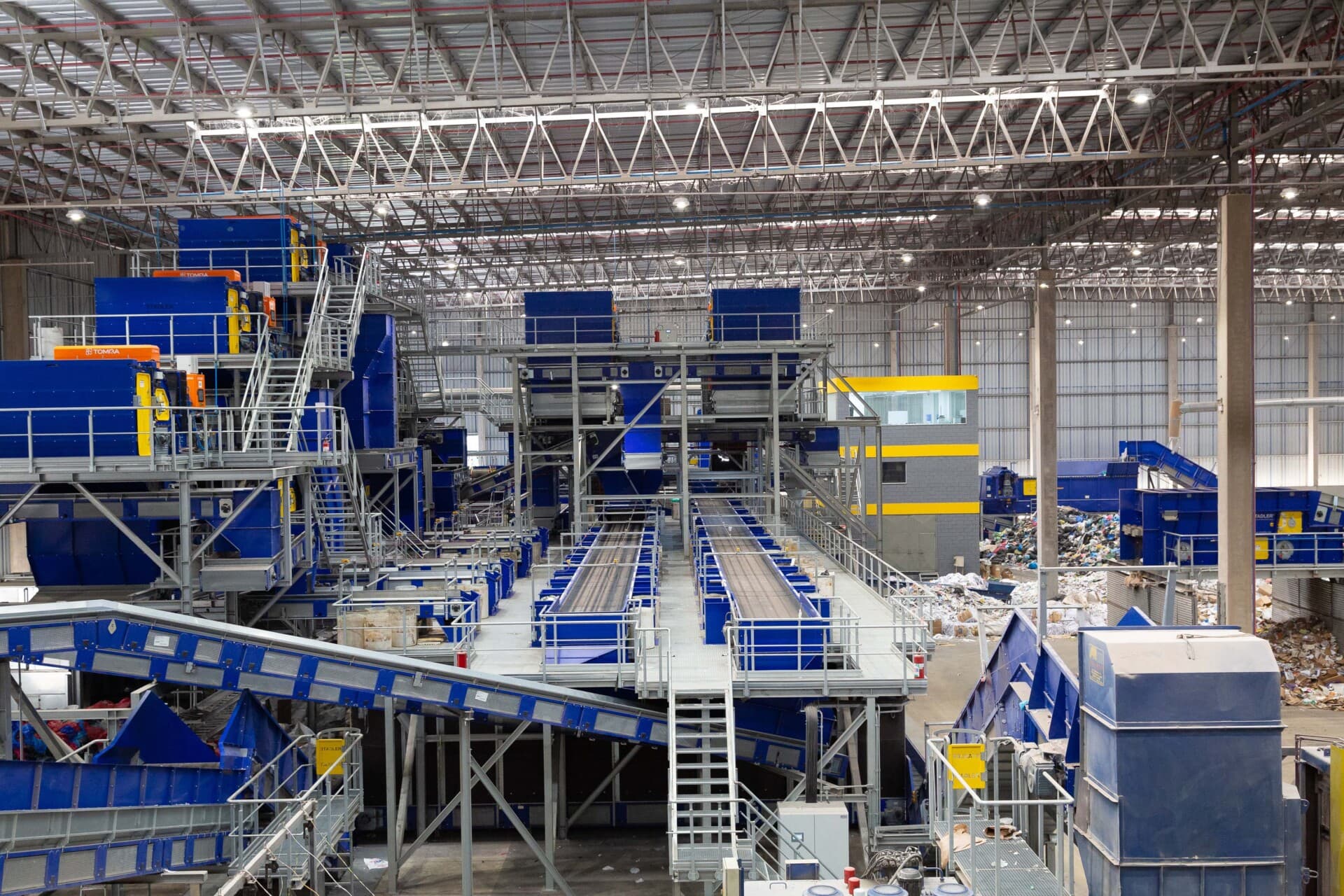
The number that chemical recyclers have been waiting for is roughly one garment per second. That is the operational throughput that PICVISA's ECOSORT TEXTILE system demonstrated at the Essaimons facility in Châtellerault, France, marking the transition from lab-validated promise to working industrial infrastructure. At a moment when the EU's revised Waste Framework Directive is reshaping who pays for what across the textile supply chain, a sorter that can process post-consumer garments at that speed, with fiber-composition data attached, changes the commercial math for everyone downstream.
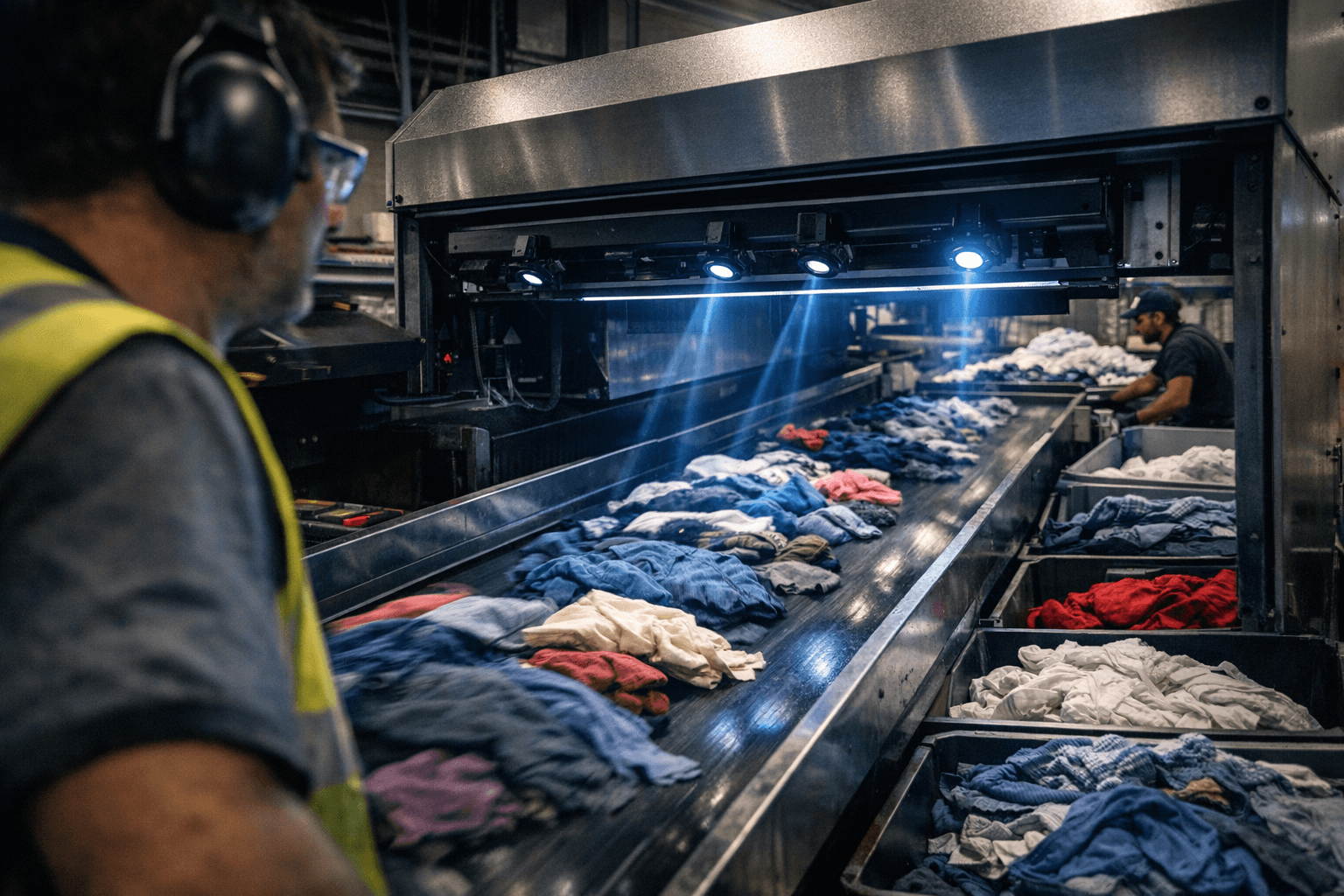
ECOSORT TEXTILE stacks three detection technologies on a single 1,000mm conveyor belt: near-infrared spectroscopy reads molecular fiber signatures, RGB vision captures color and surface data, and a machine-learning layer reconciles the two into a classification output. The system can distinguish up to 24 distinct fiber-and-color combinations simultaneously, covering cotton, polyester, viscose, and their blends. That granularity matters because chemical recyclers and fiber-to-fiber processors do not simply need sorted textiles; they need composition-verified feedstock with contamination rates low enough to feed directly into their input specifications, or the economics of the entire recycling loop fall apart.
Essaimons, an insertion enterprise and part of the Plaxtil-Essaimons group founded by engineer Olivier Civil, committed €3.5 million to build the optical sorting line. The Châtellerault site had moved into new premises in January 2025 specifically to support the industrialization of its sorting capacity. The investment signals something important: it is not a brand or a recycler absorbing the cost of smarter sorting, but a social-economy operator positioned upstream, betting that composition data has a market value that justifies eight-figure capital expenditure.
The system is not without constraints the industry needs to understand honestly. NIR reads outer fabric surfaces, which means layered garments, double-weave constructions, and pieces with interior padding can generate incomplete or misleading fiber signals. Elastane-rich blends present a particular challenge, since stretch fibers sit below detection thresholds at standard scan speeds and can inflate contamination figures in nominally cotton or polyester fractions. The client-side specification for error tolerance at Essaimons was set at roughly 10% across target fractions, which is tight enough to be commercially useful but still requires downstream processors to price residual contamination into their models.
PICVISA Technical Director Daniel Carrero described the core commercial proposition bluntly: "It enables us to identify materials and compositions of garments for pre-selection before recycling, providing a complete analysis with excellent spectral resolution." That pre-selection function is exactly what the EU's incoming regulatory framework is designed to reward. The revised Waste Framework Directive, which entered into force in October 2025, requires all member states to establish mandatory extended producer responsibility schemes for textiles, with national transposition deadlines set for June 2027 and functioning EPR schemes required by April 2028. Under those rules, textile producers will pay a fee for each product they place on the market, creating a funded mechanism that is meant to cover the cost of collection, sorting, and recycling infrastructure.
The EU generates around 12.6 million tonnes of textile waste per year, of which only one-fifth was separately collected for reuse or recycling. The Essaimons installation is among the first in France to operate at genuinely industrial scale, and an official press inauguration of the line is planned for April or May 2026. For brands negotiating recycled-content supply agreements, and for recyclers pricing fiber-to-fiber contracts, what is being built in Châtellerault is less a technology demonstration than the first piece of upstream infrastructure that makes those contracts possible to price at all.
Know something we missed? Have a correction or additional information?
Submit a Tip