Amazon and DOE Partner to Mine Battery-Grade Graphite From Textile Waste
The US imports 84,000 metric tons of graphite annually with near-zero domestic production. Amazon and DOE think old clothes can help close that gap.
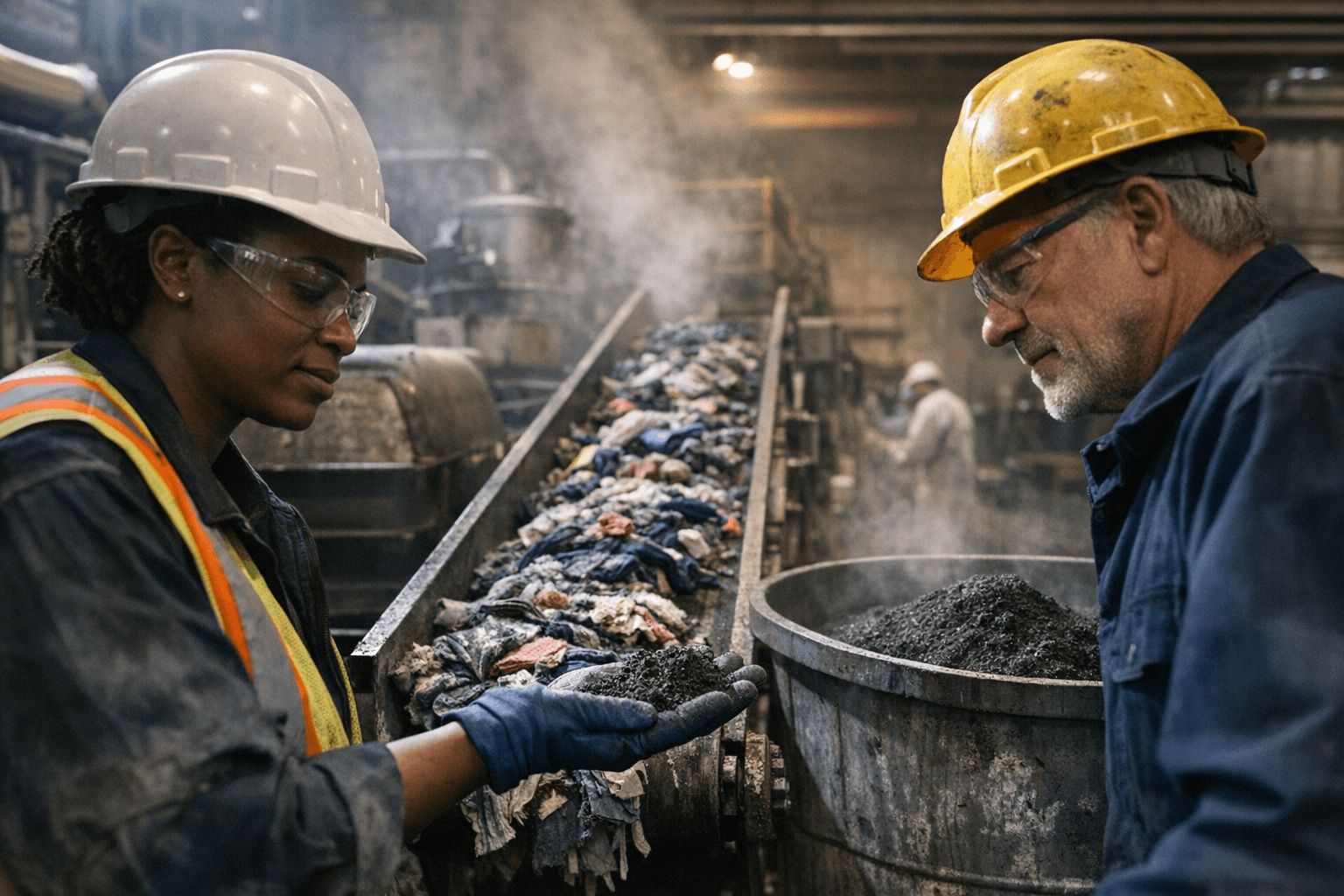
China produces 77% of the world's graphite, and United States domestic output is so negligible that the country consumes roughly 76,000 metric tons annually while importing 84,000. With battery-anode graphite demand projected to grow fourfold by 2030, that dependence looks increasingly untenable. A partnership announced in late March between DOE's Ames National Laboratory, the Critical Materials Innovation (CMI) Hub, and Amazon is wagering that part of the shortfall can be addressed by processing discarded clothing.
The collaboration pairs Amazon's AI capabilities and reverse-logistics network with CMI's decades of materials science expertise across two recovery tracks. The primary initiative will explore extracting battery-grade graphite from post-consumer textiles, advancing what DOE frames as its "Genesis Mission" goal of securing critical materials from domestic waste streams. A second track, involving Amazon Web Services, will investigate recovering gallium from end-of-life IT hardware using physical AI and supply chain management expertise.
"At scale, the recovery of critical minerals from end-of-life technologies and textile waste has the potential to transform our domestic critical materials supply chains," said Audrey Robertson, Assistant Secretary of Energy, framing the initiative as part of the Trump administration's push to reduce reliance on foreign imports and strengthen national security.
The partnership has structural advantages no government lab could deliver alone. Amazon brings AI infrastructure, including its Amazon Nova platform, alongside the returns-processing and sortation network that creates meaningful feedstock volume. Kommy Weldemariam, Amazon's Chief Scientist for Sustainability and AI, described the collaboration as "advancing a new frontier in critical materials circularity, from converting discarded textiles into battery-grade graphite to recovering critical minerals from IT hardware."
Whether it works at scale turns almost entirely on chemistry no press release can resolve. The core problem is feedstock quality. Less than 0.5% of post-consumer textile waste is currently recycled by any method, and the majority of what ends up in landfills is not clean mono-material cotton or polyester: it is blended fabric treated with dyes, flame retardants, and easy-care finishes that actively disrupt chemical processing. Certain textile dyes and finishes, such as flame retardants, are detrimental to the glycolysis chemistry central to synthetic fiber breakdown, and dye removal at industrial scale generates thousands of microplastic fiber fragments per gram of material processed.
For graphite recovery specifically, those contaminants threaten purity thresholds that cannot be compromised. Battery-grade graphite for anode applications must reach above 99.95% carbon purity, and achieving that from a dye-laden, multi-fiber feedstock demands energy-intensive purification steps that could erode the sustainability and cost arguments the whole premise rests on. Significant challenges remain, including technical scalability, economic viability against cheaper foreign sources, feedstock variability, and unclear commercialization timelines. Neither Ames Lab nor Amazon has yet published a life cycle assessment, contaminant threshold specifications, expected graphite yield per kilogram of textile input, or a public pilot timeline. Those are the numbers that will separate a genuine supply-chain breakthrough from a well-positioned green announcement.
There is also a circularity trade-off the launch materials glossed over. Directing post-consumer garments into graphite production permanently removes that material from the textile loop. The pathway makes sense only when the incoming feedstock is genuinely unrecyclable by fiber-to-fiber methods: heavily blended, chemically degraded, or contaminated enough that textile-to-textile recovery is already off the table. Demonstrating that selectivity at volume will require sorting infrastructure even Amazon has not yet demonstrated at this scale. Ames National Laboratory's involvement makes the technical ambition credible. The proof will arrive with the data.
Know something we missed? Have a correction or additional information?
Submit a Tip