Australia Launches Bold National Roadmap to Rebuild Fashion and Textile Manufacturing
Australia's 97% reliance on offshore garment manufacturing just got its first coordinated challenge: a 10-year roadmap backed by R.M.Williams, parliament, and a projected $1.4bn economic dividend.
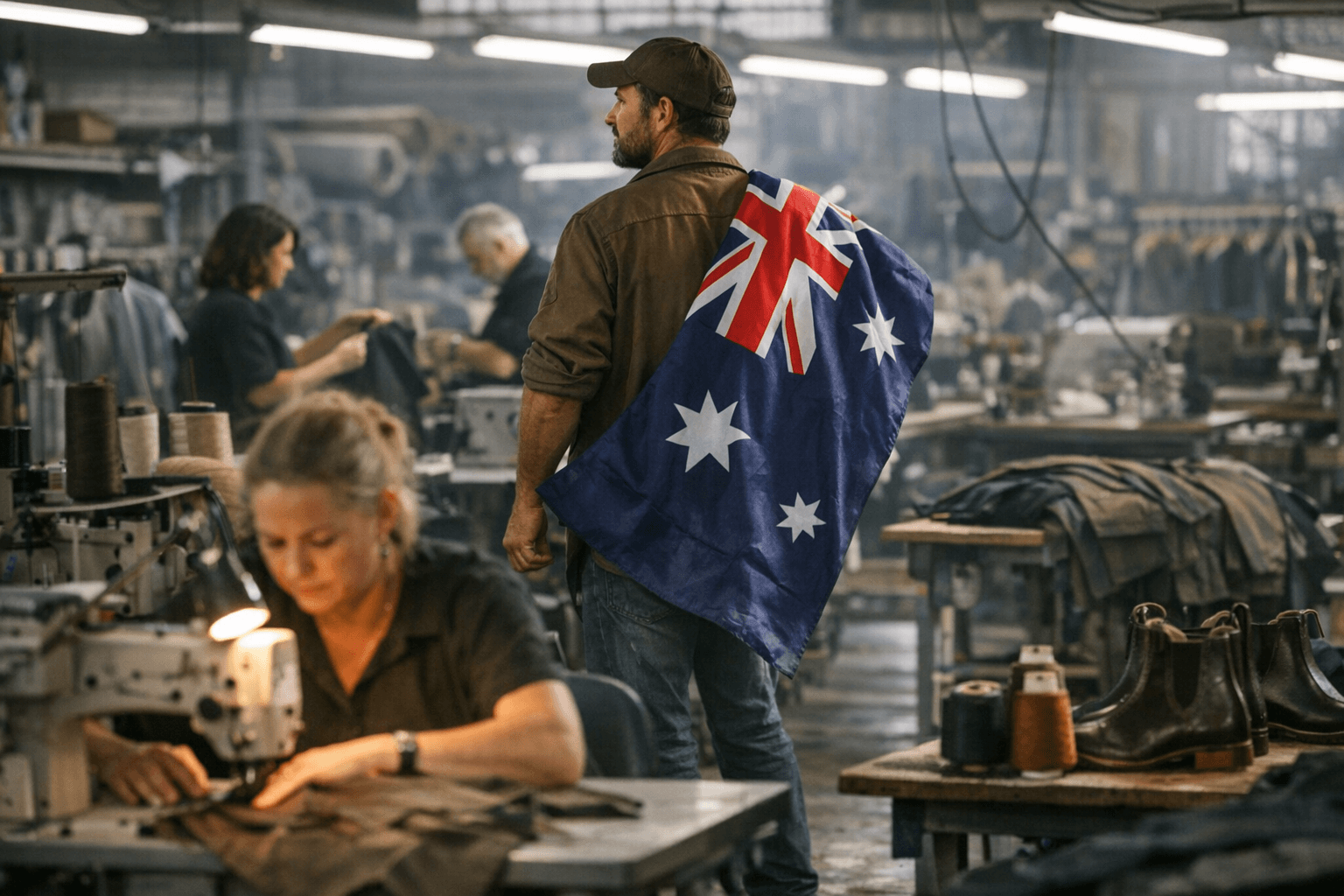
The Australian Fashion Council and R.M.Williams launched the National Manufacturing Strategy for Australian Fashion and Textiles 2026–2036 at Parliament House in Canberra on 12 March, setting out the first coordinated national roadmap to rebuild domestic manufacturing capability across Australia's textile, clothing and footwear sector. The ten-year plan arrives with a striking admission embedded in its framing: 97 per cent of Australia's fashion and textile production currently happens offshore.
AFC executive chair Marianne Perkovic did not soften the value-capture argument. "Australia is the world's largest exporter of greasy wool and a globally significant cotton producer," she said. "Yet we export raw fibre and import finished goods at multiples of the original value."
"Australia already has exceptional design talent, advanced manufacturing capability and globally recognised brands. With the right coordination across industry, skills and procurement policy, we have a real opportunity to strengthen sovereign capability, create skilled jobs and position Australia as a leader in premium manufacturing."
The strategy was developed following nearly a year of industry consultation, encompassing 14 national consultations and contributions from over 300 stakeholders. It is projected to deliver a cumulative $1.4 billion economic dividend over five years, alongside $864 million in additional wages. Progress will be measured through a two-stage assessment framework, with the Australian Fashion Council leading implementation.
The plan rests on three strategic pillars: driving demand through government procurement, securing a skilled future workforce with explicit emphasis on women and diverse communities, and accelerating advanced manufacturing. On the manufacturing side, the roadmap calls for co-investment in new technology, rebuilding first-stage processing infrastructure, and innovating in circular manufacturing and fibre-to-fibre recycling. That last priority arrives with external regulatory urgency: beginning 19 July 2026, the European Union's Ecodesign for Sustainable Products Regulation will prohibit the destruction of unsold clothing, footwear and accessories by large companies operating in the EU, forcing brands to prioritise reuse, recycling, donation channels and smarter production planning. For Australian manufacturers positioning themselves as premium, traceable suppliers, the timing is deliberate.
The launch was attended by over 90 industry and parliamentary guests, including members of the Parliamentary Friends of Australian Fashion & Textiles, co-chaired by Matt Burnell MP, Dai Le MP and Zoe McKenzie MP, with more than 60 bipartisan members across Parliament. That breadth of cross-party backing gives the strategy political insulation unusual for an industry-led initiative.
Technology infrastructure is already moving. Epson, the official print and projection partner of the AFC, is working with the council on a feasibility study for a smart factory and shared manufacturing hubs. Craig Heckenberg, Managing Director of Epson Australia, stated that Epson has "already developed and implemented" shared hub models with The Social Outfit and Citizen Wolf, where direct-to-fabric digital printing technologies form part of the production workflow.
The strategy's launch included a physical showcase of domestic manufacturing capability, featuring R.M.Williams, Bianca Spender, Bond-Eye Australia, Clothing the Gaps, ABMT, Sylvia P, Waverley Mills, Silver Fleece and Stewart & Heaton. A short film titled "Made Here, Worn Everywhere" profiles AFC members including Australian Defence Apparel, The Social Outfit, Maara Collective, Citizen Wolf, Waverley Mills and Silver Fleece, highlighting the range of manufacturing already operating across the country.
WoolProducers Australia CEO Jo Hall offered qualified support, saying the strategy "dovetails very nicely into a number of key focus areas of WoolProducers, namely the 'Ensuring a sustainable future for Australia's wool supply chain' project." That alignment between the peak wool grower body and the AFC is significant: wool remains Australia's most underprocessed fibre export, and any serious onshoring play depends on closing that gap between raw clip and finished cloth.
The AFC, which has represented Australia's fashion and textile sector for over 70 years, frames the first phase as a foundation period running to 2029. Whether the roadmap translates into factory floor reality will depend on procurement commitments from government and the willingness of brands to absorb the higher unit costs of domestic production, at least until scale makes the economics work. The strategy's existence is, at minimum, the clearest signal yet that Australia intends to stop leaving that value at the dock.
This article was produced by Prism’s automated news system from verified source data, official records, and press releases, then run through automated quality and moderation checks before publishing. The system is built and supervised by the people who set the standards it runs under. Read our full AI policy.
Did this article answer your question?


