Biomaterials Move From Lab to Supply Chain as Fashion Tackles Scale Challenges
MYCEL's 95-99% mycelium CELMURE platform and Peelsphere's Balenciaga-tested algae materials emerged from Hong Kong's Materials+ as the biomaterials closest to real procurement.
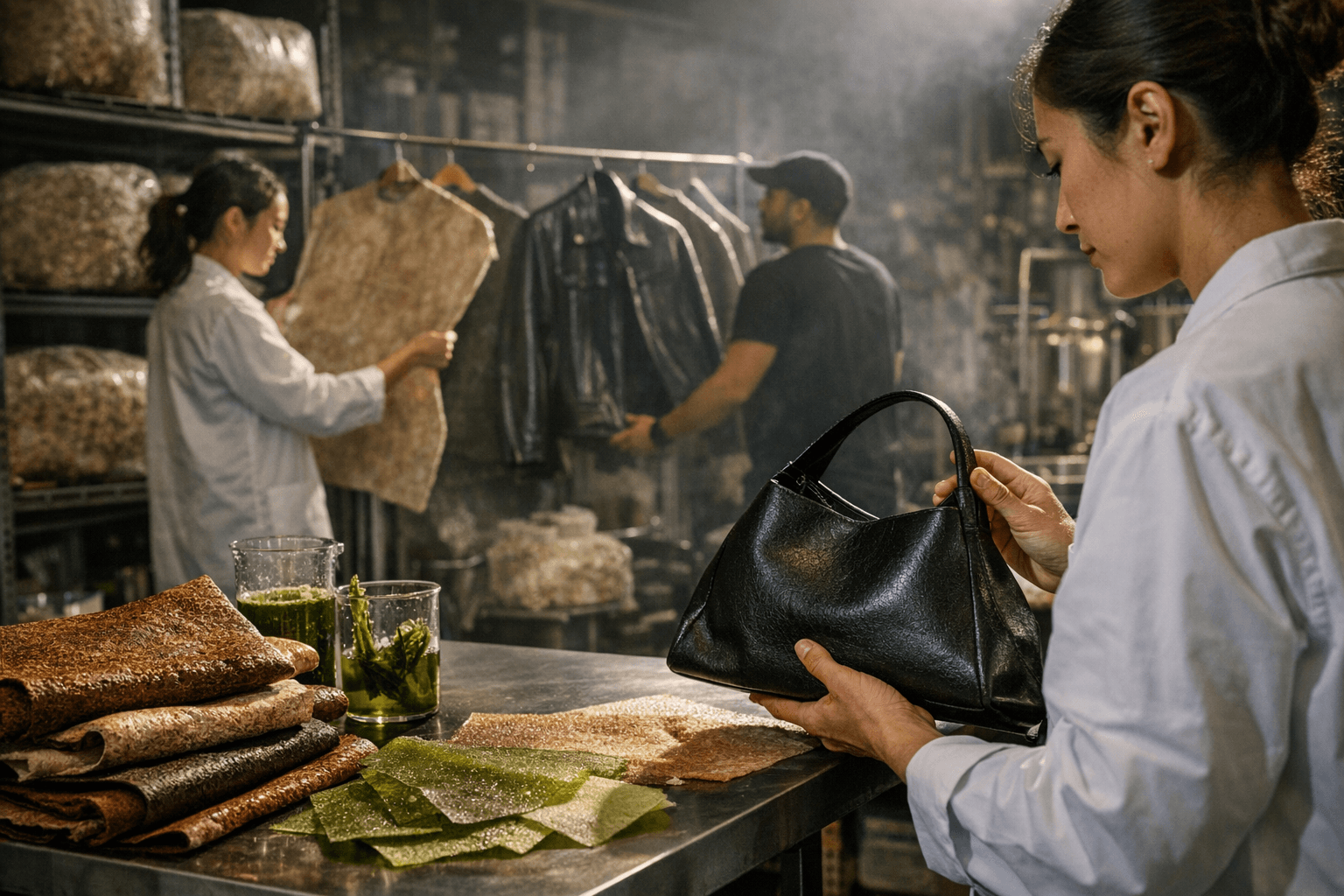
Mycelium leather running at 95 to 99 percent bio-content without synthetic coatings. Algae-based materials already tested by Balenciaga and Nike. Banana fiber entering accessories sourcing. When Materials+ convened at the Hong Kong Convention and Exhibition Centre from March 12 to 14, the biomaterial conversation had decisively shifted from whether these materials could be made to whether they could be ordered.
The short answer: some of them, now. Others, within 12 to 24 months, if the right infrastructure agreements land first.
Gigi Jung, Chief Strategy and Business Officer at MYCEL, presented a two-platform architecture that defines what "ready" actually means in mycelium. LSSC MAT is pure mycelium grown without synthetic coatings, built for brands with hard no-polymer sourcing criteria. CELMURE is the multi-layer product, running up to 95 to 99 percent mycelium content, engineered for the tensile and tear performance specifications that luxury accessories procurement teams require before signing off on a material trial. The gap between the two is essentially the gap between a clean material story and a commercially viable one. Jung's position was unambiguous: the future of the category depends on scalable systems integrating biology, manufacturing, and circular design, not on innovation alone.
Peelsphere, the Berlin-based company behind Algaeskin, a translucent algae-derived surface, and Bestwaste, a reinforced plant-based material designed for footwear uppers and automotive interiors, arrived with a stronger commercial case study than most. The company has completed design collaborations with Balenciaga, Nike, BMW, and Tiffany and Co., and has been recognized through Kering's sustainability innovation programmes. Co-founder Song framed Peelsphere's strategy as circular by design: agricultural waste, fruit peels and algae biomass, enters as feedstock and exits as a durable, potentially biodegradable material for bags and footwear.
The biodegradability question proved to be a dividing line on the floor. Ricky Kwan of MM Limited challenged the consensus that bio-based automatically means low end-of-life impact. Many materials marketed as vegan leather still carry significant plastic content, which undermines degradation and muddies lifecycle assessment comparability, a point that matters when regulatory and procurement teams are running LCA scoring. MM Alternative Leather addresses this directly: manufactured from FSC-certified paper and BCI cotton, it mimics leather's drape and surface character while remaining genuinely biodegradable.
Tannery compatibility ran through every conversation about timing. Archroma's AVICUERO chrome-free tanning process and Zeology mineral-based systems are already moving through existing finishing infrastructure, but biomaterial substrates face a harder integration question: can they run on standard drum finishing equipment without additional capital expenditure? Brands and suppliers that cannot answer that affirmatively are looking at extended lead times regardless of how strong the material specification reads on paper.
The regulatory clock is concrete. EU rules imposing tighter sourcing standards take effect in December 2026 for large companies and June 2027 for smaller businesses, while restrictions on chromium VI, azo dyes, and formaldehyde are narrowing the window for conventional tanning processes. That structural pressure is what has turned Hong Kong's biomaterial conversations from showcase to supply-chain planning.
For buyers working on accessories and footwear uppers now, Peelsphere's algae and fruit-peel materials and MM Alternative Leather's FSC-certified construction are the most immediately sourceable options. MYCEL's CELMURE platform is close but requires finishing-partner alignment before commercial runs. Cultivated collagen sheets, the category with the closest mechanical profile to full-grain hide, remain the highest-performance option on a durability basis; cost per square meter and certification pathways are not yet at procurement scale, placing them firmly in the 12-to-24-month window.
This article was produced by Prism’s automated news system from verified source data, official records, and press releases, then run through automated quality and moderation checks before publishing. The system is built and supervised by the people who set the standards it runs under. Read our full AI policy.
Did this article answer your question?


