Bloomington's Local Makers Are Turning Mending and Upcycling Into a Movement
Bloomington's repair culture is leveling up: local makers, sewing circles, and a haute-couture-trained designer are making mending the sharpest move in your wardrobe rotation.
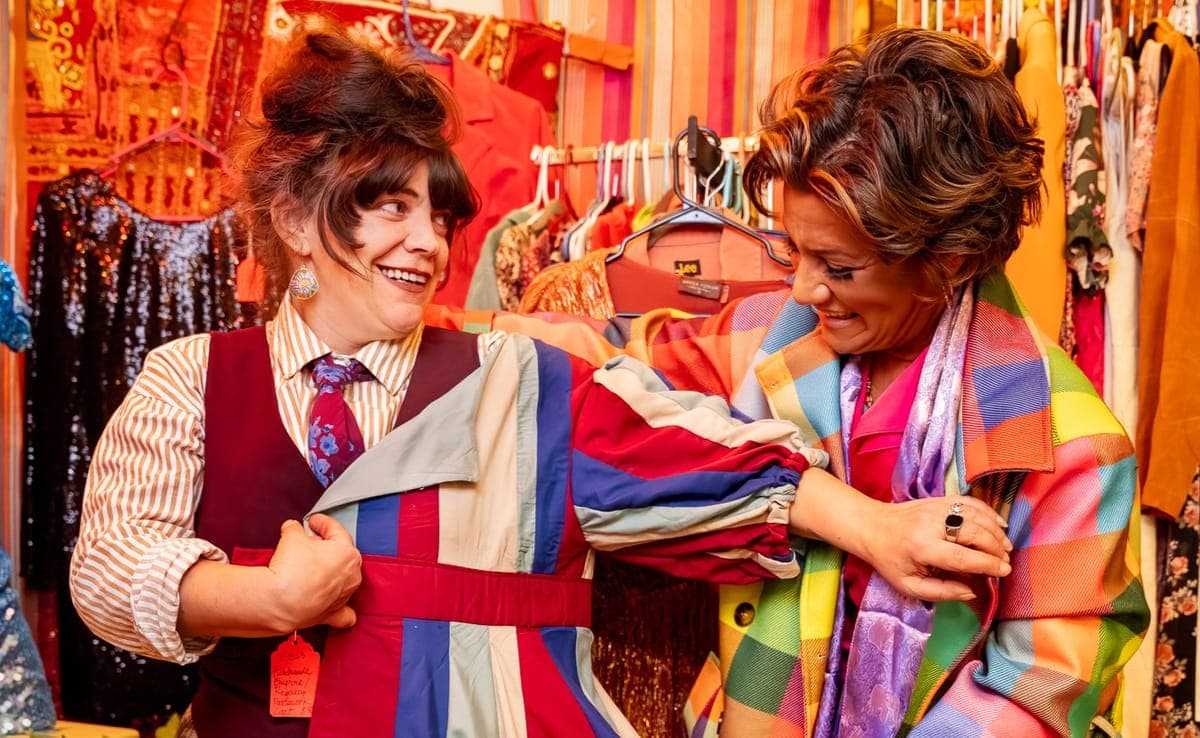
Your favorite jeans have a blown seam. Your wool coat is missing a button. Your go-to hoodie has a hole the size of a quarter near the pocket. Six months ago, you probably would have quietly retired all three. In Bloomington right now, that calculus is flipping — and a tight network of local makers, community sewing circles, and at least one designer with a Parisian Haute-Couture pedigree is doing the flipping.
Mending is not a virtue story here. It's a style upgrade with a practical roadmap, and Bloomington is the proof of concept.
The Local Scene Driving the Shift
Bloomington already has a foundation of sustainable shopping: Opportunity House, a volunteer-run non-profit thrift shop on 11th Street, channels its proceeds toward Monroe County United Ministries, which supports community resources including schooling and food assistance. Bloomington Thrift Shop Inc. on South Madison Street runs a similar non-profit model, raising funds for Psi Iota Xi. These aren't just places to score a find; they're part of an ecosystem that values the object's second life over its first markdown.
But the more interesting shift is happening upstream of the thrift rack, in the hands of people who don't want to replace what they already own.
Second Serve's community Sewing Circle meets every couple of weeks on Saturdays from 10 a.m. to noon at Central Congregational Church, drawing a mix of ages and skill levels who gather specifically to mend, sew, and remake rather than shop. It is exactly the kind of low-stakes, high-output community structure that makes a repair culture stick.
The Maker to Know: Heidi Fitzgerald at Lotus Studio
If there is one name anchoring Bloomington's handmade fashion conversation right now, it is Heidi Fitzgerald and her studio at 212 S. Rogers St. After graduating in 2003, Fitzgerald worked as a costume and stage design assistant in Germany, Austria, and Switzerland before moving to Paris in 2005, where she worked for theaters including La Comédie Française, Théâtre de la Ville, and Théâtre de la Colline. Between productions, she apprenticed at various ateliers for Haute-Couture fashions and historical cinema.
Having children in the 21st century made Fitzgerald keenly aware of both the joy and the need for creating a space where younger generations could be exposed to and learn traditional arts and crafts. That conviction became Lotus Studio of Perennial Arts and Crafts, described as "a multi-faceted little workshop, focusing on ethnic custom designs." The studio offers sewing classes specifically for children, and its ticketed fashion shows feature clothing designs created from fabrics inspired by Native American Indian culture, with each piece carefully handcrafted using natural materials and sustainable practices.
Fitzgerald represents the rarer end of this movement: someone with genuine technical depth who chose to plant that knowledge locally rather than scale it commercially. Her classes give kids a tangible skill that no algorithm can replicate — the ability to look at a broken garment and see a fixable one.
The 5 Fixes Worth Learning First
The barrier to mending is almost never skill; it's not knowing where to start. These five repairs cover the majority of what kills a wardrobe prematurely:
1. Button reattachment. A missing button is the easiest fix that most people outsource unnecessarily.
Match the thread weight to the fabric, knot it securely at the back, and reinforce with a small square of interfacing on delicate fabrics. Five minutes, zero equipment beyond a needle and thread.
2. Hem repair. Dropped hems on trousers and skirts are a one-step fix with a hand stitch or iron-on hem tape for quick invisible results.
Knowing your seam allowance saves the garment and keeps the silhouette intact.
3. Seam splits. Side seams and stress points on jeans, bags, and jackets open constantly.
A backstitch run twice along the original seam line is stronger than the original factory stitch and takes under ten minutes.
4. Small holes. Knitwear holes under a centimeter respond well to duplicate stitch if you want invisible, or to a contrasting darning stitch if you want the repair to become the statement.
The latter is where mending becomes design.
5. Zipper pull replacement. A broken zipper pull does not mean a broken zipper.
New pulls, available at any notions shop or on a short cord of paracord, can extend the life of a jacket or bag by years.
The Sub-$25 Starter Kit
You don't need a sewing machine to start. A practical first kit:
- Needles in assorted sizes (sharps and tapestry)
- Thread in neutral tones: black, white, cream, navy (covers 80% of repairs)
- Small sharp scissors or thread snips
- Iron-on hem tape for quick, no-sew repairs
- A seam ripper (essential for undoing mistakes cleanly)
- Beeswax to strengthen thread before hand sewing
- Two or three spare buttons in varied sizes
- A short length of iron-on interfacing for stabilizing thin fabrics
All of this fits in a small tin and costs under $25 at a fabric shop. Bloomington Stitchery at 421 E. 3rd St. is open Tuesday through Friday noon to 6 p.m. and Saturday noon to 4 p.m. — a walkable resource for notions, thread matching, and basic alterations advice.
Visible vs. Invisible: Choosing Your Repair Style
This is the actual decision that shapes how a mended piece reads in the wild, and it matters more than people realize.
Invisible repair is the right call when the garment's silhouette is the point: a structured wool coat, a tailored trouser, a fitted blazer. Here you're preserving the original intention of the piece, and the repair should disappear into the construction. Use matched thread, fine stitches, and press seams flat.
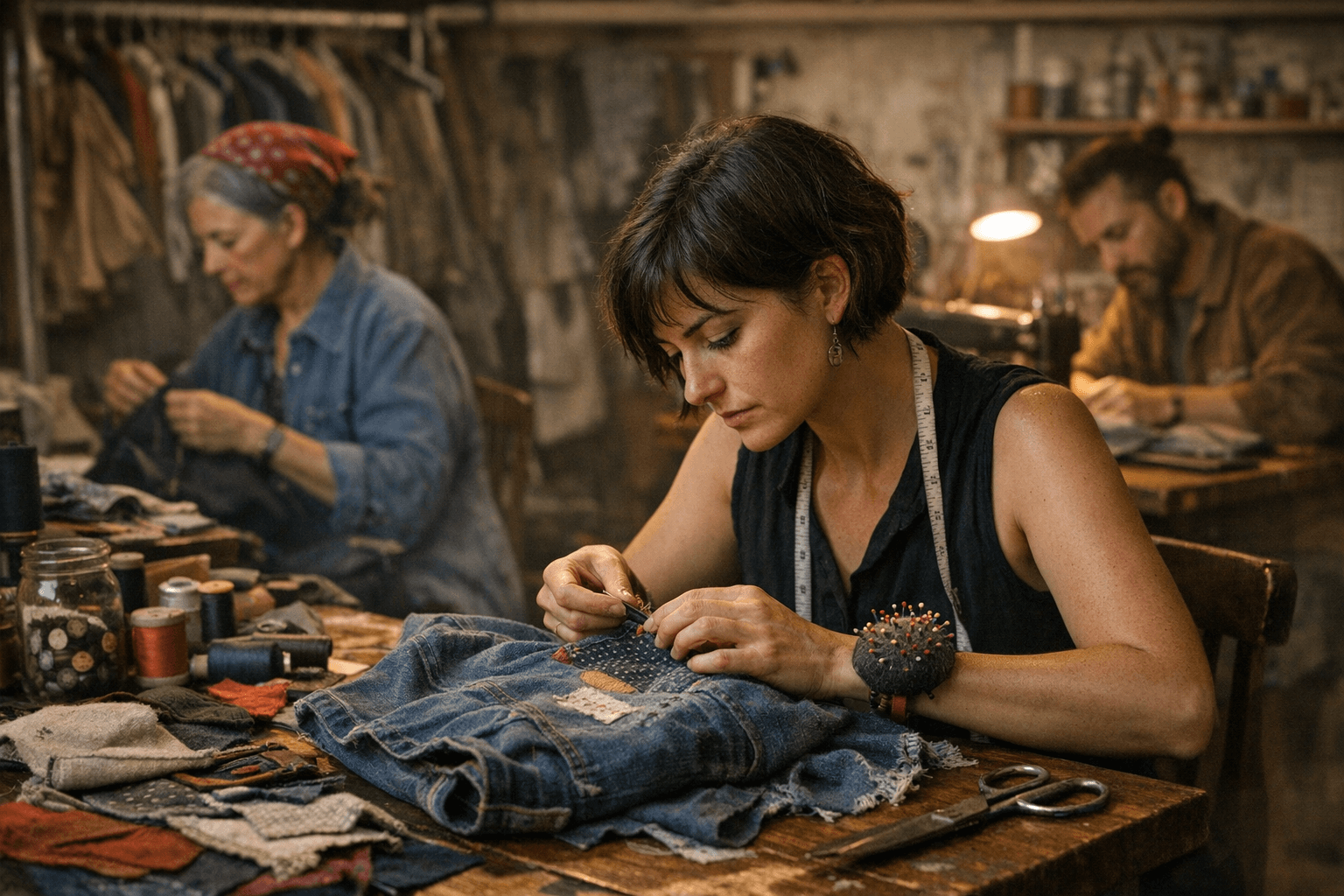
Visible repair is a design choice, and done with intention it elevates rather than apologizes. Japanese sashiko stitching on denim, contrasting darning on knitwear, an embroidered patch over a worn elbow: these techniques have deep craft traditions and they signal exactly the kind of intentionality that defines personal style in 2026. The repair becomes the proof that the garment is yours, not just something you bought.
The rule of thumb: if the fabric's structure is still intact, go invisible. If the damage point is a focal area — cuffs, knees, collar, pocket edge — make it visible and make it count.
Before and After: What Repair Actually Does to an Outfit
The concrete outcomes are what convert skeptics. A camel overcoat with a blown pocket seam and a missing toggle sits in a closet indefinitely. Thirty minutes of hand stitching and a replaced toggle returns a $200-plus garment to full rotation. A pair of straight-leg denim with a stress hole at the thigh becomes a statement piece once filled with indigo sashiko stitching that draws the eye rather than hiding. A striped linen shirt with a dropped hem and a collar starting to fray, once pressed and re-hemmed with a small visible running stitch at the collar, reads as considered rather than worn out.
None of these outcomes require a sewing machine. All of them require a starter kit and about an hour of Saturday morning attention — the kind of morning that Second Serve's Sewing Circle has built into a standing community ritual.
Why This Sticks
The cultural history of repair runs deep. During World War II, Britain's "Make Do and Mend" campaign encouraged citizens to repurpose clothes they already owned so textiles could be directed toward the war effort, teaching people both how to transform old into new and how to care for garments so they lasted longer. What Bloomington's makers are doing is not nostalgia — it's the same practical logic applied to a different crisis of excess.
Reiner Pilz, the German engineer who coined the term "upcycling" in a 1994 interview, described recycling as "down cycling" and argued instead for a process where old products are given more value, not less. Fitzgerald's Lotus Studio, the Trashion Refashion Runway Show at the Buskirk-Chumley Theater — where in 2025 designers transformed unconventional materials like burlap bags, hammocks, pop tops, and salvaged trampoline netting into runway looks — and Second Serve's biweekly sewing circles are all, in different registers, making that same argument.
The garment you already own is the most sustainable one you can wear. Bloomington is building the infrastructure to help you keep it.
This article was produced by Prism’s automated news system from verified source data, official records, and press releases, then run through automated quality and moderation checks before publishing. The system is built and supervised by the people who set the standards it runs under. Read our full AI policy.
Did this article answer your question?