Chicago's Mending Nights Teach Gen Z to Repair, Not Replace
At Chicago's CCRX, fiber artist Kristine Brandel is turning monthly Mending Nights into Gen Z's favorite social ritual, one darned sock at a time.
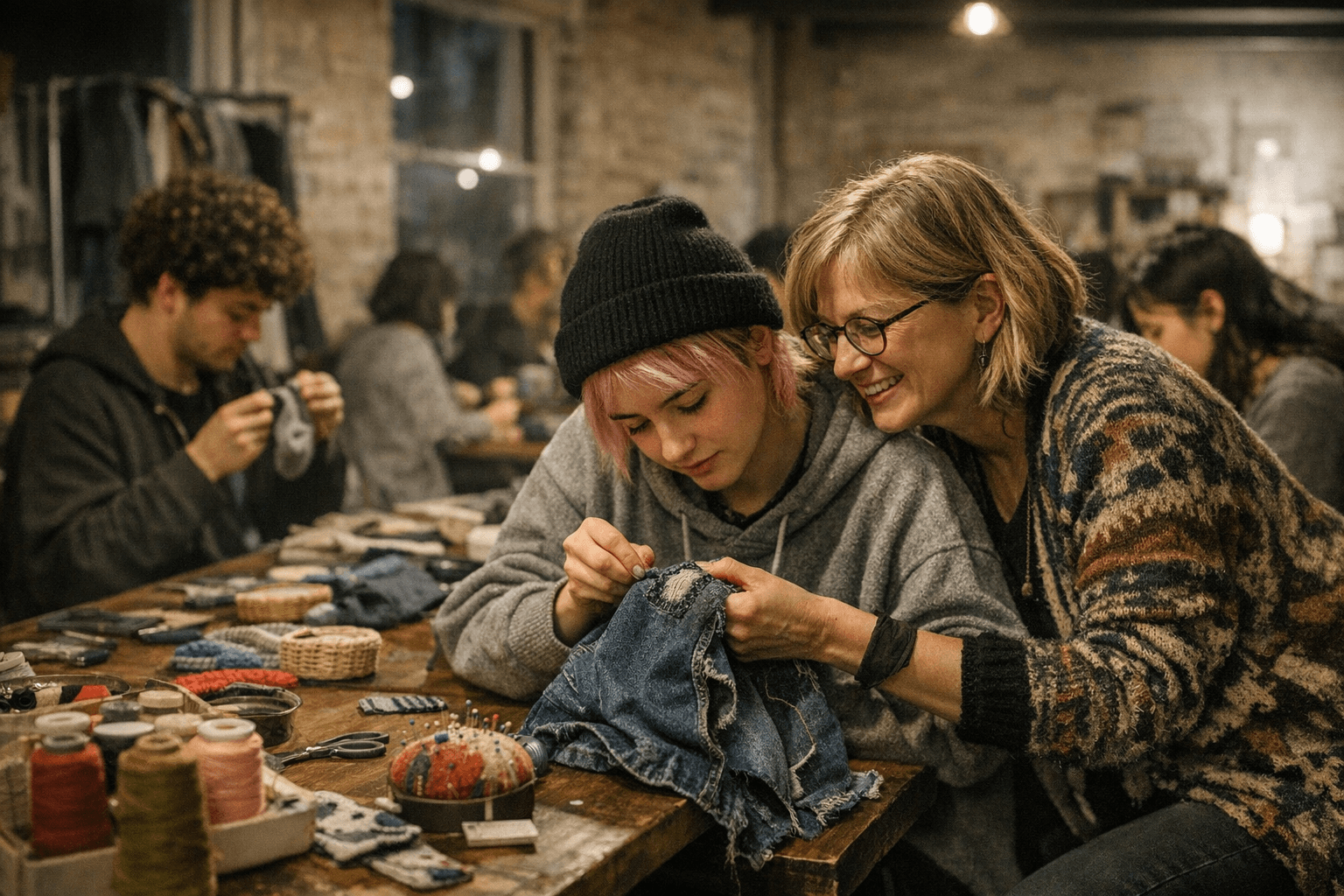
Somewhere on Chicago's South Side, a room full of twenty-somethings is bent over thrifted denim, threading needles and arguing over which color floss makes a knee patch pop hardest. Nobody is replacing anything. Nobody is opening a shopping app. This is Mending Night at the Creative Chicago Reuse Exchange, and it might be the most radical thing happening in sustainable fashion right now. Not because mending is new, but because it's suddenly the plan for a Thursday night out.
The Woman Running the Room
Fiber artist Kristine Brandel is the reason any of this works. She runs Mending Night at CCRX every second Thursday of the month, and she also teaches at Chicago-area libraries and the Chicago Fair Trade Museum in Uptown; CCRX is where the energy is undeniable. Brandel meets students exactly where they are, which is often at zero. "Some people don't even know the business end of the needle because they've never sewn," she says. That's not a criticism; that's her starting point. She builds from there, and the results are genuinely empowering. "Even something as, to me, simple as threading a needle and making a knot that'll stay there, it's really empowering," Brandel said.
Her philosophy is disarmingly simple: if you love a piece, fight for it. "And especially if it's a piece that you like, you should keep it," she said. That idea lands differently for a generation that grew up on fast fashion's churn, scrolling through $8 tops that last two washes. For Brandel's students, a repaired thrift-store flannel is not a consolation prize. It's the whole point.
What CCRX Actually Gives You
CCRX, which stands for Creative Chicago Reuse Exchange, is a 501c3 nonprofit that redistributes donated surplus materials and supplies to Chicago teachers, nonprofits, and community groups. The organization operates out of a warehouse on the South Side and runs on donations, volunteers, and an ethos borrowed from its own tagline: "trash is a failure of imagination." For Mending Night participants, CCRX functions as a free supply closet: donated fabric, buttons, and sewing supplies are on hand, so you don't have to walk in with anything except the garment you want to save.
ABC7 Chicago visited a session where Violet Q, a local LGBTQ+ social group, stopped by for a mending session, an illustration of how community and craft have collapsed into the same Thursday-night activity. One student held up a shirt that carried genuine weight: "This was a shirt that I got from when there was an eclipse in 2017. I want to make sure that this shirt stays around as long as I can." That's not just thrift. That's attachment. That's the thing fast fashion can't replicate.
Why Visible Mending Hits Different Now
The repairs happening at CCRX are not your grandmother's invisible darning, though Brandel can do that too. This is visible mending, a practice whose roots go back centuries to the Japanese tradition of sashiko, that has made a full-blown cultural comeback. As Nandi Duzynzki, CEO of Chicago-based Bliss Joy Bull, puts it: "Visible mending is a style of clothing repair and it is bringing attention to rips and tears in your clothing, usually by using colorful threads or patches or embroidery." The repair becomes the design feature. The patch on the knee tells the story. The bright-red running stitch across a worn elbow is a flex, not a fix-up.
For Gen Z, this aesthetic alignment is everything. Wearing something visibly mended signals taste, not poverty. It follows the same cultural logic that made distressed denim a status symbol, but with actual craft and environmental intent behind it. According to data from WRAP published in early 2025, repairing clothes displaces the need for buying new items by 82%. That's not a marginal impact; that's a behavioral overhaul one stitch at a time.
Three Stitches to Learn This Week
You don't need to attend Mending Night to start. These three stitches cover the vast majority of repairs you'll encounter:
1. Running stitch: The most fundamental stitch in mending.
Thread your needle, knot the end, and push the needle in and out of the fabric in small, even intervals. Use it to re-sew a split seam, reinforce a weak hem, or create a visible design across a worn area. Smaller stitches hold stronger; contrasting thread makes them a design feature.
2. Darning stitch: For holes in knit fabrics (socks, sweaters, jersey tees), darning weaves thread back and forth across the gap to rebuild the fabric structure.
Work with a darning mushroom or a smooth rounded object (a lightbulb works) held inside the garment for tension. Go horizontal first, then vertical, weaving the second pass over and under the first.
3. Sashiko-style cross stitch: Borrowed from Japanese boro textile tradition, this technique layers running stitches in geometric patterns over thinning fabric before it actually holes out.
It reinforces weak spots structurally while creating bold, graphic surface texture. The knees of your jeans, the elbows of a flannel: anywhere the fabric is wearing thin is a candidate.
Two No-Sew Fixes That Actually Hold
Not everything needs a needle:
- Iron-on patches: The fastest repair in the toolkit. Place the patch adhesive-side-down on the damaged area, cover with a pressing cloth, and apply a hot iron for 30 to 60 seconds with firm pressure. Let it cool before moving the garment. For high-stress spots like knees, reinforce the edges with a few running stitches after ironing to prevent peeling.
- Fusible webbing tape: For hems that have dropped, fusible tape inserted between the fold and ironed flat bonds fabric without a single stitch. Works on most woven fabrics and holds through multiple washes when applied correctly. Not suitable for stretch fabrics, where a stitch is the better call.
The One Tool That Changes Everything
Before you touch a needle, buy a needle threader. It costs less than a dollar, fits in any pocket, and removes the single most frustrating barrier between you and actually sitting down to mend. Push the wire loop through the needle eye, pass your thread through the loop, pull back, done in under five seconds. Brandel's students arrive not knowing "the business end of the needle," and that's fine. A needle threader makes that irrelevant. Pair it with a self-threading needle if your eyesight or patience runs short, and the mechanical barrier to mending drops to essentially zero.
The Math: Why Repairing Beats Replacing
The average garment is now worn fewer than seven times before disposal, down from around 200 wears in the 1950s. Run that through a cost-per-wear lens and the numbers are brutal. A $20 t-shirt worn only three times before it's discarded has a cost per wear of $6.67. A thrifted version of the same shirt at $8, repaired at CCRX with donated supplies at zero additional cost, worn 50 more times costs $0.16 per wear. That's the difference between a disposable and an object. The repair doesn't just save the garment; it collapses the cost-per-wear figure to something that makes luxury economics look wasteful by comparison.
Professional button replacements start around $10 at a tailor; Brandel's class and CCRX's donated supplies bring that to zero. The financial case for mending is now as strong as the environmental one.
Bring This, Not That: First-Timer's Checklist
If you're heading to Mending Night at CCRX or sitting down at home for your first repair session, here's what actually matters:
- A garment you genuinely wear and want to keep: thrifted finds, beloved band tees, or jeans with sentimental mileage all qualify
- One specific problem (a split seam, a missing button, a blown-out knee) rather than a pile of everything broken
- An open mind about what "fixed" looks like; visible mending is a feature, not a flaw
- A needle threader and basic embroidery floss in a few colors you like
Bring this:
- A garment you already hate and won't wear even after repair; mending is not magic, and your motivation has to start with the piece
- The expectation of invisible repairs: if you want seamless, take it to a tailor; if you're at Mending Night, lean into the color
- Fancy equipment; CCRX provides buttons, fabric, and supplies, and you don't need a sewing machine or a full notions kit to start
- The assumption that you need prior experience; "some people don't even know the business end of the needle because they've never sewn," and Brandel is fine with that
Not that:
Mending Nights at CCRX run the second Thursday of every month. Brandel also teaches at various libraries and the Chicago Fair Trade Museum in Uptown. For a generation that inherited both a climate crisis and a wardrobe full of clothes that weren't built to last, the needle and thread feel less like a step backward and more like the most credible move forward available. The eclipse shirt from 2017 is still in rotation. That's the whole argument.
This article was produced by Prism’s automated news system from verified source data, official records, and press releases, then run through automated quality and moderation checks before publishing. The system is built and supervised by the people who set the standards it runs under. Read our full AI policy.
Did this article answer your question?


