Clean200 2026 Finds Fashion Underrepresented in Fast-Growing Clean Economy
Only eight fashion and fashion-adjacent companies made the Clean200 2026 list, even as the ranking credits over $2.8 trillion in sustainable revenue across its members.

Only eight fashion and fashion-adjacent companies made the Clean200 2026 list, while the ranking compiled by As You Sow and Corporate Knights shows Clean200 firms collectively generate more than $2.8 trillion in sustainable revenue. Finance Yahoo, covering the 13th edition of the list since 2016, put the point starkly: "So, where does fashion fold in? Barely."
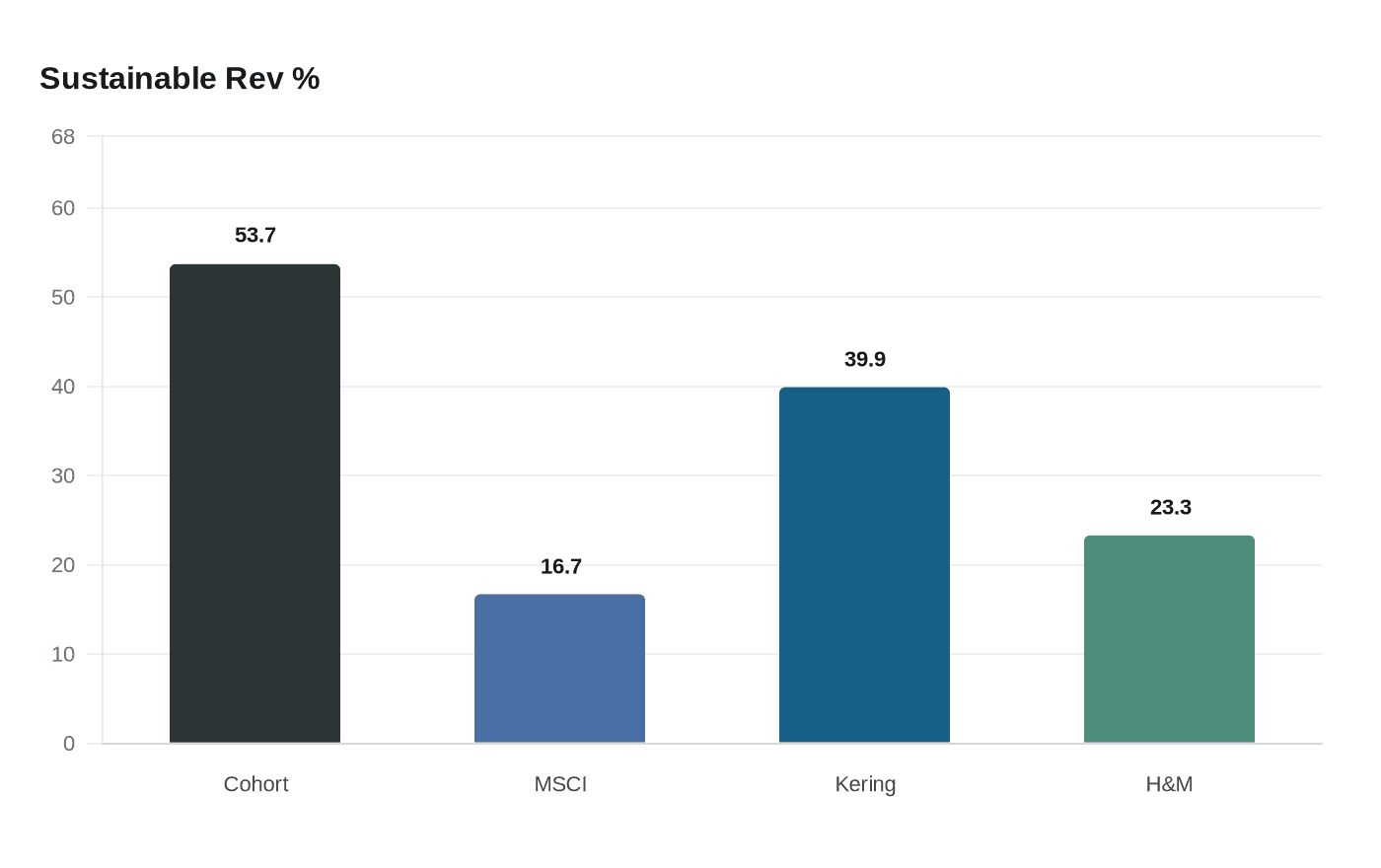
The Clean200 is designed to measure where green revenue appears on corporate income statements rather than in climate promises. Finance Yahoo summarized the list as built "to show where 'clean revenue' is actually showing up in financial statements - not where it’s being promised in climate pledges." As You Sow’s excerpts show the cohort averages 53.7% of revenue from activities classified as sustainable, a figure presented alongside a $2.8 trillion aggregate and set against a 16.7% sustainable-revenue average among MSCI ACWI peers.
Regionally, As You Sow’s key findings show concentration in Asia-Pacific with 36% of Clean200 headquarters, Europe with 33%, North America with 26%, and South America with 5%. Country counts list the United States with 41 Clean200 companies, China with 28, and Japan with 15, underscoring that the clean-economy winners are clustered by geography and sector more than by cultural prominence.
Fashion names that do appear are instructive. Kering ranks No. 64 on the Clean200 with a sustainable-revenue ratio of 39.9%, equivalent to roughly $11.05 billion in sustainable revenue. Hennes & Mauritz (H&M) appears at No. 116 with a 23.3% sustainable-revenue ratio and about $6.23 billion in sustainable revenue. Industria de Diseno Textil SA, Inditex, is listed as Rank 13 in As You Sow’s table excerpt, and News Commonshare frames Inditex and H&M as "setting the pace by demonstrating significant sustainable revenue ratios." The available excerpts name Adidas, Nike, and Converse in contextual coverage, but the full roster of the eight fashion-related companies and their precise Clean200 metrics were not included in the published snippets provided.
Market signals are converging on supply chains and investor scrutiny. News Commonshare argues that "The Clean200 report signals a fundamental shift in the global supply chain dynamics, where sustainability considerations are becoming paramount," and it cites suppliers such as Suzano as part of that shift. News Commonshare further warns that "Investors are increasingly scrutinizing ESG performance, urging companies like H&M to align with environmental stewardship," and urges fashion brands to pivot toward measurable sustainable revenue.
The sportswear cluster is a useful comparator. Finance Yahoo and News Commonshare both note Adidas and Nike are competing in sustainable revenue generation and are closely ranked on absolute sustainable revenue, while Sourcing Journal headlines flagged by Finance Yahoo mention Converse amid sale speculation, layoffs and restructuring. Adidas also appears in Sourcing Journal coverage as having double-digit Q4 growth and record sales in 2025, a reminder that commercial momentum and clean-revenue reporting can run on parallel tracks.
Clean200’s methodology and reporting details carry caveats. As You Sow’s excerpts place superscript footnote markers after key figures - "53.7% 1" and "$2.8 trillion2" - indicating definitions and assumptions that were not included in the snippets. The Clean200 remains an educational tool for investors and corporate strategists; its 2026 findings expose a clear disparity: when the clean economy accounts for trillions in measurable revenue, fashion’s footprint on those balance sheets remains modest rather than dominant.
This article was produced by Prism’s automated news system from verified source data, official records, and press releases, then run through automated quality and moderation checks before publishing. The system is built and supervised by the people who set the standards it runs under. Read our full AI policy.
Did this article answer your question?