EcoSmart Club Launches Nine-Month Project Tracking Nigeria's Women-Led Clothing Trade
EcoSmart Club's Oniparo Project documents Nigeria's barter-based women clothing traders, unseen circular economy actors keeping garments alive since long before "sustainable fashion" became a hashtag.
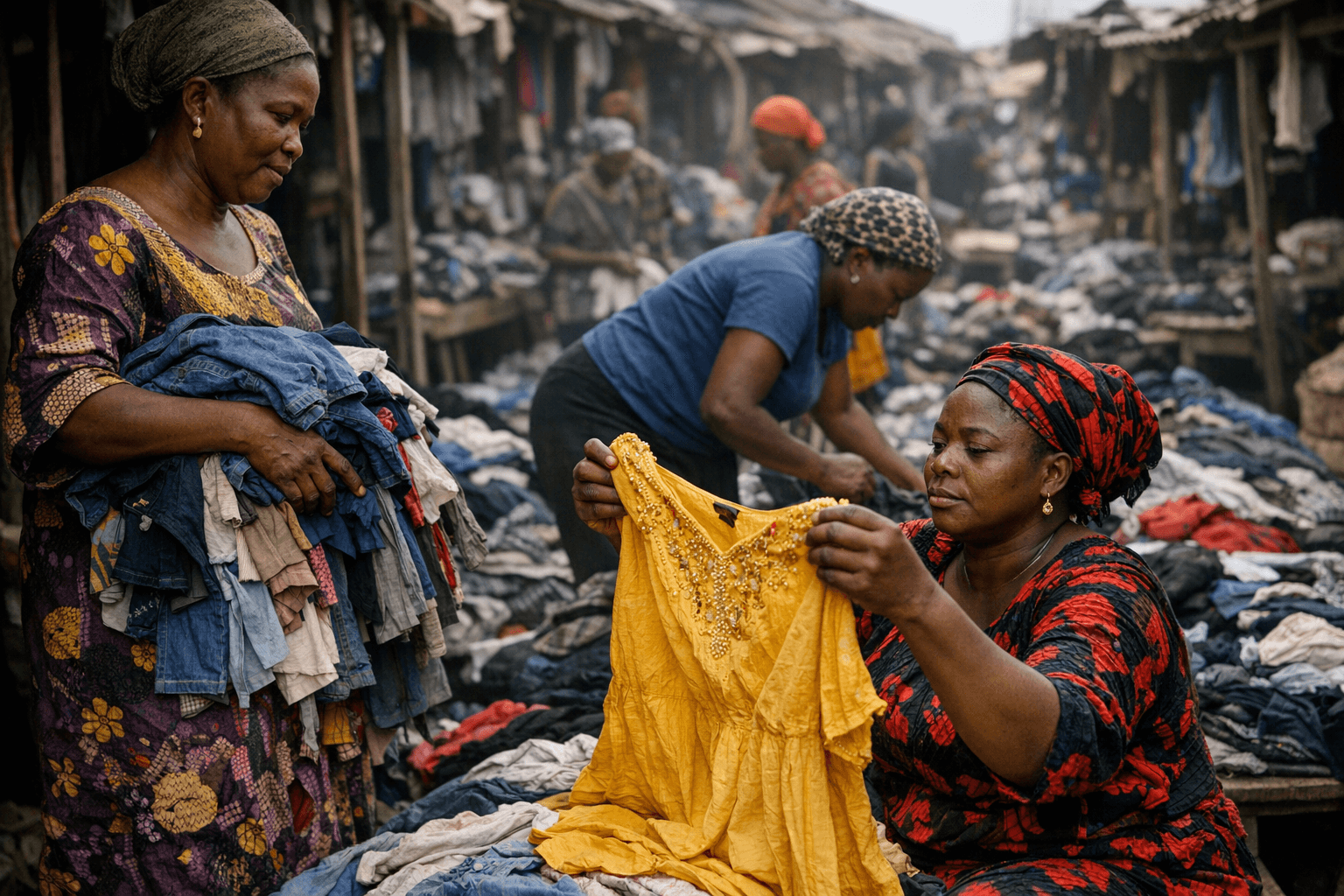
The women have always been there, moving through neighbourhoods in western Nigeria with bundles of used clothing, exchanging blouses and wrappers for buckets and basins, keeping garments circulating through communities that cannot afford to buy new. What EcoSmart Club, a youth-led grassroots climate organisation, has now done is decide that their work deserves documentation.
The Lagos-based group launched the Oniparo Project in March 2026, a nine-month research and awareness initiative running through October that will formally document the barter-based clothing trade practiced by Oniparo women in parts of western Nigeria. The project is supported by the African Climate Alliance.
Oniparo is a Yoruba term for people involved in exchange trade. In practice, it describes women who move from house to house collecting discarded or fairly used garments, which they then exchange for money or household goods including buckets and basins. The trade supplies affordable clothing to low-income households and, according to EcoSmart Club founder Hannah Omokhaye, functions as a vital livelihood for many families while performing a quietly significant environmental role.
"These women are pioneers of the circular economy in Nigeria," Omokhaye said. "They help ensure clothing remains accessible for lower-income communities while also reducing the amount of textile waste entering the environment."
That environmental context is significant. According to UNEP, about 92 million tonnes of textile waste are generated globally each year, with large volumes either incinerated or dumped in landfills. The Oniparo trade, which operates entirely outside formal waste management structures, intercepts garments before they reach that end point, extending the life cycle of clothing through redistribution rather than disposal.
The project's stated aims go beyond documentation. Project Manager Oluwatoyin Ajao said the initiative will also push for policy discussions around sustainable fashion and the formal inclusion of women who anchor Nigeria's informal circular economy. "This project uses inclusive storytelling to preserve culture while showcasing Afrocentric solutions to global issues such as textile waste and environmental sustainability," Ajao said.
That framing matters in a global fashion conversation that has historically centred European and North American sustainability frameworks while overlooking longstanding informal systems in the Global South. The Oniparo trade predates the language of circular economy by generations; EcoSmart Club's work is less about invention than recognition.
The nine-month timeline will take the project through October 2026, with research and awareness outputs planned across the period. No specific towns or local government areas within western Nigeria have been named as fieldwork sites, and the methodology, whether ethnographic interviews, photography, or quantitative tracking, has not yet been detailed publicly. What is clear is that for the first time, the Oniparo women's contribution to keeping clothing in circulation will be formally examined, recorded, and placed within the broader argument for why informal traders deserve a seat at the sustainable fashion table.
This article was produced by Prism’s automated news system from verified source data, official records, and press releases, then run through automated quality and moderation checks before publishing. The system is built and supervised by the people who set the standards it runs under. Read our full AI policy.
Did this article answer your question?


