Eugène Riconneaus turns marine biomass into biodegradable Sei fibers
A couture dress at Paris’s Grand Palais turned seaweed and seafood waste into a test case for luxury-scale textile chemistry.

Eugène Riconneaus is making marine biomass look less like a laboratory curiosity and more like a supply chain. His ER Ocean Recherche project turned invasive seaweed and seafood waste from Nouvelle-Aquitaine, France, into Sei fibers, then brought the material to life in a dress and T-shirts shown at ChangeNOW in Paris.
The most striking piece was Ocean Apocalypse, unveiled at the Grand Palais during ChangeNOW 2026, which ran from March 30 to April 1. Framed as the first couture dress born of marine biomass, it is meant to do what swatches and spec sheets rarely can: let brands see the fiber in motion, in silhouette, under light, with the kind of finish that matters in fashion. That is the commercial argument here. A material does not become relevant because it is novel; it becomes relevant when it can survive the brutal translation from concept to garment.
ER Ocean Recherche was publicly introduced on April 17, 2025, with two marine-derived materials, SeiShell™ and SeiYarn™. The newer portfolio also includes SeiFibre™, described as a breathable, silk-like staple fiber that is recyclable, naturally antimicrobial and dope-dyed. The company says it has reached one year of secured production capacity, and that costs are expected to be divided by two at scale. That is the number to watch, because luxury sustainability lives or dies on whether promising chemistry can stop behaving like a prototype and start behaving like an industrial material.
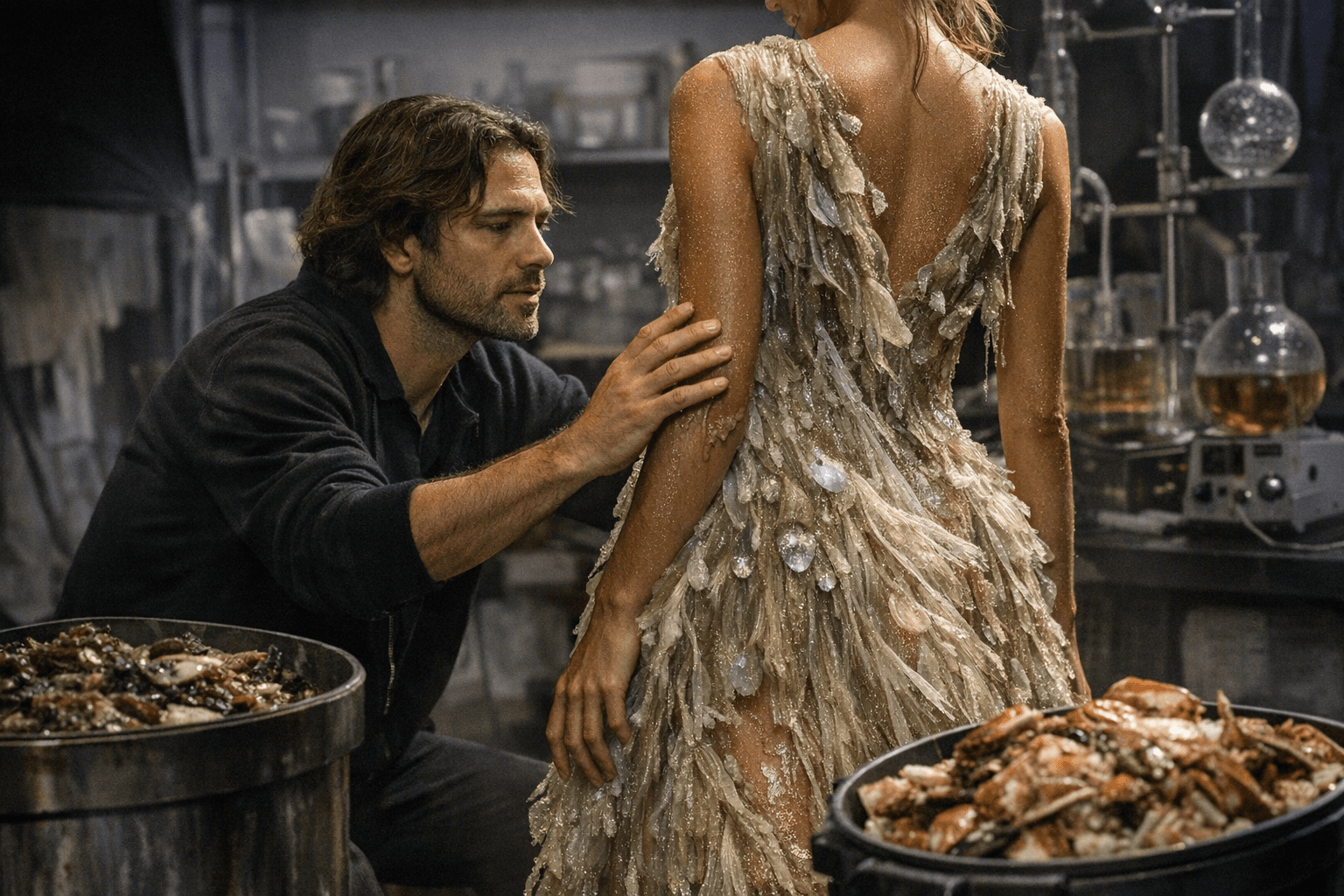
Riconneaus has made clear why he moved from footwear and product design toward material science. He said he could not find next-generation materials that met designers’ expectations and could scale, so he began experimenting with algae, cyanobacteria and seafood shells. In his telling, the work has shifted from designing objects to designing materials themselves, with the design challenge moving deeper into “microns.” It is a precise phrase, and a revealing one. The next battle in sustainable fashion is no longer only about surface storytelling; it is about feedstock, processing, performance and whether a fiber can hold its own against the conventional staples that still dominate wardrobes.
That is what makes ER Ocean Recherche worth watching. It sits at the intersection of ocean-linked activism, lab science and couture atelier savoir-faire, but its future depends on something less glamorous: whether marine biomass can be sourced consistently, processed efficiently and spun into a textile that feels expensive enough to win over fashion houses. If it can, Sei may become more than a headline material. If it cannot, Ocean Apocalypse will remain a beautifully dressed proof of concept.
This article was produced by Prism’s automated news system from verified source data, official records, and press releases, then run through automated quality and moderation checks before publishing. The system is built and supervised by the people who set the standards it runs under. Read our full AI policy.
Did this article answer your question?


