Everlane's Spring Linen Collection Cuts Carbon Emissions by 74 Percent
Everlane's spring linen cuts carbon by 74.3% versus conventional, independently verified by Bureau Veritas. Here's what that certification actually guarantees.

Seventy-four point three percent. That's not a marketing rounding; it's the verified carbon reduction figure tied to Everlane's Spring 2026 linen collection, measured under the EU's Product Environmental Footprint framework and audited by Bureau Veritas, one of the world's oldest independent inspection bodies. The number puts real weight behind what too many brands reduce to a mood board of golden fields and "naturally low-impact" copy.
The linen itself comes from cooperative farms spread across France, Belgium, and the Netherlands, the region known as the European Flax Belt, where the climate has sustained quality flax cultivation for centuries. Under the Masters of Flax Fibre standard, an evolution of the former European Flax certification administered by the Alliance for European Flax-Linen and Hemp, every garment in the collection must contain a minimum 50% certified European linen, with traceability verified at each step from seed to scutching to finished garment. No GMOs. No irrigation. Cultivation powered entirely by rainfall, with every part of the plant processed toward a zero-waste operation. The standard consolidates eight agricultural criteria into a single audited mark; that specificity is what separates it from the generic "European linen" labels still proliferating on fast-fashion tags with no verification behind them.
Here's what the certification actually guarantees: Bureau Veritas, not Everlane, audits the chain. That distinction matters enormously. Self-reported sustainability claims are still rampant in fashion, and third-party verification by a named body means the 74.3% emissions figure holds up to scrutiny outside the brand's own marketing. When evaluating any linen piece from any brand, the question isn't "does the label say sustainable?" It's: who signed off on that claim, and what methodology did they use?
The Spring 2026 collection includes the Tie-Front Scallop Tank, available in Bone and Henna Red, with a V-neckline and scalloped detailing along the cutaway front and hem. Relaxed and cropped, it pairs with the Linen Scalloped Edge Tailored Short as a set, or carries wide-leg trousers with that particular ease that linen manages and nothing else quite does. The styling is resort-adjacent without being precious; the fiber's natural drape and coarse texture do the visual work that stiff synthetics can only approximate.
CEO Alfred Chang has framed the approach plainly: Everlane has "worked with responsibly sourced linen for years because it shows what the future of materials can look like." That longevity matters. This is not a launch-and-leave Earth Month activation. Everlane's 2024 impact report confirmed that 90% of materials used that year met its lower-impact preferred standards, whether recycled, organic, responsible, or FSC-certified. The sustainability and sourcing team described Masters of Flax Fibre linen as part of a deliberate gap-closing strategy, "focusing on materials where we can better measure impact, improve over time, and be transparent about what we know."
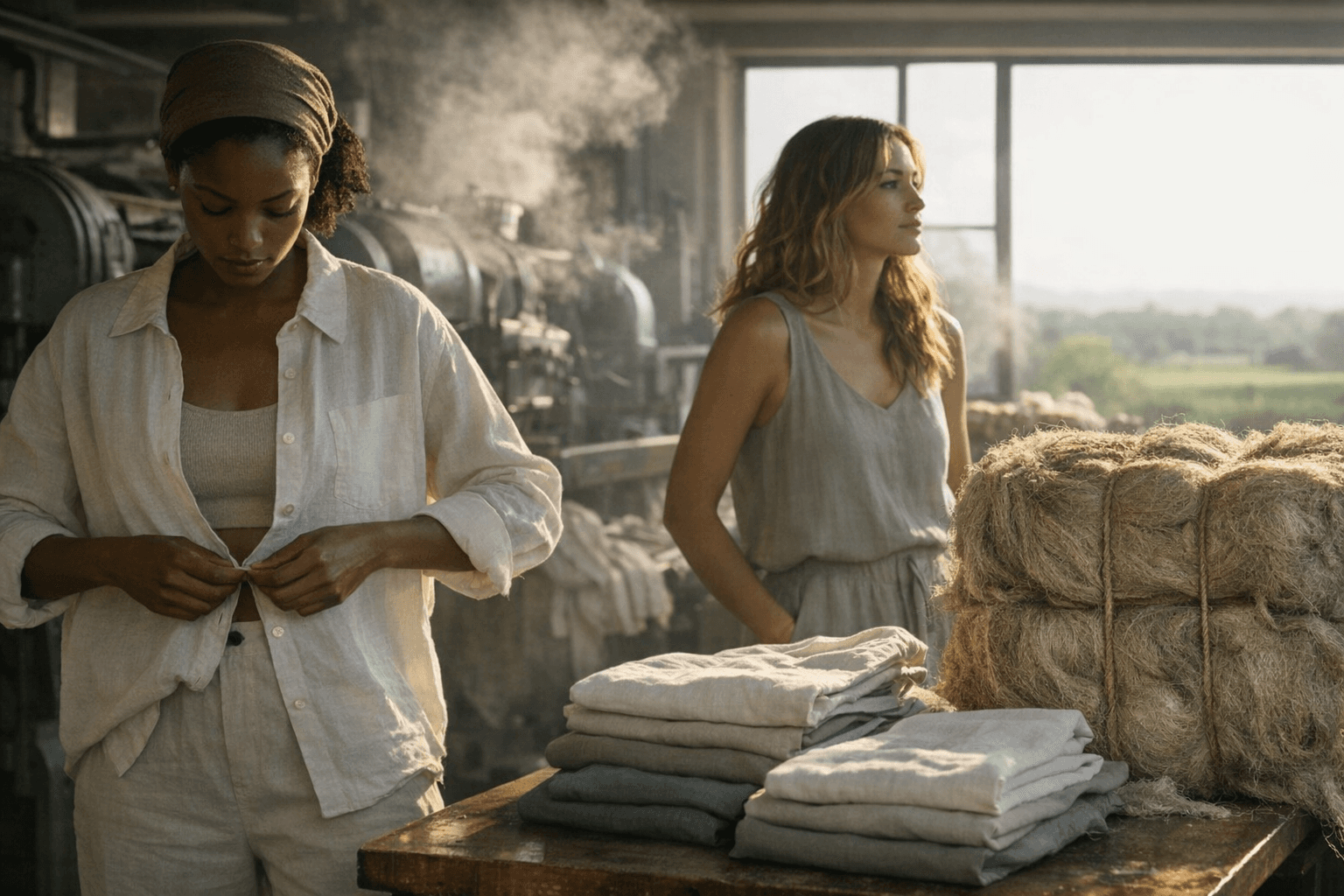
Now for the honest trade-offs, because no fiber is without them. Linen wrinkles, and certified linen wrinkles exactly as much as uncertified linen. Flax's inherently low elasticity is what produces that crisp, architectural quality; you accept the creases or you work with them. Dyeing is the other variable: linen's coarser cell structure absorbs color differently than cotton, and saturated hues are harder to achieve evenly, which is why natural-palette linens tend to hold better wash-to-wash. On durability, linen is exceptional; it gets softer and stronger with each wash, unlike cotton, which degrades. The price premium on certified linen is real, because verified supply chains with documented traceability cost more to operate. That's money going toward infrastructure, not margin.
To distinguish legitimate linen claims from atmospheric marketing, look for a named third-party certifier, a specific country of origin in the European Flax Belt, and an emissions figure derived from a methodology you can actually look up. Phrases like "European-inspired," "natural feel," or "eco-conscious" without a named certification behind them are signals to pause.
Care sidebar: wash cold, tumble dry low or line dry, since heat accelerates fiber breakdown. Iron while slightly damp if you want a sharper press; linen accepts it well at that stage. For repairs, linen's tight weave makes it one of the most mendable natural fibers available. A visible running stitch in a contrasting thread along a frayed hem or worn pocket edge is both structurally sound and, increasingly, an intentional finishing choice.
The 74.3% is a number that came from somewhere specific. That somewhere is the cooperative farms, the Bureau Veritas audit trail, and the eight consolidated agricultural criteria that make the Masters of Flax Fibre mark mean something. In a category where "better" is easy to claim and hard to prove, the methodology is the point.
This article was produced by Prism’s automated news system from verified source data, official records, and press releases, then run through automated quality and moderation checks before publishing. The system is built and supervised by the people who set the standards it runs under. Read our full AI policy.
Did this article answer your question?


